In Red States, the Bill for School Voucher Bait-and-Switch Is Coming Due
For GOP lawmakers who view public education as a quasi-socialist project, the gaping hole in state budgets left by subsidizing private school tuition is a feature, not a bug.
Bait-and-switch is an old retail tactic. You lure customers in with promises of a deep discount, only to inform them that the deal has a catch. The real price tag, it turns out, is quite a bit more.
Though it took supporters of school vouchers a while to catch on, they’ve learned quickly that the trick works just as well in education policy as it does in retail sales. Pick a price that will get people in the door, and then break the news once you’ve got them where you want them.
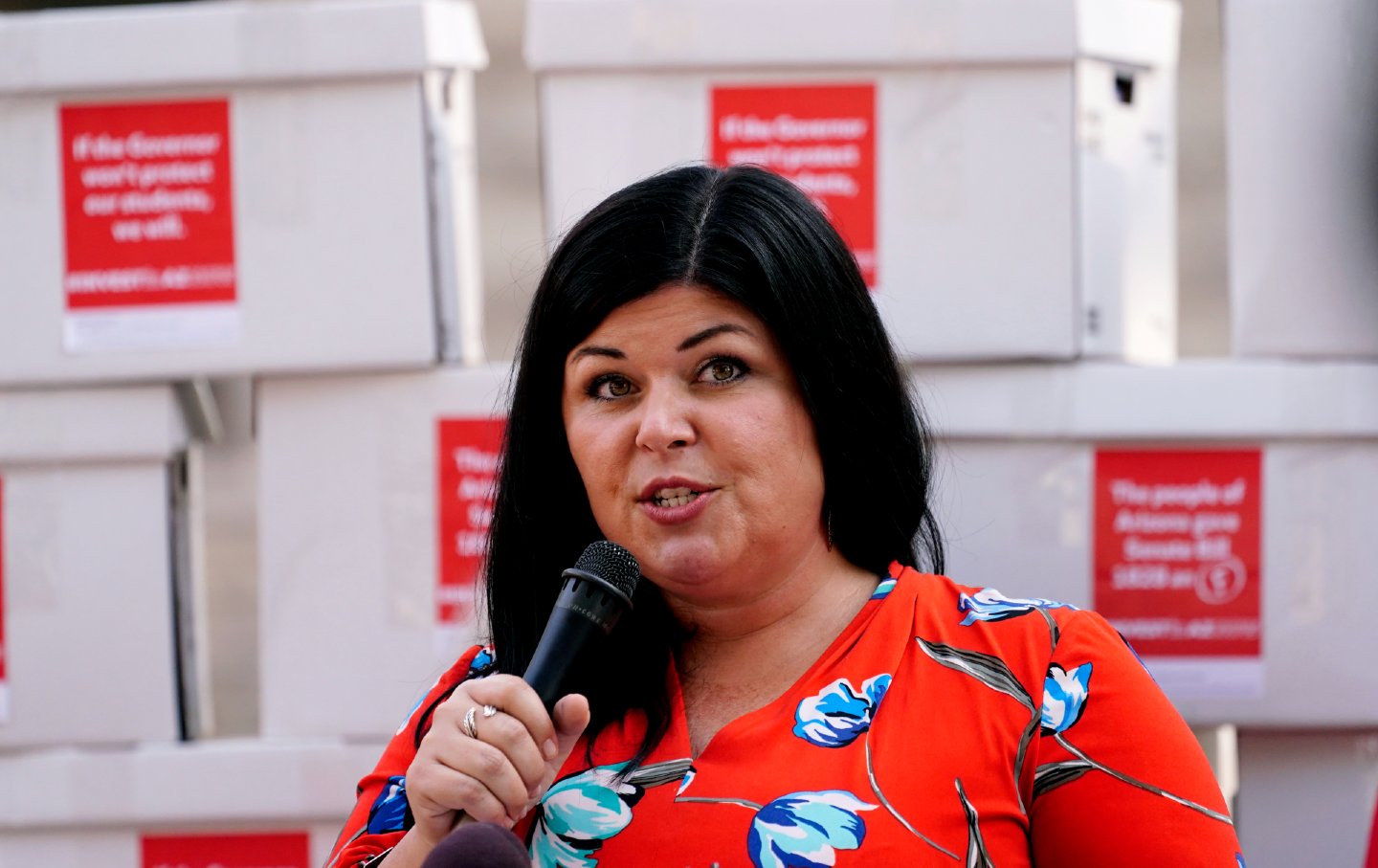
In Arizona, taxpayers are now staring down a $400 million shortfall, with an even bigger bill coming due next year. How did the Grand Canyon State go from sitting on a huge cash reserve to facing a rising tide of red ink? Simple. Voucher proponents suggested that paying for private school tuition would cost taxpayers $65 million a year; but as it stands, the program is on track to cost roughly 15 times that. All told, Arizona taxpayers are likely to spend close to a billion dollars reimbursing the cost of tuition and luxury expenses—including ski resort passes, pianos, and theme park tickets—for families whose children were never enrolled in the public schools.
It isn’t just Arizona’s problem. Over the past two years, multiple states have enacted universal or near-universal voucher programs that far exceed initial cost projections. In Iowa, for instance, Governor Kim Reynolds pushed an expansive voucher program that gives roughly $7,500 to any Iowa family for private school tuition. But demand for the program among parents who already send their kids to private schools, most of which are religious, has far exceeded expectations. Now Iowans are on the hook for the tuition of 17,000 private school students—a bill that will total $345 million a year next year. The same story has unfolded in Ohio, Arkansas, West Virginia, and elsewhere.
It wasn’t just the price tag that voucher proponents were deceptive about—it was also the projected beneficiaries of such programs. Advocates promoted vouchers as a benefit for poor students, students with disabilities, and students in struggling schools. Yet the reality has looked very different. As The Wall Street Journal recently reported, the vast majority of parents taking advantage of these tuition coupons are those who already send their kids to private schools. And this dynamic is likely to accelerate as private schools begin to encourage, or even require, families to apply for vouchers. As these schools are discovering, a new willingness by states to pick up the tab for tuition makes it easier to charge families more.
Such budget-busting bills would be bad enough if these states were maintaining robust revenue streams. But as spending on private school vouchers continues to exceed projections, state treasuries are being emptied by tax-cutting schemes. In Arizona, for instance, former Governor Doug Ducey ushered in another age-old conservative priority: a flat tax that delivers huge benefits to the wealthy. In Iowa, Governor Kim Reynolds has slashed taxes and aspires to eliminate the Hawkeye State’s income tax altogether. In West Virginia, the situation is even more dire. Thanks to a massive personal income tax cut that will cost more than $800 million per year starting in 2025, revenues are plunging—even as a growing private school voucher program puts new demands on state coffers. And more states are poised to join the march towards a fiscal cliff. Missouri and Tennessee are currently debating costly religious school choice bills even as state revenues plunge as a result of tax cuts benefiting the wealthy.
With all this red ink on their balance sheets, it won’t be long before states need to make major spending cuts. And the first place they’ll start is with their biggest line items: public schools, healthcare, and other social programs. In other words, it isn’t merely that vouchers are subsidizing fortunate families rather than families in need. It’s that these increasingly expensive giveaways threaten to displace programs that working families and those below the poverty line depend on, further entrenching inequality. The result will be a pitched battle over scarce resources, pitting affluent parents who benefit from school vouchers against the majority of families whose children still attend public schools. Guess who’s likely to win?
For lawmakers who loathe taxes and view public education as a quasi-socialist project, the specter of cratering state budgets is a feature rather than a bug. But when voters wise up to the bait-and-switch, as they inevitably will, the backlash will be fierce. Just look at deep-red Kansas, where voters soured on a tax-cutting experiment precisely because public schools paid the price. As programs were slashed and class sizes swelled, Democrats weren’t the only ones to take exception. Republicans also rebelled, as they saw opportunities for their own kids held hostage to their party’s anti-government ideology.
Bait-and-switch may get them in the door. And a good salesperson can sometimes close the deal. But Republicans need to remember that people don’t like to be lied to. Sometimes they’ll just turn their backs and walk out.