Kids Need Public-School Funding—Not a TikTok Ban
Social media apps are not the enemy of America’s children. But Republican mega-donor Jeffrey Yass is.
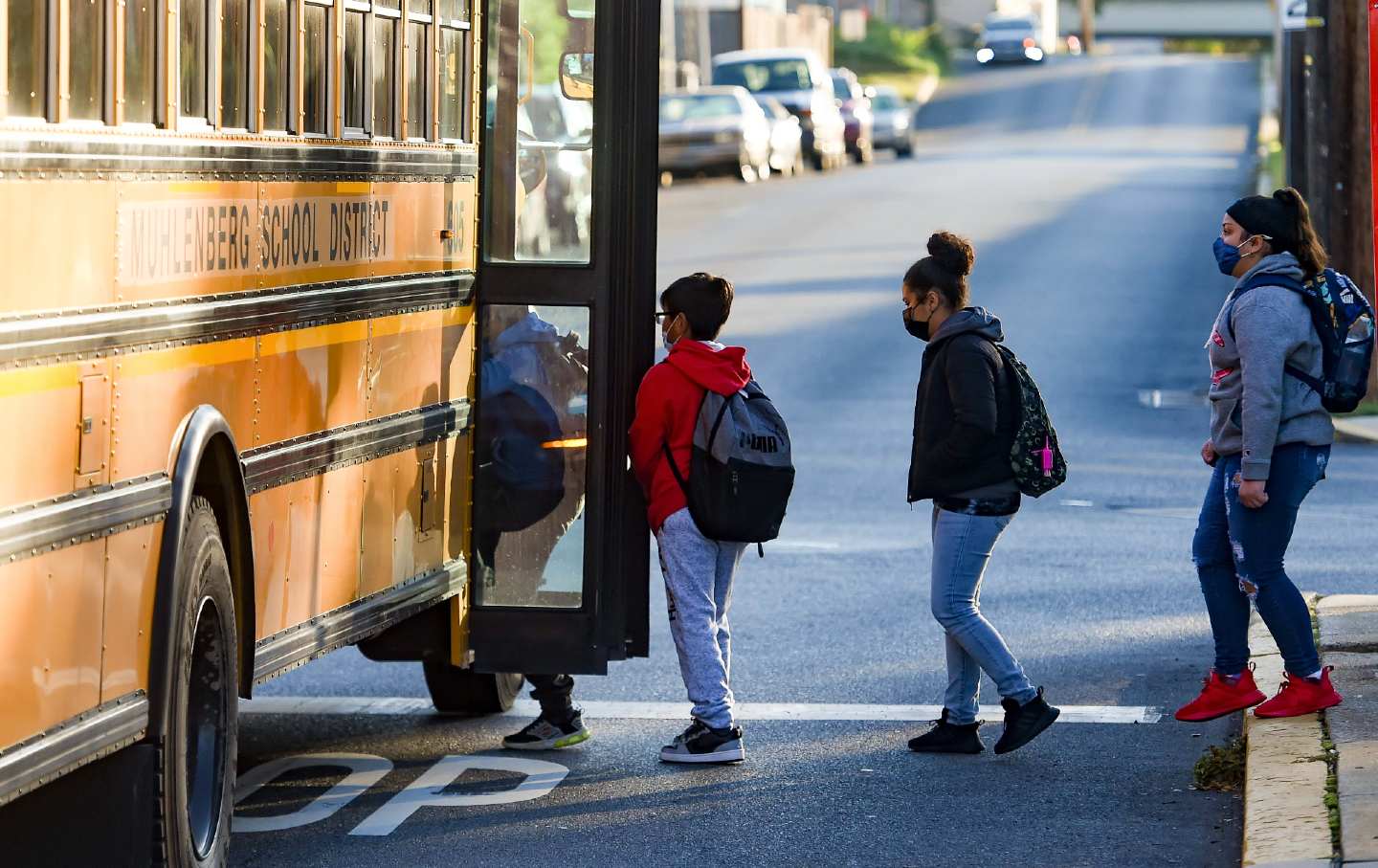
Young students get on a school bus in Muhlenberg Township, Pennsylvania, on October 20, 2021.
(Ben Hasty / MediaNews Group / Reading Eagle via Getty Images)I learned on March 13 that our country’s polarized lawmakers had crossed the aisle to deliver a bill they say will protect our children. As the parent of a special needs child in Reading, Pennsylvania, one of the most underfunded school districts in the country, I wondered: Did they renew federal funding for childcare from the now-expired CARES act? Did they expand requirements for state education funding? Did they fix our immigration system? No, no, and no. Instead, they voted to ban TikTok in the US if its China-based parent company, ByteDance, refuses to sell.
The threats an entertainment app presents to my children are the least of my many worries. I’m concerned about poorly paid teachers and poor teacher retention; overcrowded classrooms and inadequate teaching materials; crumbling and inadequate school sites; the loss of extracurricular opportunities, arts programs, and the capacity for special needs accommodation. Last year, a lawsuit affirmed what we already knew to be true: The students who need the most get the least under Pennsylvania’s current public school funding system. The current funding system was ruled unconstitutional, and the legislature and governor have been ordered to fix it. These are all concerns our elected leaders could do a lot to alleviate by investing in our public-school systems across the country, but our lawmakers don’t seem to want to prioritize.
America is just getting to know one of the reasons why this is the case. Billionaire trader, Republican mega-donor, and Pennsylvania public-school enemy #1 Jeff Yass has had his name thrust into the spotlight with the TikTok bill. But his real influence on our children has nothing to do with an app. Yass has been pouring millions of dollars into PACs and national campaigns to promote “school choice,” a euphemism for diverting public education funding to private entities, stealing from taxpayer pockets and our kids’ futures. Yass is the biggest donor in this year’s national election cycle, but in Pennsylvania we’re all-too-familiar with his devastating mission, as he has used our state as a proving ground before moving on to a national stage. In Pennsylvania, he donated more than $22 million to anti–public school causes in 2022 alone. Now, school-voucher programs are seeing primary wins in Texas, with funding support from Yass, and hundreds of state and local lawmakers have signed his Education Freedom Pledge, vowing their support for legislation that would ensure that federal funding for education is not tied to public schools. Fights like these over vouchers and school funding go back decades, but Yass and other conservative players are throwing heaps of money into the ring today, preparing for the fall election. A reckoning for public-school education is upon us. Congress isn’t paying attention to that, though. Maybe my kids should come up with a viral dance to save their schools.
Public-school education is critical to our kids’ futures and to the future of our country. Right now, our students’ achievement is falling behind other industrialized countries, lagging even more since the pandemic. Our nation’s school system is fragmented into pieces across states, cities, and local communities, where layered bureaucracies and funding disparities make it nearly impossible to forge meaningful progress in the places where kids need it most. Public-school enrollment is down at the national level, with some kids dropping out of the system for economic reasons and other families pulling out their children in favor of charter- and private-school options. How can we possibly claim to be a world leader when our schools cannot be relied on to support, educate, and—in many places, feed—our children, no matter their background, needs, or means?
Yass and others have pounced on the fact that public schools in Pennsylvania and elsewhere are ailing as the reason to fund vouchers. But that approach is not only wrong; it is leading us down a path to the destruction of a necessary public good. The solution to an underfunded, under-supported, and fractured school system is more funding, support, and labor organization, not less. Pennsylvania ranks 45th in the nation for its share of education funding. The solution to our childrens’ worsening education is unified political action. Elected officials in Pennsylvania need to stop taking money from Yass-affiliated PACs and to resist his privatizing agenda—and instead help pass Governor Josh Shapiro’s full proposal for public-education funding 2024–25 and ensure that this budget also codifies a seven-year timeline for full constitutional compliance. And we are asking our federal representatives to take a stand as well and invest in reducing the disparities and filling the gaps in the education system. In this important election year, we in Pennsylvania will continue to take on Yass in our state, but he is rapidly becoming a national problem.
Lawmakers need to wake up and direct their attention to what’s really at stake for our children in this election. Our public-school system is drowning, and conservative billionaires like Yass are shoving our kids further underwater. As a parent, I’m begging Pennsylvania’s state legislature to fund our public schools now. And if Congress comes together with even half of the unity it demonstrated for the TikTok bill, we can ensure that our country provides a free and equitable education for all of our children.