The Weekend Read / January 10, 2026

Deportation and the Silence That Follows
When ICE abducted my father without cause, something strange filled his vacancy.

Taiwo Adepetun

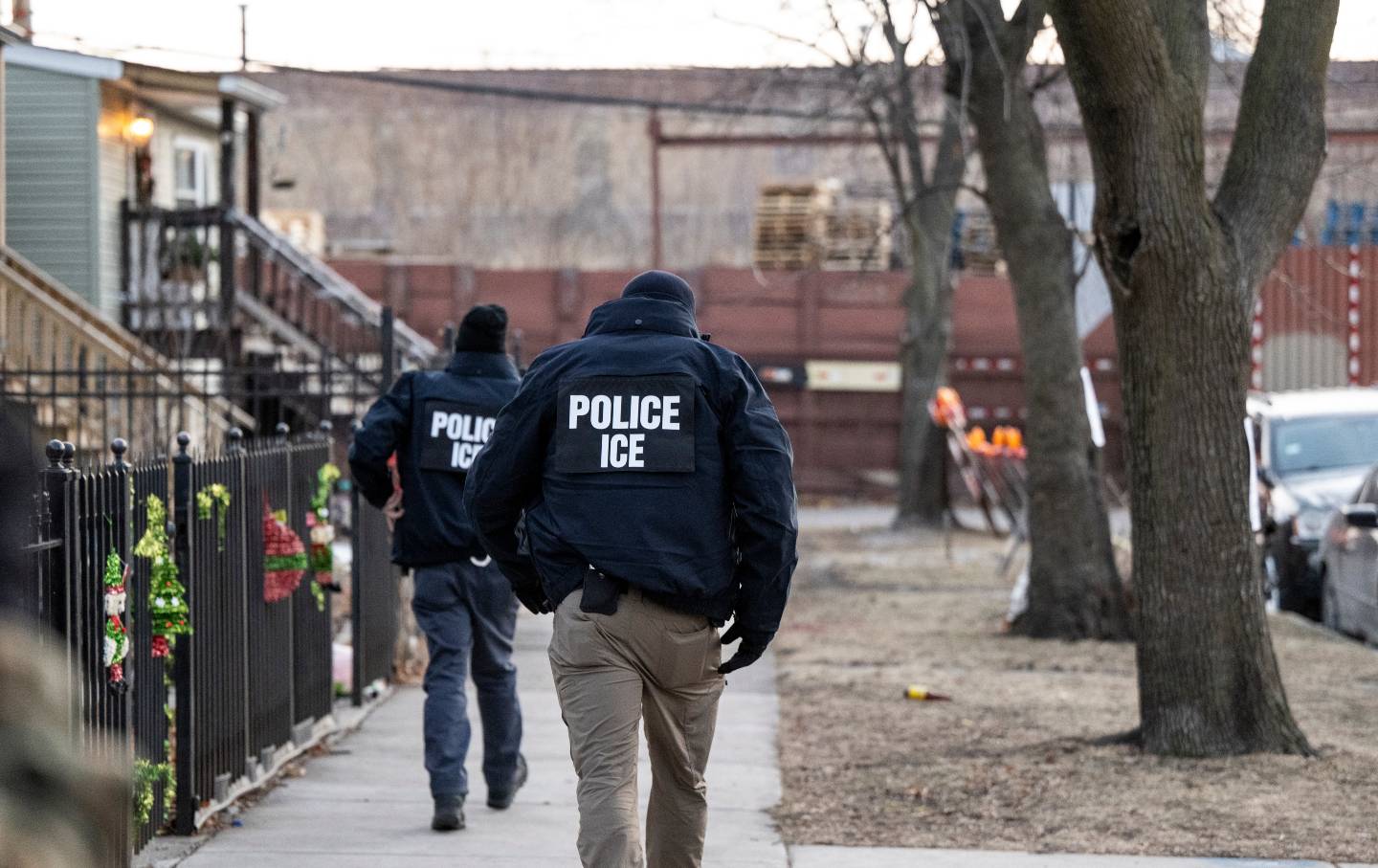
US Immigration and Customs Enforcement (ICE) agents walk down a street during a multi-agency targeted enforcement operation in Chicago, Illinois.


(Christopher Dilts / Bloomberg / Getty Images)

When ICE took my father, everything went quiet.

It was still dark outside on that February morning in Chicago, the first week of February 2025, with the kind of cold that bites through your coat and makes you want to stay under the blanket forever. Mom was in the kitchen, boiling water for tea. The house smelled like bread and Vicks. I was half-awake, scrolling through my phone, when someone started banging on the door. Hard.

“Immigration!”

My father froze. He looked at my mom, then at me. For a few seconds, nobody moved. My mom whispered, “Don’t open it.” But he did. Maybe it was pride. Maybe it was fear. Maybe he thought cooperating would make it all OK.

The people at the door said it would be quick, just a few questions. They said he’d be back soon. They said a lot of things that didn’t turn out to be true.

By sunrise, my father was gone.

The door was still open, as if they had left in a hurry. The cold rushed into the house like it was going to live with us now. That morning, the air felt heavy. No sirens, no shouting, just my mom’s quiet breathing. She stood in the kitchen for hours, staring at her phone. It didn’t ring.

For days, the silence was deafening. My mother and I spoke, but only around the loss, never through it. It was like we were both holding a fragile thing between us, afraid that naming it would cause it to shatter. She started keeping the TV on—not to watch, just to fill the void: judge shows, gospel channels, cooking contests. I’d still set a plate for him at dinner, then realize halfway through the process that he wasn’t coming.

The neighbors stopped talking to us. They’d see us in the hallway and look down. I think some of them were afraid—afraid that if they stood too close to us, ICE might come for them next. In buildings like ours, silence is a kind of survival strategy. It wasn’t that our neighbors were ashamed of us, but rather that they weren’t sure what to say. People who once came over for Nigerian jollof rice or to borrow sugar just disappeared. Our pastor texted a prayer but never showed up to our apartment. It hit me that deportation isn’t only about borders. It’s about how afterward silence moves in and takes up space, how it makes a home out of your grief.

I don’t think I understood that in the moment, not fully at least. Back then, everything felt like a shock, like we were held together in autopilot: making tea I wouldn’t drink, staring at doors that wouldn’t open, answering calls with a voice that didn’t sound like mine. The realization came later, slowly, like a bruise surfacing through layers of skin. It was in the way the apartment stayed too quiet even when the city outside was loud. It was in how conversations with friends dissolved into awkward pauses, and how I kept pretending I was fine because no one seemed to know what to do with my pain.

The Nation Weekly

Fridays. A weekly digest of the best of our coverage.
By signing up, you confirm that you are over the age of 16 and agree to receive occasional promotional offers for programs that support The Nation’s journalism. You may unsubscribe or adjust your preferences at any time. You can read our Privacy Policy here.

Only in hindsight did I see how deportation keeps happening long after the person is gone: how it rearranges your routines, your relationships, even your sense of safety, until the silence becomes the loudest thing in the room.

A week after ICE seized my father, we found out that he hadn’t yet been sent back to Lagos. Word came through another man being held with him, who managed to relay a message to someone on the outside. That stranger showed more compassion than most people who lived on our floor.

My father had moved from Lagos to Chicago in 2004 to work as a mechanic, building a life with his own two hands. Instead of returning home to us, he was being held in Kankakee, a town about an hour outside the city. We packed a bag with warm clothes, his Bible, and a small photo of us from Christmas.

The place didn’t look like a prison, but it somehow felt worse: gray walls, fluorescent lights, guards walking fast like they were late to something. The waiting room was full of families, all of us clutching bags and hope, waiting for the system to treat our loved ones like human beings rather than numbers.

When my father emerged in an orange jumpsuit, he tried to smile. But it looked wrong, like his face didn’t remember how to make the gesture. I realized then that this system wasn’t just about removing people; it was about erasing them slowly, piece by piece.

A few weeks later, he was finally deported to Lagos. ICE didn’t call. No one told us anything. My mother and I only learned of the news when he called from a borrowed phone, his voice shaky. He said, “I’m OK.” Then the line cut off.

That night, I lay awake with anger and frustration, thinking about how this country measures humanity in paperwork.

For the first time in my life, I started paying attention to the news. “ICE arrests 680 in nationwide raids.”

“Record-breaking deportations this year.”

Reporters talked about deportation like it was a math problem. Numbers, policies, debates. Nobody mentioned what it was like to pack someone’s clothes into a plastic bin or the way you start sleeping with your shoes on just in case they come back and you need to run to answer the door. I wanted to write to all those reporters and say: We are the people inside your numbers. We are what’s left after the story fades.

My dad, a man who moved to this country to work, wasn’t a criminal: He was a man who loved fixing leaky sinks, broken bikes, and people’s moods. But to ICE, he was a number, one more target to round up.

After he left, his shoes stayed by the door. His jacket still hung on the hook. My mom refused to move them. She said it made her feel like he might come home.

Sometimes, when I hear keys jingling in the hallway, I still think it’s him. But it never is.

There’s a silence that follows deportation. It’s not peaceful. It’s the kind that hums, the kind you can feel in your throat but can’t talk about.

At school, surrounded by other students whose parents work long hours or who share whispered warnings about ICE raids, I said nothing. I didn’t want to be known as the girl whose dad got deported. I didn’t want pity looks. So I smiled too hard. Studied too much. Acted like everything was normal. But grief doesn’t care about your performance. It shows up anyway in the way you jump when someone knocks, or how your voice shakes when you have to talk about “home.”

My dad’s deportation didn’t just take him away. It also took away my belief that if you simply followed the rules, you’d be safe. Silence, I learned, doesn’t protect you. It just eats you alive from the inside.

My father, now living back in Lagos and working long hours at a small auto repair shop, still calls sometimes. The differences in our time zones mean his morning is my midnight. We don’t say much. Just the basics:

“You good?”

“Yeah.”

“You eating?”

“Yeah.”

Sometimes I can barely hear him through the crackling line. He never asks if I want to come to Nigeria. I never ask if he wants to come back. Some questions just hang there, too heavy to touch.

Once, he said, “Don’t let this change you.”

But I was already changed.

On April 20, 2025, ICE had 49,184 people in detention. About 44.7 percent of them, my father included, had no criminal record. Politicians argued. Advocates protested. The news moved on. But behind those numbers were birthdays missed, calls dropped, kids who stopped setting an extra plate at the table.

Months after my father had been abducted, my mom found a support group for families like ours. Most of the people there had loved ones from everywhere: Mexico, Ghana, El Salvador, Haiti, the Philippines. Different languages, different stories, but the same hollow look in their eyes. It was the first time I realized how border pain echoes the same way, no matter which flag is on your mind. At first, no one spoke. We just sat there with our coffees, eyes on the floor. Then one woman said her 5-year-old still poured two cups of juice every morning: one for her dad, one for herself. Another said she still couldn’t open her husband’s closet.

And just like that, the words came. Slowly, painfully, but real. That’s when I started writing about the knock, the cold air, the quiet. Because saying it out loud felt like reclaiming something they tried to take from us.

Time has been split in two: before and after. In the “after,” I learned that home isn’t always a place. Sometimes it’s a person. And when that person is gone, you learn how to build a life around the space they left.

I used to think survival meant staying strong, holding it together no matter what. But now I see it differently. Survival is softer than that. It’s waking up even when your heart feels heavy. It’s laughing again without guilt. It’s letting the world touch you, even when it once hurt you.

Maybe that’s what my father wanted when he said, “Don’t let this change you.” Maybe he meant: Don’t let the pain harden you. Let it teach you how to stay open, how to keep loving in a world that keeps taking.

Sometimes I wonder if missing someone this much is its own kind of country: a place built out of memory and longing. You learn to live there quietly, building rituals out of grief—saving his contact on your phone, even though you know the number doesn’t work anymore; lighting a candle when the power flickers, just because he used to. Some days, I catch myself talking to him out loud in the car, doing dishes, walking home. It’s not even full sentences, just small things I wish he could hear: “I passed my class.” “Mom’s OK.” “I miss you.” It makes the world feel less empty, even if no one answers back.

Grief is strange in that it teaches you to love in silence. To keep someone alive not with pictures or phone calls but with memory, with words. And maybe that’s what I’m doing now writing him back into existence.

Some nights, I dream of him at the door again. The same knock, the same cold, but this time, when I open it, he’s smiling, holding the small blue mug he always used for tea. I wake up before I can reach him, but for a second, it feels like he’s really there: like the distance between Chicago and Lagos has disappeared, and the silence has finally been broken.

Taiwo Adepetun

Taiwo Adepetun is a Nigerian American writer. She writes about migration, identity, and how families survive the quiet aftermath of policies that tear them apart.

More from The Nation

On Cora Weiss (1934-2025) and Peace

On Cora Weiss (1934-2025) and Peace On Cora Weiss (1934-2025) and Peace

Cora Weiss died in December at age 91. She never stopped campaigning to save the world from nuclear destruction.

Obituary / Katrina vanden Heuvel

Tony Dokoupil, CBS News anchor and imperial stooge.

The Media’s Coverage of the Venezuelan Coup Has Been Dreadful The Media’s Coverage of the Venezuelan Coup Has Been Dreadful

War may be the health of state, but it’s death to honest journalism.

Jack Mirkinson

Dismantling the Meme Logic Behind Renee Good’s ICE Execution

Dismantling the Meme Logic Behind Renee Good’s ICE Execution Dismantling the Meme Logic Behind Renee Good’s ICE Execution

The Trump administration is once more invoking upside-down alibis of state to conjure the bogus specter of imminent threat.

Jeb Lund

People demonstrate against ICE during a vigil honoring Renee Nicole Good, who was shot dead by an immigration officer earlier in the day in Minneapolis, Minnesota, on January 7, 2026.

Minneapolis to ICE: Get the Fuck Out! Minneapolis to ICE: Get the Fuck Out!

An ICE agent shot dead Renee Nicole Good. Residents are ready to fight back.

Alyssa Oursler

Community members hold a vigil following the fatal shooting of Renée Nicole Good by an ICE agent in Minneapolis.

Prosecute Renee Nicole Good’s Murderer Prosecute Renee Nicole Good’s Murderer

The ICE agent who killed Renee Nicole Good not only can be held accountable for murder—he must be.

Elie Mystal

Mary Bassett, commissioner of the New York State Department of Health, speaks during a health department press briefing on August 22, 2022 in New York City.

Harvard’s Ouster of Mary Bassett Is a Revolting Act of Cowardice Harvard’s Ouster of Mary Bassett Is a Revolting Act of Cowardice

The public health icon was brutally removed from her job for one reason: her opposition to genocide in Gaza.

Gregg Gonsalves