
The Uses of Affirmative Action
The right denounced it as “reverse racism,” while the liberal center hailed it as the endpoint of egalitarianism. But as a limited measure in the fight against discrimination, it has never been either.
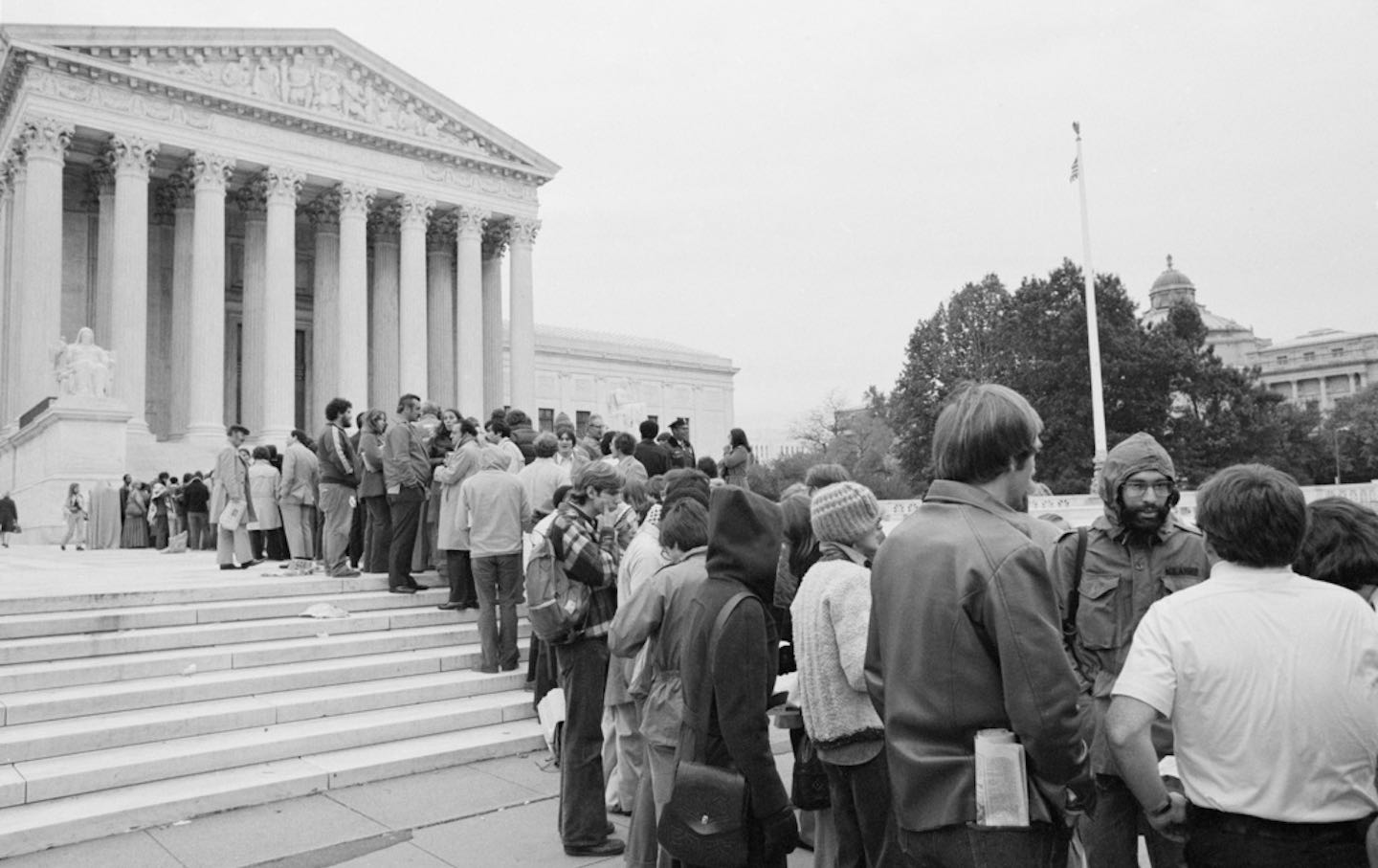
What does the US Supreme Court’s ruling against affirmative action in college admissions have in common with proposals for eliminating the “racial wealth gap”? Neither will have any impact whatsoever on the lives and material circumstances of the vast majority of Black Americans. It’s little wonder, then, that the group that cares most passionately about both is the upper middle class. Why do they care so much? Because neither is even supposed to have any impact on the lives and material circumstances of the vast majority of Black Americans. Wealth and income differentiation have increased greatly among Black Americans since 1967, when the percentage earning the equivalent of $150,000 a year or more was negligible. By 2018, 7 percent of Black Americans earned more than $150,000. Similarly, more than three-quarters of so-called Black wealth is held by the richest 10 percent of Black people. Over the course of a half-century of widening national inequality, the goal of affirmative action has not been to combat that inequality but to diversify its beneficiaries.
Popular
"swipe left below to view more authors"Swipe →
For that reason, I was reluctant to write about the Supreme Court decisions in Students for Fair Admissions, Inc. v. President and Fellows of Harvard College and Students for Fair Admissions, Inc. v. University of North Carolina and have not followed the cases closely. I’ve long supported affirmative action, even as I’ve long understood that its interventions might produce only narrow forms of egalitarianism. At its core, affirmative action is a technique in the implementation of antidiscrimination law, based on an understanding that overt prejudice is too limited a standard for identifying redressable discrimination.
It was a recognition of that limitation that underlay early notions of institutional racism. Affirmative action was not, historically, a product of Black activists operating in their own interests. The term first appeared in a provision of the 1935 National Labor Relations Act that directed employers to redress discrimination against union organizers. President John F. Kennedy echoed the terminology in Executive Order 10925, issued in 1961, which required government contractors to “take affirmative action to ensure that applicants are employed, and that employees are treated during employment, without regard to their race, creed, color, or national origin.” President Lyndon B. Johnson used the same language in Executive Order 11246, on Equal Employment Opportunity enforcement, issued in 1965, and had articulated the notion more extensively three months earlier in his Howard University commencement address. The sociologist Frank Dobbin has examined affirmative action’s roots in the private sector, as well, tracing its growth as a pragmatic policy in corporate human resources departments, rather than as the spread of radical egalitarian social theories.
It is the right that is responsible for much of the attempt to elevate affirmative action to the level of high moral principle, like so many of its bogus misdirection campaigns. Ideologues have denounced affirmative action with a lofty rhetoric of “colorblind ideals” or “merit,” shifting attention away from the prosaic fact that it is a technique of antidiscrimination enforcement. Anti-egalitarians have a long history of concocting formalist “principles,” whether by advocacy or denunciation, to perfume their ugly and ultimately anti-popular political agendas.
This was at play during the good cop/bad cop choreography that Southern elected officials crafted in their campaign of “Massive Resistance” to the Brown v. Board of Education decision that outlawed school segregation. The good cops contended that they were not so much opposed to desegregation as they were concerned with defending the hallowed principle of “states’ rights.” I still recall North Carolina Senator Sam Ervin passionately playing the good-cop role, styling himself as a constitutional “strict constructionist,” which later became the basis for his rise to folk-hero status as a “country lawyer” protector of the Constitution during the Watergate hearings—not to mention his 1977 American Express commercial.
In the years since its implementation, affirmative action has been a useful instrument in the enforcement of antidiscrimination law. In the 1970s, it significantly informed efforts to open access for nonwhites and women in occupations and job categories—notably in police departments, fire departments, and air traffic control, in part because all are in the public sector—from which those groups had previously been largely excluded. Perhaps its most important victory came in the Supreme Court’s 1971 Griggs v. Duke Power ruling, which mandated that only tests related to actual job performance can be used to screen job applicants. (Those who have plowed through Richard Herrnstein and Charles Murray’s odious racist tract The Bell Curve will recall that Griggs was its main practical target.) As Dobbin shows in his book Inventing Equal Opportunity, the greatest evidence of affirmative action’s success is its routine incorporation into human resources management practices. That success also underscores its key limitation.
As an instrument of antidiscrimination enforcement, affirmative action is not equipped to address broader economic inequality, which has steadily intensified throughout American society since the 1970s across race, gender, and sexual orientation. The court’s 1978 ruling in Regents of the University of California v. Bakke shifted affirmative action’s justification from combating inequality to the pursuit of “diversity.” This provided a workaround to address the complaint that affirmative action constituted “reverse discrimination,” but an unintended effect was to obscure its inadequacy as a remedy to rising poverty and the increasing concentration of wealth.
Equal opportunity in a diverse society is an unobjectionable ideal. However, within a regime of ever greater economic polarization, in the absence of a vigorous commitment to egalitarian economic redistribution, the pursuit of equal opportunity has come to center on facilitating access to the upper reaches of wealth, status, and power for individuals held to embody previously underrepresented groups. Technically, this is as defensible a standard of equality as any other. In practice, however, it depends on a mystified, essentialist understanding of the relation between individual and nominal group: That Kamala Harris is vice president does little for any Black woman not named Kamala Harris. Diversifying the upper class can be an ideal only for a “left” that is totally embedded within neoliberalism. It’s the sleight of hand that Barbara and Karen Fields call “racecraft,” which permits the presumption that benefits conferred on upper-status people of color will trickle down to all the rest. And that presumption, by the way, is the quintessence of racism.

