
Zohran Mamdani Is Following a Trail That Jesse Jackson Blazed
Mamdani’s election represents a profound and seismic development in the country’s political landscape—one set in motion by Jackson over 40 years ago.
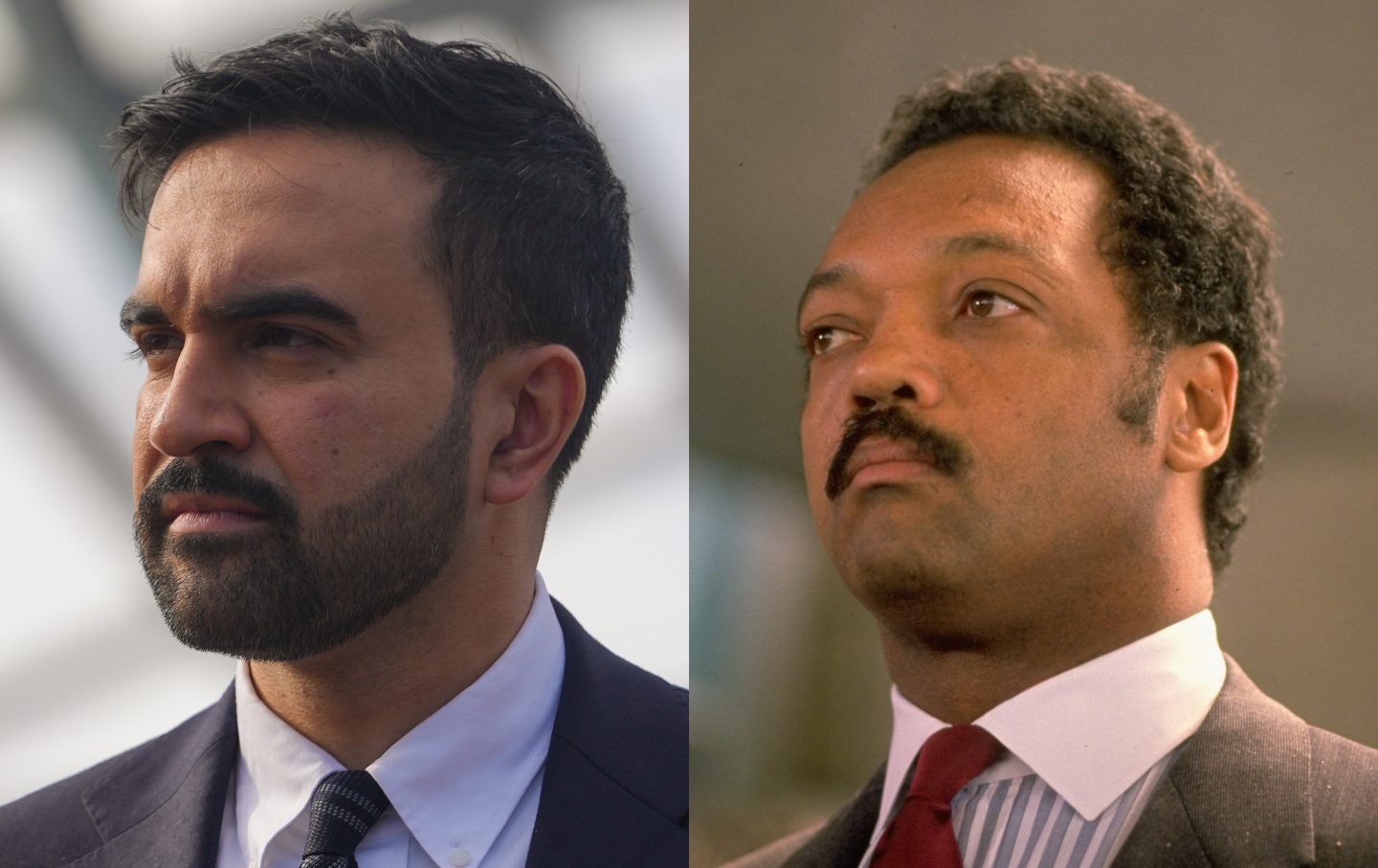
Three recent events have converged to illuminate the road map for Democrats, progressives, and anyone committed to building a multiracial democracy: the election of Zohran Mamdani as mayor of New York, the hospitalization of the Rev. Jesse Jackson, and the release of journalist Abby Phillip’s book on Jackson’s transformative political journey.
Most significantly, Mamdani’s election represents a profound and seismic development in the country’s political landscape. The coalition he assembled, the campaign he ran, who he is, and the vision he offers provide critical and urgent lessons about stopping the rise of authoritarianism and fascism and resuming the struggle to build the kind of country we want—one rooted in justice, equality, and inclusion.
The first core lesson from Mamdani’s win is simple but often ignored: The way to win is to inspire, organize, assemble, and unleash the multiracial majority that wants justice, equality, and inclusion. Too much of the dominant conventional wisdom on the progressive and Democratic side holds that championing justice and equality is a losing electoral proposition. This view stems from a deep-seated, unfounded fear of alienating conservative white voters who are seen, with little empirical evidence of success, as cornerstones of any winning coalition. But Mamdani’s victory—along with other recent election results across the country, including Virginia electing a Muslim woman of color as lieutenant governor and Mississippi picking up seats in the state legislature—proves there is a New American Majority. This is the same majority that elected and reelected Barack Obama and ousted Donald Trump in 2020. And it continues to grow every single day.
The demographic reality is stark and undeniable. Every day, 7,000 people of color are added to the population while 1,264 white people are subtracted (when you look at the numbers of births, deaths, and legal immigrants). The majority of people under 18 are people of color. Four million young people turn 18 every year. The margin of difference in the 2024 election was just 2 million people. The country is inexorably becoming increasingly diverse (which explains the ferocity and intensity of the immigration crackdown and voter suppression efforts). But the math shows it’s too late to turn back the clock.
Obama would not have beaten Ronald Reagan in 1984 with the coalition he assembled in 2008, because the country was insufficiently diverse. Eighty percent support from voters of color and 43 percent of whites was not enough to win in 1984. But by 2008, the demographic revolution had made it possible. And that revolution continues apace.
What Mamdani did was tune into this reality. He spoke to justice, equality, and affordability. He energized young people, people of color, and Muslims. He ran a campaign full of joy and celebration that permeated the streets of New York for six months.
A key lesson for Mamdani and for America comes from the Chicago of the 1980s—and two historic figures, Jackson and Harold Washington, in particular. In 1983, Washington ran for mayor of Chicago. Like Mamdani, Washington went up against the establishment figure of his day—Jane Byrne, a moderate who distanced herself from people of color, failed to root herself in the movement for justice and equality, and disrespected communities. She was the Andrew Cuomo of her time.
Harold Washington was encouraged to run by Jackson and others. He put together the kind of coalition that Mamdani assembled—and had to have that kind of coalition in order to win.
Chicago is a city with very few Republicans. No Republican had been elected mayor in decades. But when a Black man won the Democratic nomination, many white political leaders lost their minds. They did nothing to douse the flames of racial fear and resentment. The intensity of the white backlash led Leanita McClain, the first Black editorial writer for the Chicago Sun-Times, to write a searing column explaining, “Whites were out of their wits with plain wet-your-pants fear. Happy black people can only mean unhappy white people in this town.”
The white flight was overwhelming. And this is probably the unspoken but widely shared fear among many Democratic consultants and political leaders today—not just white ones. The reluctance people had to embrace Mamdani, the actual Democratic nominee, flowed from a similar mistaken assessment of the electorate and a similar absence of political courage.
But—and this is the crucial thing—Harold Washington won. He won through massive mobilization of the New American Majority, including the many progressive whites in Chicago.
He refused to get into the race until 100,000 new Black voters had been added to the voter rolls by community organizations and civil rights groups in an effort that was termed Operation Big Vote. Then those people turned out in droves. Eighty-two percent of Black people turned out to vote—a historic and unheard-of level of voter turnout. And it was absolutely necessary to enable Washington to prevail in the overwhelmingly Democratic city. He prevailed by just a small amount. But prevail he did.
Washington’s campaign gave rise to Jesse Jackson’s presidential campaigns. As Abby Phillip captures so compellingly and accurately in her book, Jackson learned in 1983 that the Black community and its allies could no longer solely depend on white allies. Jackson then expanded the Washington and Chicago model nationally.
He ran with an unapologetic, strong, progressive public policy agenda, calling for far-reaching change around justice and equality. He made a massive commitment to and investment in voter registration and participation. Jackson would end all of his rallies with a church-like summons for people to come down front and register to vote.
In the process, he brought new people into the electoral process and changed the composition of the electorate, making it dramatically more diverse.
Jackson also committed to democratizing the electoral process itself—reforming the Democratic Party rules for delegate selection, moving away from backroom deals and winner-take-all mechanisms. Although Jackson actually led the nomination contest after winning the Michigan primary in 1988, he ultimately fell short—the country still needed to change more—but, 20 years later, the combination of those reforms, changes, and advancements in political development paved the path that made it possible for Barack Obama to win.
The democratization of the nomination process enabled Obama to accumulate delegates all over the country in a fashion that was different than had been done before. That surprised Hillary Clinton, who had been relying only on the big states and thinking that the prior winner-take-all mechanisms would propel her to victory.
Popular
“swipe left below to view more authors”Swipe →The expansion of the electorate, the diversification of the electorate, and the making younger of the electorate is what enabled Obama to win the Iowa caucuses and, ultimately, the White House.
What Phillip captures, what Jackson helped lead, is what the country and progressives should heed at this moment in history.
Mamdani’s example should be embraced and disseminated across the entire country and enthusiastically followed. In so doing, we will lay the foundation for empowering the New American Majority to both take back the country and then rebuild and remake the country.
That is what these past few weeks have offered us—if we are willing to see and follow what is being shown.
The future of the party—and the country—hangs in the balance.
Become a Sustaining Donor This September
Between the reemergence of right-wing red-baiting and Donald Trump’s use of the chilling National Security Presidential Memorandum–7 to criminalize left political organizing, we’re seeing McCarthyism reborn before our eyes.
This assault on democracy cannot be ignored or wished away. Resisting it requires bravery in the face of threats and repression, a steadfast commitment to the truth, and the unwavering belief that we can—and will—overcome this darkness.
We must have an independent media that sets the record straight, unearths corruption and abuses of power, and advances a politics of justice and dignity for all if we’re to win this fight.
That’s why I’m writing to you today. This September, The Nation needs to add 100 monthly donors to sustain our progressive journalism. Your contribution makes the next investigative report, the next truth-speaking column, and the next pathbreaking essay all possible.
I hope you’ll support our work with a recurring donation today. If you donate $10 or more a month, we’ll send you a brand new “Hands Off the Free Press!” sticker to recognise your commitment to our cause. Please, donate today.
Onward,
Katrina vanden Heuvel
Editor and Publisher, The Nation
More from The Nation

CEOs Are Losing Control of AI CEOs Are Losing Control of AI
With no slowdown from Trump’s administration.
Gina Hinojosa: “We Flip Texas, and It’s Over” Gina Hinojosa: “We Flip Texas, and It’s Over”
Talking to Texas gubernatorial candidate Gina Hinojosa about what redistricting could mean and how a new generation of Democrats is speaking more directly to voters.

Trump Wants to Keep Journalists Out of the White House. He Should Get His Wish. Trump Wants to Keep Journalists Out of the White House. He Should Get His Wish.
The president has banned MS NOW, CNN, and Politico from attending press briefings. The rest of the media should respond with a boycott.

The GOP’s Incredible Shrinking Senate Map The GOP’s Incredible Shrinking Senate Map
Trump has so badly damaged the Republican Party’s brand that strategists are contemplating bitter fights—and losses—in races they’d been banking on as sure things.
Bernie Sanders: “People Are Sick and Tired of the Status Quo. People Want Change” Bernie Sanders: “People Are Sick and Tired of the Status Quo. People Want Change”
Exclusive: Read the text of a major foreign-policy address delivered by the independent senator at Riverside Church.

Even Republicans Are Figuring Out That Pete Hegseth Is a Disaster Even Republicans Are Figuring Out That Pete Hegseth Is a Disaster
Hegseth was always a horrible choice for defense secretary. At long last, some in the GOP are admitting it.

