Zohran Mamdani’s Internationalism Is Not an Afterthought
How Mamdani can make municipal solidarity more than a slogan.
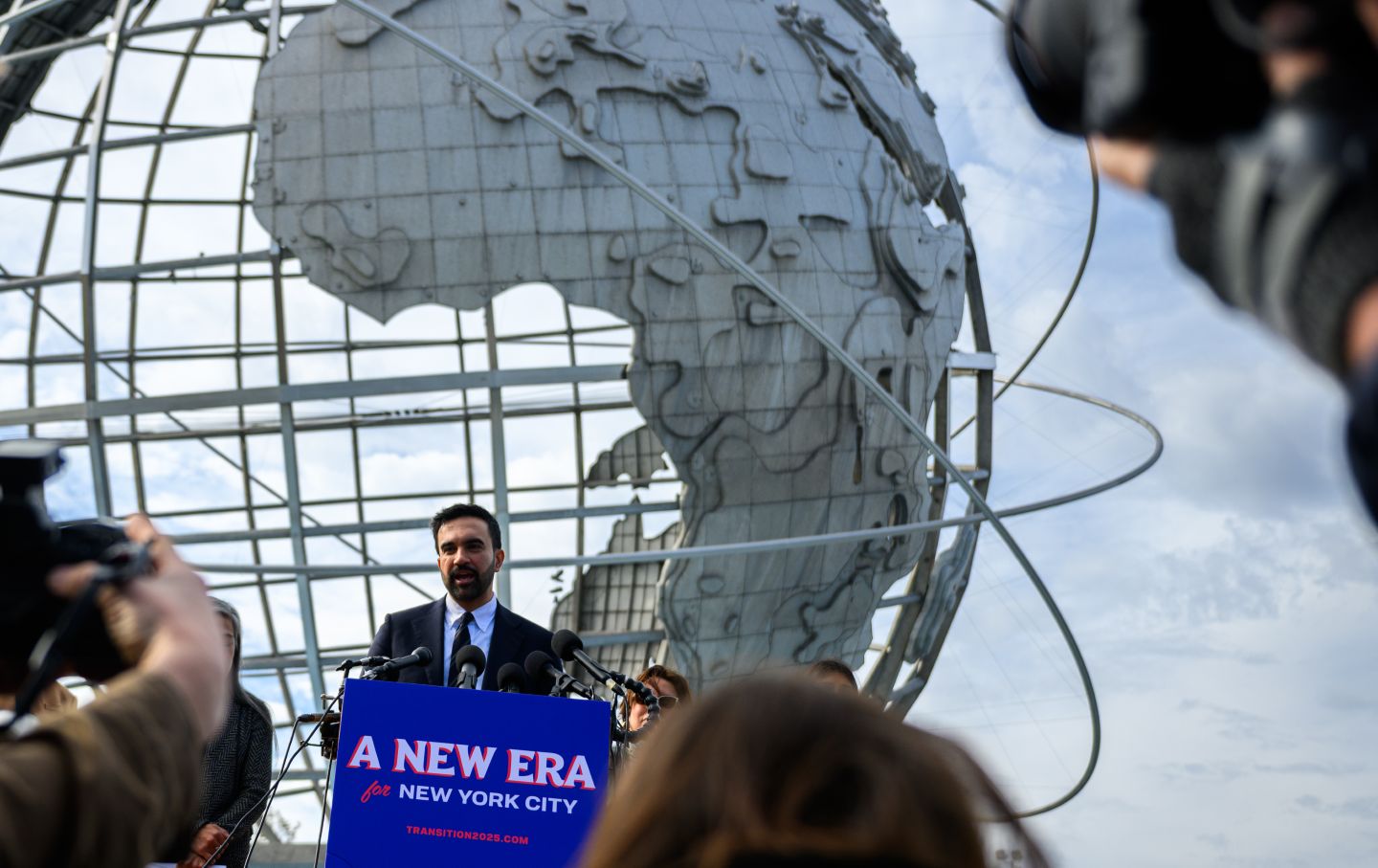
Mayor-elect Zohran Mamdani speaks during a press conference at the Unisphere on November 5, 2025 in the Queens borough of New York City.
(Alexi J. Rosenfeld / Getty Images)As the dust settles on New York City’s mayoral election, the international impact of Zohran Mamdani’s victory has become clear: Mamdani didn’t just win a race; he redefined the meaning of local politics in a global city.
New York City is not only the headquarters of international diplomacy, home to vibrant migrant communities, and a major hub of tourism. Through its municipal partnerships, growing cultural production, and finance sector, New York City also has an outsize influence on the world—and not always for good.
Throughout his political career in New York, Mamdani has both celebrated and interrogated his city’s global footprint. As a member of the New York State Assembly, he introduced legislation to prevent nonprofits based in New York from funding the occupation of Palestine, while joining South Asian members of the New York City Council to denounce the visit of Indian Prime Minister Narendra Modi.
In his campaign for mayor, Mamdani was careful to focus on the pocketbook issues that united his broad-based coalition. But international solidarity carried a critical, if quieter, through-line in the campaign. He mobilized immigrant communities across the five boroughs in their own languages, including Urdu, Spanish, and Arabic. In his victory speech on election night, he addressed them directly: “I speak of Yemeni Bodega owners and Mexican abuelas, Senegalese taxi drivers and Uzbek nurses, Trinidadian line cooks and Ethiopian aunties, yes, aunties.”
Now the incoming Mamdani administration has an opportunity to turn affective sentiments into effective policy, and transform the NYC Office of International Affairs into an instrument of international solidarity—at a time when Trump’s White House is escalating its assault on migrant rights, international law, and the multilateral system more broadly.
New York City has a rich tradition of municipal internationalism. Mayor Fiorello La Guardia, for example, understood that the city’s international role was at once moral and material. Born to a Jewish and Italian immigrant family, La Guardia worked as an interpreter for new arrivals at Ellis Island, where he worked in Italian, Yiddish, German, and Croatian. In Congress, before becoming mayor, he opposed the sweeping anti-migrant policies of the Immigration Act of 1924 and its “fixed obsession on Anglo-Saxon superiority.”
Once elected mayor, La Guardia used his office to denounce the rise of fascist movements in the 1930s and to protect democracy at home. He recorded regular messages in Italian supporting antifascist partisan revolt for radio broadcast across Italy from 1942–44 and personally led fierce attacks against “that swine Hitler” at anti-Nazi rallies of tens of thousands in New York. “To be against Hitler is to be for the German people,” La Guardia said in a prewar speech in 1934 urging the boycotting of German goods, “To be against Hitler is to be for the peace of the world. To be against Hitler is not to permit conditions which civilization won’t countenance.”
Half a century later, Mayor David Dinkins revived that tradition. Under his leadership, New York became a crucial node in the global movement against South African apartheid. At Dinkins’s direction, the city divested over $500 million from companies doing business in South Africa and even established incentives for financial institutions that pressured the South African government for anti-apartheid reforms.
Dinkins also used the symbolic power of internationalism to build a common front with the emerging progressive leaders in South Africa and Haiti, just as he fought to make racial justice tangible in Harlem and Brooklyn. In 1992, Dinkins rallied25,000 largely Caribbean New Yorkers in Central Park in support of the Rev. Jean-Betrand Aristide, the popular former president of Haiti and liberation theologian, who was ousted in a right-wing military coup. Dinkins also hosted Nelson Mandela after his release from prison and later toured South Africa at Mandela’s personal invitation. “People say I’ve come a long way from home,” Dinkins said upon arriving in South Africa, “And it’s true: I have come a long way. But today, I finally am home.”
The Mamdani administration can also turn to cities abroad to draw inspiration for a renewed and reinforced Office of International Affairs. Under Mayor Ada Colau, for example, Barcelona retooled its Department of International Relations to transform the values of the “City of Rights” into international policy. It forged partnerships on affordable housing, feminist policy, and participatory democracy, shared expertise with European, Latin American, and African cities, and suspended its formal relationship with Tel Aviv due to Israel’s systematic human rights abuses.
Mamdani can learn from these examples not only to make a principled point about international solidarity, but also to advance his core affordability agenda. By building bridges to new sister cities, for example, New York City can source concrete solutions to its acute cost-of-living crisis: social housing from Vienna, public grocery models in Greenland or Sri Lanka, or bold plans to rein in car traffic and support active transportation from Paris.
Popular
“swipe left below to view more authors”Swipe →The current constellation of sister cities reflects decades of ad hoc decision-making, missed opportunities, and outdated priorities. Cities like Jerusalem in Israel are still elevated as close allies, while natural partners with large migrant populations such as Mexico City, Kingston, or Quito remain at arm’s length. These relationships can be evaluated and, where necessary, restructured to align with the administration’s agenda on behalf of all New Yorkers.
Even Mayor Eric Adams recognized this opportunity. During his tenure, New York expanded its sister city arrangements to include both Bridgetown, Barbados, and Ho Chi Minh City, Vietnam. Mamdani can now go even further. With Mexico City, New York could establish concrete policy exchanges around its universal pension program, integrated, community-based public safety and the expansion of social housing. With Toronto, Canada’s economic engine, progressive Mayor Olivia Chow is building thousands of new rent-controlled and non-market homes, rolling out programs for providing schoolchildren free breakfast and lunch, and investing hundreds of millions of dollars into public transit.
Yet the sister city program is just one of the instruments available to the NYC Office of International Affairs to forge effective solidarities with the world at large. The office currently hosts a Junior Ambassadors Program to train students in the practice of diplomacy; Mamdani could expand the program to support international exchanges that train a new generation of solidarity activists. New York City hosts more consulates than any US city outside Washington, DC; the Mamdani administration can use its consular engagement program into a vehicle for policy coordination or the defense of migrant rights.
But to do so, international affairs cannot be dismissed as a mere afterthought. All too often, international portfolios are granted as consolation prizes to scorned political allies—or worse, as in the case of outgoing Mayor Eric Adams, they can become porous avenues to advance special interests from abroad.
With a more considered approach to the NYC Office of International Affairs—and a proper plan of action to govern it—Mamdani can turn the page on the corruption of the Adams administration, stand up to the brutality of the Trump White House, and turn New York City from a playground for the global elite into a hub of genuine solidarity with all working people.
The world is already looking to Mamdani’s leadership. If he empowers his Office of International Affairs to act with purpose—to align solidarity with the needs of New Yorkers—he can once again turn the cause of global justice into a practice of local governance.
Become a Sustaining Donor This September
Between the reemergence of right-wing red-baiting and Donald Trump’s use of the chilling National Security Presidential Memorandum–7 to criminalize left political organizing, we’re seeing McCarthyism reborn before our eyes.
This assault on democracy cannot be ignored or wished away. Resisting it requires bravery in the face of threats and repression, a steadfast commitment to the truth, and the unwavering belief that we can—and will—overcome this darkness.
We must have an independent media that sets the record straight, unearths corruption and abuses of power, and advances a politics of justice and dignity for all if we’re to win this fight.
That’s why I’m writing to you today. This September, The Nation needs to add 100 monthly donors to sustain our progressive journalism. Your contribution makes the next investigative report, the next truth-speaking column, and the next pathbreaking essay all possible.
I hope you’ll support our work with a recurring donation today. If you donate $10 or more a month, we’ll send you a brand new “Hands Off the Free Press!” sticker to recognise your commitment to our cause. Please, donate today.
Onward,
Katrina vanden Heuvel
Editor and Publisher, The Nation