The Washington Post’s Craven Capitulation to the Billionaire Class
What the newspaper’s editorial page editor really meant was, “My corporate paymasters want to wallow in Donald Trump’s tax cuts.”
The Washington Post’s Craven Capitulation to the Billionaire Class
What the newspaper’s editorial-page editor really meant was, “My corporate paymasters want to wallow in Donald Trump’s tax cuts.”
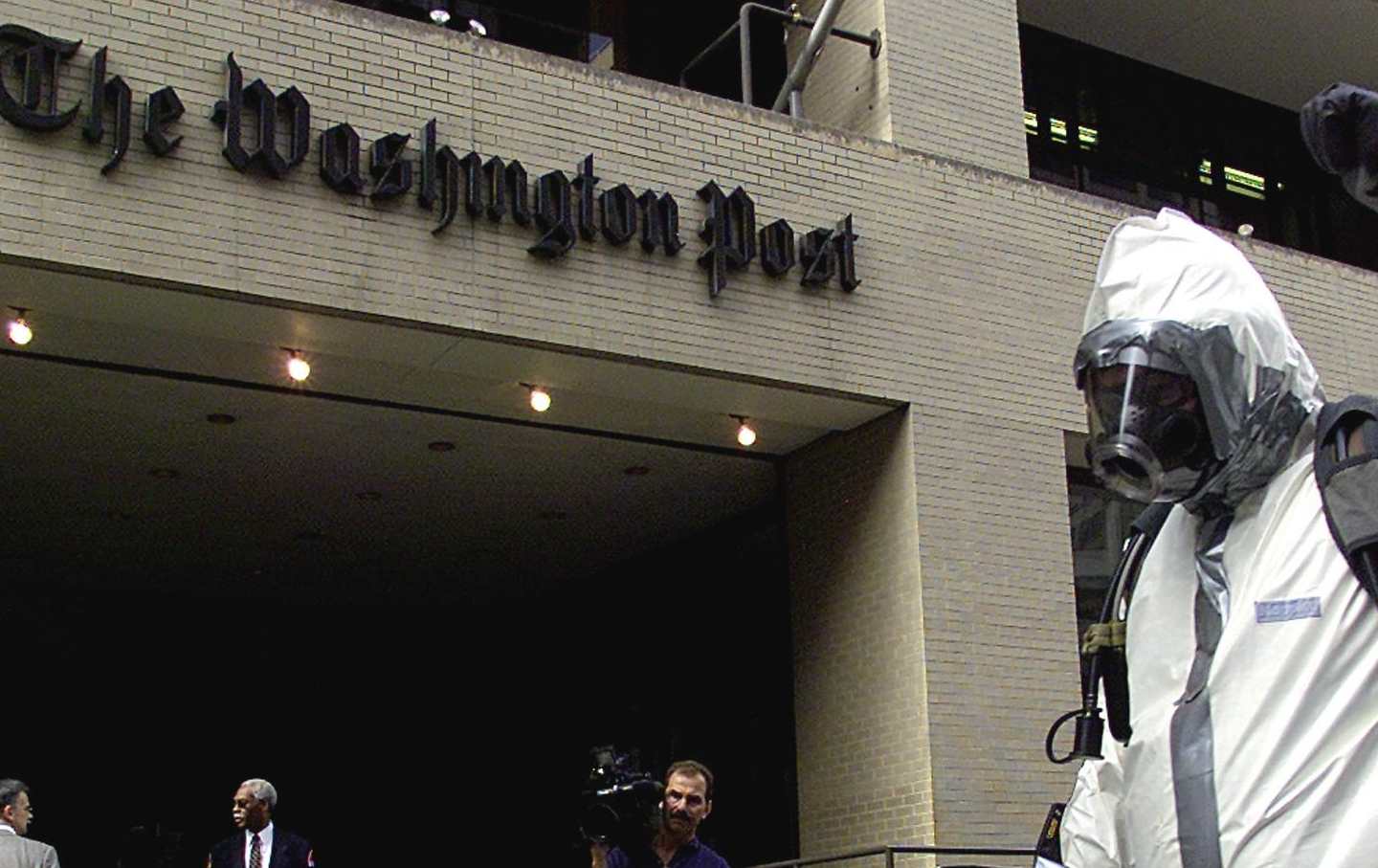
A hazmat worker outside the old Washington Post building in 2001.
(Stephen Jaffe / AFP via Getty Images)
Here’s a new slogan that seems right for the sanctimonious-yet-venal brain trust at The Washington Post: Democracy dies in the darkness of Jeff Bezos’s wallet. The paper that’s long dined out on its reputation as a principled foe of a paranoid, authoritarian Republican regime announced on Friday that it wasn’t going to endorse a presidential candidate this time out (or indeed ever again), even though the twice-impeached, criminally convicted Donald Trump makes Richard Nixon look like a mere piker in the realm of unhinged abuses of maximum executive power.
The newspaper that still has the temerity to envision itself as a heroic guardian of the country’s embattled democracy rolled over for the MAGA thugocracy under the flimsiest imaginable pretext: It intends to safeguard an “independent space” for voters who don’t want to be told whom to vote for, editorial-page editor David Shipley reportedly told outraged staffers of the paper in what NPR media reporter David Folfenflik called a “tense meeting.” Never mind that Americans are already told whom to vote for on a never-ending loop in every imaginable public venue, and seem to emerge with their delicate sensibilities intact. Never mind that the whole idea of an op-ed section is to assemble voices arguing over what people should say and do. And never mind that there’s no such thing as an impartial “independent space” in a battle over how and whether America’s formal democracy can continue. What Shipley was actually doing was saying, “My corporate paymasters want to wallow in Donald Trump’s tax cuts and avoid jeopardizing their lucrative federal contracts,” but the phony rhetoric of noncommittal journalistic objectivity is far better suited to newsroom meetings where you’re trying to get reporters to toe the management line.
Shipley had reportedly already drafted an endorsement of Harris, but per the Post’s own reporting, it was overruled by Post owner and retail predator Jeff Bezos, the centibillionaire owner of Amazon. During Trump’s first administration, the then-president threatened to withhold key tax breaks and postal subventions in retaliation for the Post’s critical coverage of Trump. When the editorial board weighed its 2020 endorsement, Bezos approved its choice of Joe Biden; this time out, the paper’s owner is hedging his bets against economic penalties in a second Trump term, to say nothing of the resolution of several pending antitrust actions against his company unlikely to break his way in a Harris administration. And like his fellow billionaires, King Amazon is clearly warming to the prospects of more pelf in his coffers thanks to Trump’s pledge to continue lavishing giveaways on our economic oligarchy.
It’s worth noting that the same scenario played out at the Los Angeles Times, where its billionaire owner, Patrick Soon-Shiong, blocked the paper’s planned endorsement of Harris. In addition to being a standard-issue plutocrat with a pharmaceutical fortune sure to prosper under a more lax Trump-appointed FDA, Soon-Shiong is a longtime pal of Elon Musk, the man-child centibillionaire who’s gone all in on Trump’s reelection. (Indeed, in a fine irony, the Post published a front-page account of how Musk’s Starlink satellite company stands to rake in billions more in government dosh in a second Trump term, on the very day the paper’s managers announced their craven capitulation to Musk’s would-be benefactor.)
What’s different about the shameful LA Times saga is that the paper’s editorial-pages editor, Marial Garza, recognized the actual journalistic and political stakes of having the paper’s voice squelched by a billionaire’s diktat. “I am resigning because I want to make it clear that I am not okay with us being silent,” Garza told Columbia Journalism Review editor Sewell Chan:
In dangerous times, honest people need to stand up. This is how I’m standing up.… This is a point in time where you speak your conscience no matter what. And an endorsement was the logical next step after a series of editorials we’ve been writing about how dangerous Trump is to democracy, about his unfitness to be president, about his threats to jail his enemies. We have made the case in editorial after editorial that he shouldn’t be reelected.
As for David Shipley, here’s the brutal assessment of one Post employee: “The story about Shipley has long been that he got the job because he knows how to get along with rich men.” Jacob Heilbrunn, a former colleague of Shipley’s at The New Republic, concurs: Back then, he was “earnest, conventionally liberal,” but “now seems to have morphed into a total empty suit.”
Indeed, while Shipley said he “owned” the Post’s cowardly decision in that heated staff meeting, the official rationale for it was published under the byline of Bezos’s handpicked publisher, Will Lewis, the former Murdoch lackey still neck-deep in the fallout from Britain’s phone-hacking scandal.
In an arrogant and obtuse editorial, Lewis waved away the paper’s recent history of presidential endorsements by citing its non-endorsement in the 1960 presidential race—a statement of putative journalistic principle that chiefly succeeded in being weaselly and pompous in equal measure: “We have said and will continue to say, as reasonably and candidly as we know how, what we believe about the emerging issues of the campaign,” the 1960 editorial read in part. “We have sought to arrive at our opinions as fairly as possible, with the guidance of our own principles of independence but free of commitment to any party or candidate.” Translation: We don’t relish candor as anything more than an expedient rhetorical posture, and must shy away from the clear moral implications of our own journalistic work.
That’s the gist of Lewis’s own slapdash argument, as well. Dismissing the notion that his quisling pose doubles as “as a tacit endorsement of one candidate, or as a condemnation of another” Lewis asserts that it is, in fact, “consistent with the values the Post has always stood for and what we hope for in a leader: character and courage in service to the American ethic, veneration for the rule of law, and respect for human freedom in all its aspects.” If the Post indeed cherishes those values, it’s objectively impossible to square them with sitting out an election that could restore maximum power to a multiply convicted lawbreaker, bigot, sexual assaulter, abuser of executive power, and self-styled agent of political retribution whose own former cabinet members regard as a fascist. Readers of the Post’s editorial page would have been better served by an entirely blank space or a horoscope or word game, in place of Lewis’s self-congratulatory bilge.
Yet long-suffering Post readers couldn’t be all that surprised by Lewis’s moronic, self-canceling reasoning. This was also the paper that sat for three years on the damning news that Martha-Ann Alito, the wife of the Supreme Court justice who stans for Trump’s maximal executive power and gleefully struck down women’s rights to their own bodily autonomy, flew an upside-down flag outside of the couple’s home in a gesture of solidarity with the failed coup of January 6. And according to NPR’s Folfenflik, Lewis dangled the prospect of an exclusive interview with him in exchange for the writer’s pledge to bury developments in the phone-hacking case in his reporting.
This is a universe or so removed from the high-minded standards of character and public probity that Lewis professes to uphold in embracing a morally indefensible posture of nonalignment in a moment of democratic crisis. But it’s what you get when you staff the top of a masthead exclusively with people who know how to get along with rich men.
Support independent journalism that does not fall in line
Even before February 28, the reasons for Donald Trump’s imploding approval rating were abundantly clear: untrammeled corruption and personal enrichment to the tune of billions of dollars during an affordability crisis, a foreign policy guided only by his own derelict sense of morality, and the deployment of a murderous campaign of occupation, detention, and deportation on American streets.
Now an undeclared, unauthorized, unpopular, and unconstitutional war of aggression against Iran has spread like wildfire through the region and into Europe. A new “forever war”—with an ever-increasing likelihood of American troops on the ground—may very well be upon us.
As we’ve seen over and over, this administration uses lies, misdirection, and attempts to flood the zone to justify its abuses of power at home and abroad. Just as Trump, Marco Rubio, and Pete Hegseth offer erratic and contradictory rationales for the attacks on Iran, the administration is also spreading the lie that the upcoming midterm elections are under threat from noncitizens on voter rolls. When these lies go unchecked, they become the basis for further authoritarian encroachment and war.
In these dark times, independent journalism is uniquely able to uncover the falsehoods that threaten our republic—and civilians around the world—and shine a bright light on the truth.
The Nation’s experienced team of writers, editors, and fact-checkers understands the scale of what we’re up against and the urgency with which we have to act. That’s why we’re publishing critical reporting and analysis of the war on Iran, ICE violence at home, new forms of voter suppression emerging in the courts, and much more.
But this journalism is possible only with your support.
This March, The Nation needs to raise $50,000 to ensure that we have the resources for reporting and analysis that sets the record straight and empowers people of conscience to organize. Will you donate today?