The Trump-Musk Regime Wants to Make Segregation Great Again
In a boon for racist businesses, the administration has ended a ban on segregated facilities for federal contractors.
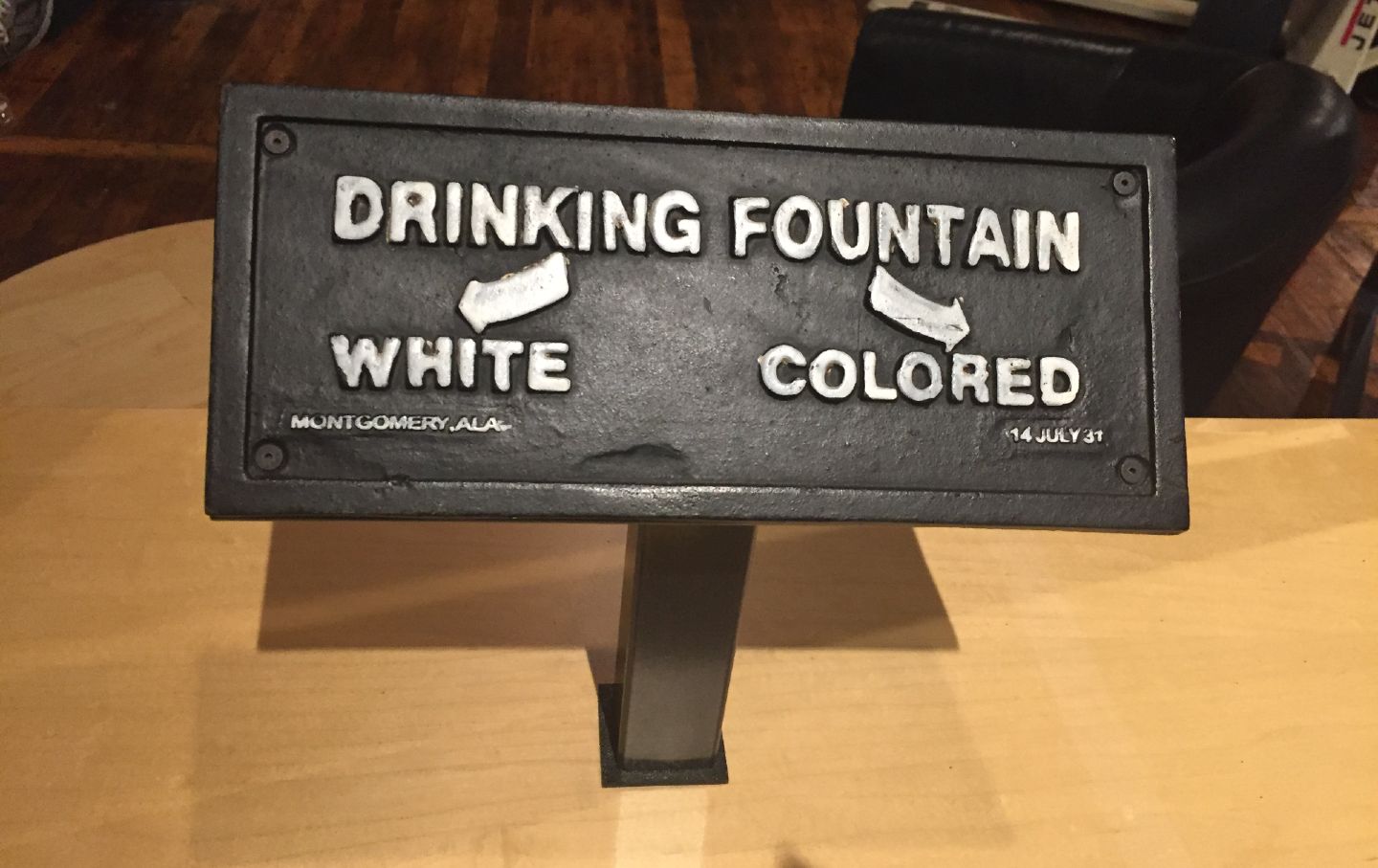
A segregation-era sign that hung over a water fountain in Montgomery, Alabama.
(Meg Kinnard / AP Photo)
When I was 11, I was taken on a trip to Clarksdale, Mississippi, for a family reunion. My mother was born there in 1950, in the deeply segregated and violent South. I remember only two things from the trip: One was the Ticonderoga-class mosquitos that populate the Mississippi Delta; I thought one of them was a dragonfly until it started sucking my blood like I was in a Bram Stoker novel.
My other memory was the drinking fountains. My mom took me to the local library, and told me to grab a drink from a water fountain. I didn’t feel like it, and I was a kid so I told her I wasn’t thirsty. She got really serious, and I think there must have been a cloud that blocked out the sun right at that moment, because the whole scene darkened. She told me again to have a drink, only this time it was an order. I did as I was told. As I leaned in, I could see, plain as day, the “whites only” message etched into the stone on the fountain. It hadn’t even faded.
I realized I was drinking from a fountain my mother wasn’t allowed to drink from when she was my age, but that’s not why the memory has stuck with me. The whites-only sign had been scratched out (obviously ineffectually), but the fountain hadn’t been replaced. It hadn’t been smashed. It hadn’t been thrown away as a relic of a shameful period. The sign was just… dormant. I didn’t know then about the “Lost Cause” and the Federalist Society and all those who were working for the day that the South would rise again, but it was clear to me then that the people who made the original sign (and their progeny) hadn’t given up. They were just waiting for their opportunity to refurbish the fountain and once again exclude Black people from using it.
That opportunity has come to them in the form of Donald Trump and his copresident, Elon Musk. Under this new regime, all of their white supremacist and neo-apartheid ideations can be realized again. Literally. Last month, NPR reports, the Trump administration made a racist change to its rules for business that get federal contracts, so that “the federal government no longer explicitly prohibits contractors from having segregated restaurants, waiting rooms and drinking fountains.”
The change to the Federal Acquisition Regulation—which is promulgated by the General Services Administration—doesn’t necessarily mean that people are free to segregate to their heart’s desire. Technically, for now at least, anyone that contracts with the federal government still has to comply with all relevant civil rights laws, including the Civil Rights Act, which prohibits segregation.
But the change to the rules is not just symbolic. Everything we know and have seen from this administration tells us that compliance with anti-segregation laws will not be enforced by Trump’s government. The Department of Justice will not bring discrimination lawsuits against companies that reimpose segregation. And now, any business that does segregate its workforce can still get a federal contract, even if the business is in blatant violation of the Civil Rights Act, which won’t be enforced against them anyway.
There is one man who stands to benefit above all others from this change in federal acquisition rules, and that man is of course Elon Musk. Musk had been under an intense investigation about allegations of (wait for it) segregationist policies at his Tesla facilities. Trump shut that investigation down as one of his first acts in power, but the allegations remain. Meanwhile, Musk has been gobbling up federal contracts like a (grand) dragon hoards gold.
In the absence of an ongoing federal investigation into Musk’s business practices, this little anti-segregation rule buried in the federal acquisitions policy could have opened up a new legal front against him. If the government is not allowed to contract with businesses that run segregated workplaces, and Musk allegedly runs a segregated workplace and receives government contracts, businesses that didn’t receive a federal contract might have had standing to sue the government (because the equal-employment opportunity businesses that didn’t receive a contract could say they were harmed by the government’s refusal to apply anti-segregationist prohibitions on federal contractors)—and that claim could require an adjudication on whether Musk is running a segregated company.
Thanks to the rule change, that cause of action is gone. While I’m only learning about the rule change now, thanks to NPR, the GSA actually changed the rule back on February 15, five days after Trump ended the DOJ investigation into Musk and Tesla.
Maybe it’s just a coincidence that Trump changed an anti-segregation government contracting rule less than a week after he ended an investigation into whether his chief contractor was a segregationist. Maybe Clarksdale, Mississippi, simply couldn’t afford to replace its drinking fountains. Maybe the white folks who run this joint “don’t have a racist bone in their body” and are just trying their best.
I wasn’t a fool when I was 11, and I’m not about to start acting like one now. I know what white supremacy looks like when I see it, and I’m not distracted when the white folks doing it make pathetic attempts to cover it up.