
As Trump Closes in on Public Service Jobs, Young Workers Look Elsewhere
The president’s executive orders have raised concerns among college students and recent graduates, prompting some to reevaluate their career plans.
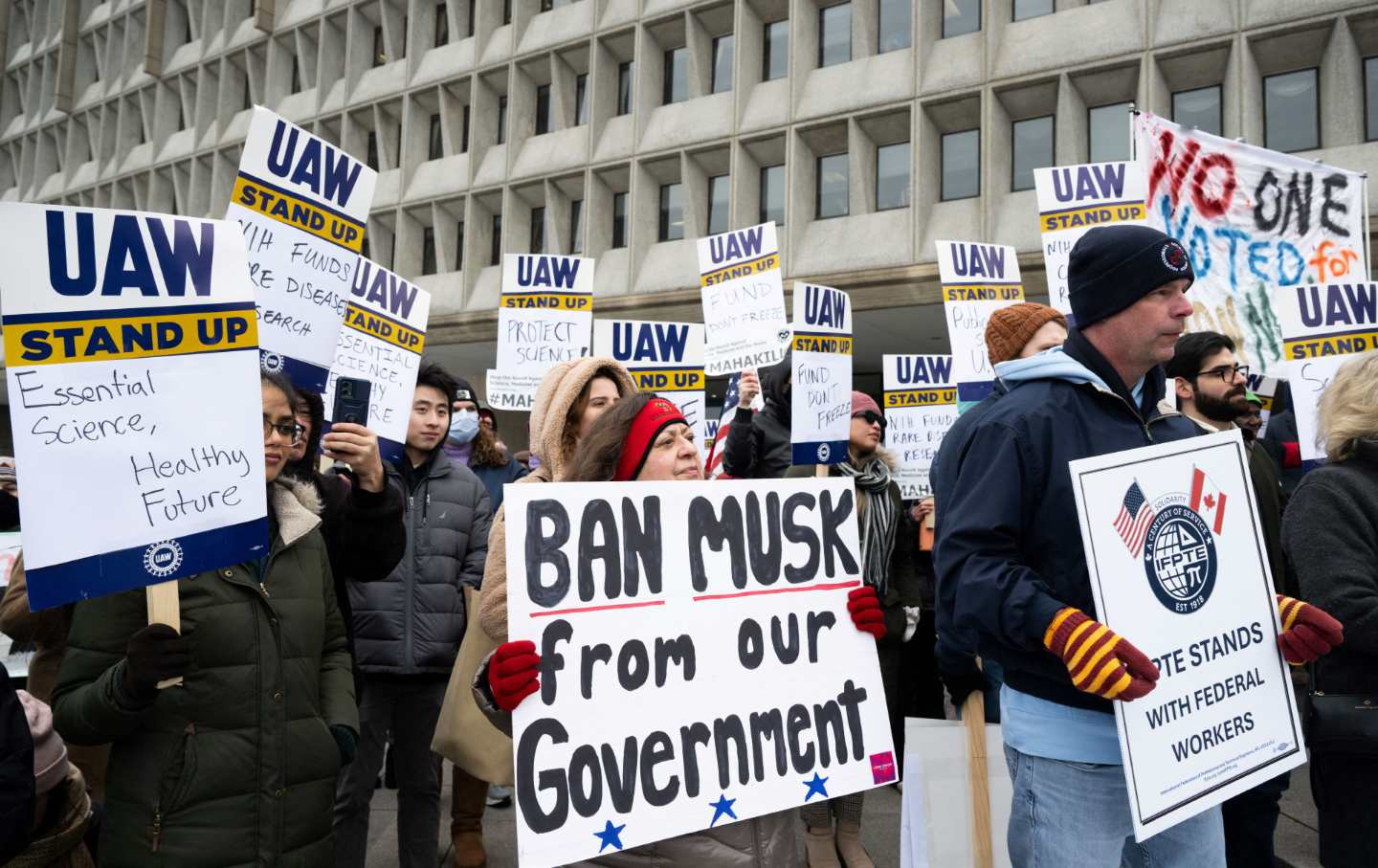
A protest against US President Donald Trump and Elon Musk’s DOGE cuts to medical research and higher education during a “Fund Don’t Freeze” rally outside the Health and Human Services headquarters in Washington, DC, on February 19, 2025.
(Saul Loeb / Getty)Natalie submitted her application for the US Department of State’s Pathways Internship Program in November. The program, designed to give students a route into federal careers, was an opportunity to explore a field “that feels fulfilling” and could help her “give back” to the places that have served her: public service. But at the end of January, she received an e-mail informing her that the program had been canceled. The 22-year-old is one of thousands of young people across the nation affected by the Trump administration’s funding freeze and job cuts across federal agencies in its first weeks.
These executive actions have raised concerns among college students and recent graduates, prompting some to reevaluate their career plans. Though having previously interned with the Environmental Protection Agency and the State Department, Natalie is now reconsidering her plans for a future working in federal agencies, eyeing opportunities with NGOs and on Capitol Hill. “The federal government is just not a pathway that I see for myself going into, at least in the upcoming two years, and potentially, the upcoming full four years,” she told The Nation.
“I am more focused now on state and local government rather than federal government,” said Kye Benford, a freshman majoring in political science and government at Purdue University. “Especially with what’s happening—purges and firings of people—it doesn’t seem very stable to go into that room.”
The now-rescinded hiring freeze, initially set to take effect on January 28, led federal agencies to cancel numerous jobs, including thousands of legal internships and entry-level positions within federal departments. In recent weeks, Trump has also dismantled the US Agency for International Development, proposed eliminating the Department of Education, and temporarily shut down the Consumer Financial Protection Bureau, resulting in thousands of additional job losses. This marks a significant shift from a year ago, when the Biden administration updated regulations that expanded government internship opportunities to attract younger talent.
With internship programs and entry-level job opportunities being cut, these actions will weaken the role of the government and sow public distrust toward federal employees more broadly, according to critics. Trump’s actions are “certainly trying to undermine the civil service and increase public hostility toward government employees” according to Peter Levine, a professor of citizenship and public affairs at Tufts University.
“I would imagine that serving in a federal executive branch position would become a much less attractive opportunity for most given the more precarious nature of these positions in the current moment,” A. Benjamin Spencer, the dean of William and Mary Law School, told The Nation. He said that multiple students in this year’s graduating class lost job offers from the Department of Justice and the Nuclear Regulatory Commission.
Mahir Rahman, a junior at Brown University studying economics and international and public affairs, said that the recent funding and job cuts have made the internship search process “a lot more challenging.” Following graduation, Rahman plans to attend medical school and hopes to work at a public hospital, but cited the Department of Government Efficiency’s (DOGE) scrutiny of Medicare as a source of concern. “It’s making me want to consider different options,” he said. “Right now, there’s just an air of uncertainty, because people don’t really know what’s going to happen next.” Natalie said that the State Department did not provide a timeline for when internship positions would return—if at all.
“My plan was always to go into public service, and now I have to build up an entirely new network in the private sector,” a recent law school graduate told The Nation. “I had intended to spend my career in public service, ironically because it seemed like a stable option that would allow me to give back to my community,” they said. “Now, I can’t imagine myself returning to public service unless I had no other options.”
In 2024, 60 percent of young adults saw a career in public service as a meaningful way to make a positive impact on their communities. A separate 2023 poll found that 29 percent of 18-to-29-year-olds found public service work appealing. “We know that young people really want a sense of purpose in their work—that’s something that is especially apparent within the Gen Z population, and public service can be a way to get that sense of contributing to something larger than yourself,” Nathan Hora, a senior adviser for federal policy at the National Youth Employment Coalition, told The Nation.
However, Trump’s recent attacks on public service could shift these views. Levine explained that during Trump’s first term, his administration struggled to enact major policy changes because of congressional roadblocks. This time, however, Trump’s team has identified ways to circumvent Congress by “canceling contracts, issuing executive orders that conflict with federal laws, and firing employees.” Levine added that young federal workers, particularly those in provisional roles, are especially vulnerable since they are easier to dismiss. “I also assume that federal employment looks unattractive to many young people who might otherwise be interested,” he said.
Lynn Hastings, a student at Purdue University, dreams of becoming a federal judge, but noted that her studies and work “feels like it is all going down the drain. She’s afraid that, because of executive orders affecting diversity, equity, and inclusion programs across the federal government, employers “might not be as fair when seeing my application, as I am a Black woman from a lower-class background,” she said.
“Just seeing how the White House and the executive branch have been acting is very concerning to see,” Benford added. “Would I be able to not only get a career there, but would I even be treated fairly?”
Popular
“swipe left below to view more authors”Swipe →“The American Dream is fading into a nightmare—especially for international students,” said Aayushi Umbare, a high school junior from India. Umbare, a student with an interest in international relations who grew up in the states, is hesitant about returning to the country under the current administration. “Long-term planning feels impossible, and that uncertainty is making it harder and harder to justify pursuing higher education and a career in the US.”
Although the long-term impact of these widespread hiring cuts remains uncertain, experts anticipate a decrease in young people’s interest, engagement, and representation in the federal government—a likely goal of the new administration.
“If young people are not able to engage in internships and other early work experiences to hone their skills, make connections, and solidify their interests in public service and government work, it is likely to decrease both their interest in that work and their ability to develop the knowledge and skills to do that kind of work in the future,” Dr. Robin Jacob, a research professor at the Institute for Social Research at the University of Michigan and faculty codirector of the Youth Policy Lab, told The Nation. “I think it is quite likely that we will see a decline in youth participation and representation in the federal government and in government more generally over the next several years.”
Levine believes that restoring the civil service may fall to the next generation. “At some point, the executive branch will have to be rebuilt with hundreds of thousands of new workers, many of whom will be young,” he said. “Rebuilding the government is going to be the opportunity and the calling of Generation Z.”
Become a Sustaining Donor This September
Between the reemergence of right-wing red-baiting and Donald Trump’s use of the chilling National Security Presidential Memorandum–7 to criminalize left political organizing, we’re seeing McCarthyism reborn before our eyes.
This assault on democracy cannot be ignored or wished away. Resisting it requires bravery in the face of threats and repression, a steadfast commitment to the truth, and the unwavering belief that we can—and will—overcome this darkness.
We must have an independent media that sets the record straight, unearths corruption and abuses of power, and advances a politics of justice and dignity for all if we’re to win this fight.
That’s why I’m writing to you today. This September, The Nation needs to add 100 monthly donors to sustain our progressive journalism. Your contribution makes the next investigative report, the next truth-speaking column, and the next pathbreaking essay all possible.
I hope you’ll support our work with a recurring donation today. If you donate $10 or more a month, we’ll send you a brand new “Hands Off the Free Press!” sticker to recognise your commitment to our cause. Please, donate today.
Onward,
Katrina vanden Heuvel
Editor and Publisher, The Nation
More from The Nation
Zohran Mamdani Hosts the World Zohran Mamdani Hosts the World
In a meeting with mayors from around the globe, Mamdani argued that the left must fix everyday problems—or the right will find someone to scapegoat for them.

Is There Any Good News Left? Is There Any Good News Left?
Despite what our algorithms suggest, there’s still news worth celebrating.
CEOs Are Losing Control of AI CEOs Are Losing Control of AI
With no slowdown from Trump’s administration.
Gina Hinojosa: “We Flip Texas, and It’s Over” Gina Hinojosa: “We Flip Texas, and It’s Over”
Talking to Texas gubernatorial candidate Gina Hinojosa about what redistricting could mean and how a new generation of Democrats is speaking more directly to voters.
Trump Wants to Keep Journalists Out of the White House. He Should Get His Wish. Trump Wants to Keep Journalists Out of the White House. He Should Get His Wish.
The president has banned MS NOW, CNN, and Politico from attending press briefings. The rest of the media should respond with a boycott.

