
How Donald Trump Dismantled a Worker Protection Agency With One Late-Night E-mail
By firing Gwynne Wilcox, Trump is hoping the Supreme Court will overrule 90 years of legal precedent and give him the authority to fire members of independent boards.
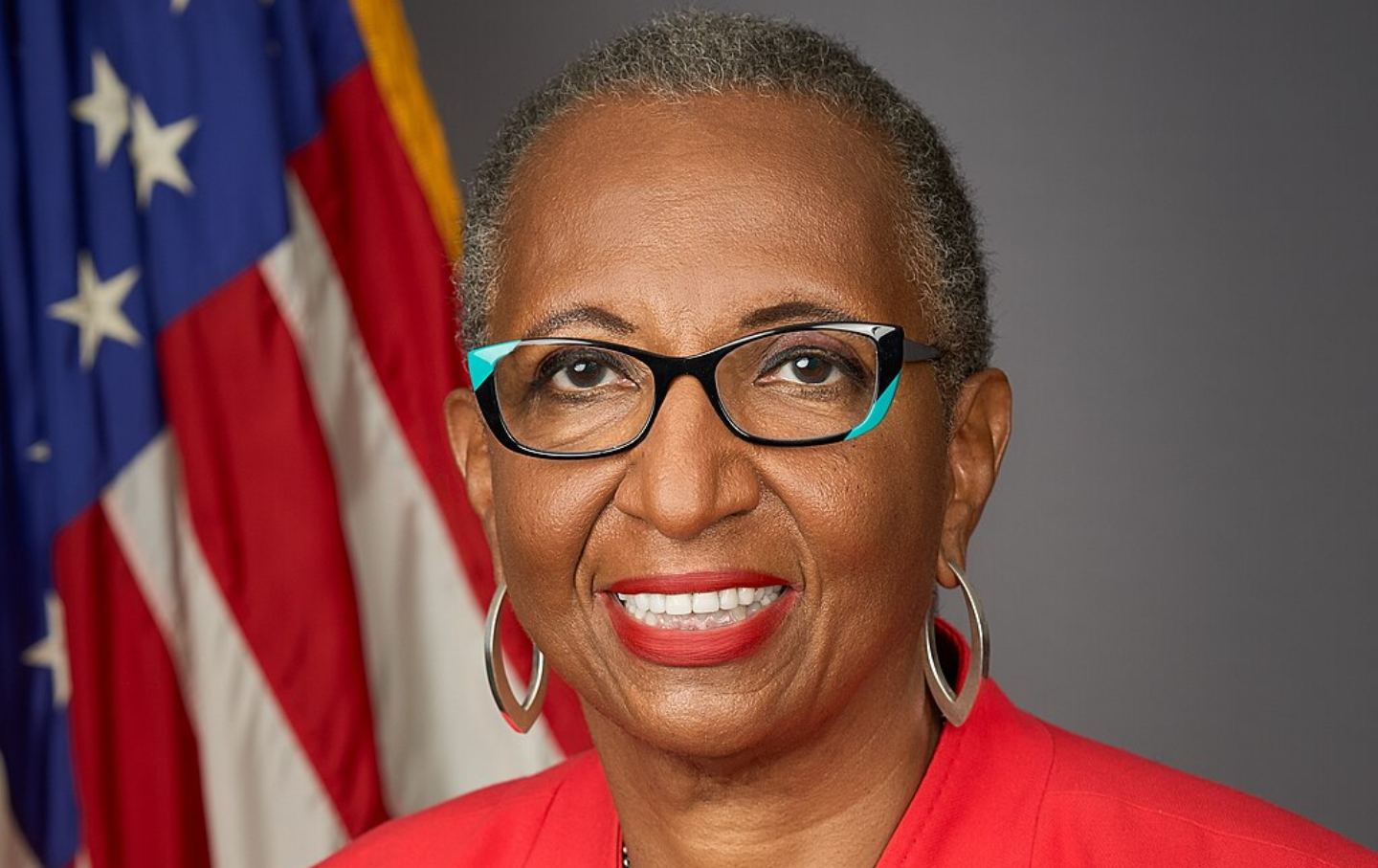
Late in the evening of January 27, 2025, Gwynne Wilcox, a distinguished union-side labor lawyer, Senate-confirmed member of the National Labor Relations Board (NLRB) and the first Black woman to ever serve on the board in its 90-year history, received an error-filled e-mail from a White House staffer informing her that President Trump was removing her from her position effective immediately. The next day, agency officials cut off Wilcox’s e-mail and proceeded to terminate her employment, despite the fact that more than three years remained on Wilcox’s five-year Senate-confirmed term.
The consequences and implications of Trump’s action were immediate and far-reaching. By firing Wilcox, President Trump disabled the NLRB, because by law, the board needs three members to issue decisions. Since there were already two vacancies (caused by the failure of the Senate to confirm two nominees in December 2024), Wilcox’s removal left the board with just two members (both of whom happen to be white men, consistent with the Trump administration’s record of only appointing white men to the NLRB).
It didn’t take employers long to seize upon the opportunity presented to them. Whole Foods (owned by anti-union Amazon boss Jeff Bezos) filed a protest over its workers’ decision to unionize at a Philadelphia store, asserting (incorrectly) that the NLRB’s regional director was powerless to certify the election result because the NLRB lacked a quorum. Whole Foods is wrong on the law—the regional director still has the authority to certify the election. But without a functioning NLRB, there is no entity to enforce the regional director’s determination and hold Whole Foods accountable. Other employers are sure to follow suit and thumb their noses at their obligations under the National Labor Relations Act (NLRA), adding to the recent flood of employer challenges against the constitutionality of the NLRB itself.
The bottom line: A single late night e-mail has jeopardized the organizing and bargaining rights of 80 million workers.
Wilcox is fighting back. Days after her removal, she filed a lawsuit against President Trump and NLRB chair Marvin Kaplan challenging her removal as unprecedented and unlawful. Legal briefing is underway, and a federal judge will hear arguments in her case on March 5.
By all accounts, Wilcox should win her case and be reinstated. The NLRA contains explicit language saying that an NLRB member “may be removed by the President, upon notice and hearing, for neglect of duty or malfeasance in office, but for no other cause” (emphasis added). (There is no such “for cause” removal protection in the NLRA for the agency’s general counsel, whom Trump also fired in the January 27 e-mail.) The president has not identified any neglect of duty or malfeasance by Wilcox, nor has he provided her with the basic due process required in the statute of notice and a hearing. For this reason, legal observers have consistently said that Wilcox’s termination was illegal—at least under current law.
And that’s the hitch—by firing Wilcox and myriad other members of independent agencies like the Equal Employment Opportunity Commission, the Federal Election Commission, the Federal Labor Relations Authority, and others, President Trump is seeking to provoke a legal challenge and get the law changed. He is hoping the Supreme Court—three of whose justices Trump appointed—will overrule 90 years of legal precedent and rule that the president has the authority to fire members of independent boards and commissions at any time, for any reason at all, notwithstanding statutory language to the contrary. The White House staffer said as much in his late-night e-mail to Wilcox, saying that the “for cause” removal protections in the NLRA undermined the president’s executive authority. Trump’s Justice Department affirmed this position in a letter to Representative Jamie Raskin, asserting that “for cause” protections were unconstitutional.
The consequences of the Supreme Court’s overturning 90 years of precedent protecting the independence of federal agencies would be far-reaching and severe. Congress has established numerous independent agencies—the NLRB, the Equal Employment Opportunity Commission, the Federal Trade Commission, the Federal Elections Commission, and more—to protect workers, consumers, and the public from discrimination, unfair competition, junk fees, and other corporate wrongdoing. The Federal Reserve is another independent agency whose members have statutory protection against removal. If President Trump is given the green light to fire members of these independent agencies for any reason, including merely taking actions or decisions he disagrees with, it completely undermines the independence and objectivity of the agencies and leaves them vulnerable to political influence over their decisions and actions. That would end the operation of independent agencies as we know them.
This is scary business indeed, when one thinks back to the presidential campaign and then-candidate Trump praising Elon Musk for firing strikers, which is of course illegal under our labor law. How are appointees to the NLRB expected to uphold workers’ right to strike and other fundamental rights when they know the president who thinks striking is illegal can fire them at any moment? The chilling effect on NLRB members and their ability to uphold and enforce workers’ rights is unmistakable.
With the NLRB disabled until Wilcox is reinstated (or Trump wins Senate approval of new NLRB members who have not yet been nominated), what should workers and their advocates do? For starters, workers and advocates need to continue to speak out and call attention to Trump’s power grab—his unprecedented and illegal firing of the first Black woman to ever serve on the NLRB, and the damaging consequences to workers’ rights and the agency’s ability to protect and enforce their rights. Elected officials of both parties need to speak out about the president’s actions and how they undermine the Senate’s constitutional role. Responsible employer associations should be joining in the outcry as well, because the NLRA protects them from illegal activity and helps ensure stability.
The utter silence on the part of the business community in response to this unprecedented and destructive act has been disheartening and disturbing. But most importantly, workers and advocates need to keep the focus on organizing the millions of workers who want unions but don’t yet have them, and visibly, forcefully and loudly stand up for workers’ organizing and bargaining rights. Worker advocates—unions, community leaders, elected officials—need to continue publicly shaming Whole Foods and other corporations who stand in the way of workers trying to exercise their rights.
Donald Trump may have temporarily disabled the NLRB—and the truth is, the board is unlikely to be pro-worker once his appointees are in place—but he didn’t, and can’t, take away workers’ rights to form unions and engage in collective bargaining to improve their working conditions. There is a long history of workers successfully organizing despite legal obstacles and setbacks. This is another of those moments, and it’s essential that workers be encouraged and supported to exercise their rights.
Become a Sustaining Donor This September
Between the reemergence of right-wing red-baiting and Donald Trump’s use of the chilling National Security Presidential Memorandum–7 to criminalize left political organizing, we’re seeing McCarthyism reborn before our eyes.
This assault on democracy cannot be ignored or wished away. Resisting it requires bravery in the face of threats and repression, a steadfast commitment to the truth, and the unwavering belief that we can—and will—overcome this darkness.
We must have an independent media that sets the record straight, unearths corruption and abuses of power, and advances a politics of justice and dignity for all if we’re to win this fight.
That’s why I’m writing to you today. This September, The Nation needs to add 100 monthly donors to sustain our progressive journalism. Your contribution makes the next investigative report, the next truth-speaking column, and the next pathbreaking essay all possible.
I hope you’ll support our work with a recurring donation today. If you donate $10 or more a month, we’ll send you a brand new “Hands Off the Free Press!” sticker to recognise your commitment to our cause. Please, donate today.
Onward,
Katrina vanden Heuvel
Editor and Publisher, The Nation
More from The Nation
The UAW Wave Has Hit Our Shores The UAW Wave Has Hit Our Shores
The union’s endorsements of insurgent candidates led to big wins this summer. It’s all part of a strategy to remake American politics for the working class.
The Making of the Millennial Working Class The Making of the Millennial Working Class
A new book follows a rising generation of labor organizers as they attempt to unionize their workplaces.
Dolly Parton Was a Proud Union Sister Dolly Parton Was a Proud Union Sister
Organized labor is celebrating the life and legacy of an artist who championed working women and carried a union card for almost 60 years.
Adjuncting Until the End of Time Adjuncting Until the End of Time
Universities now have more adjuncts than tenured and tenure-track professors combined. The conditions are unsustainable—for professors and students alike.
The Dignifying Solution to America’s Care Crisis The Dignifying Solution to America’s Care Crisis
Employee ownership turns care work jobs into good jobs—and leads to better patient outcomes.

Mamdani’s Team Redefined Political Video. Now They’re Betting on Short Films. Mamdani’s Team Redefined Political Video. Now They’re Betting on Short Films.
Premiering exclusively in The Nation, a new short film produced by City Hall and narrated by Morgan Spector highlights the efforts of the biggest tenant-led union in New York City...

