Trump Sets His Sights on “Eliminating” Public Education
Yesterday’s executive order would dismantle the Department of Education, shutting down programs American families rely on.
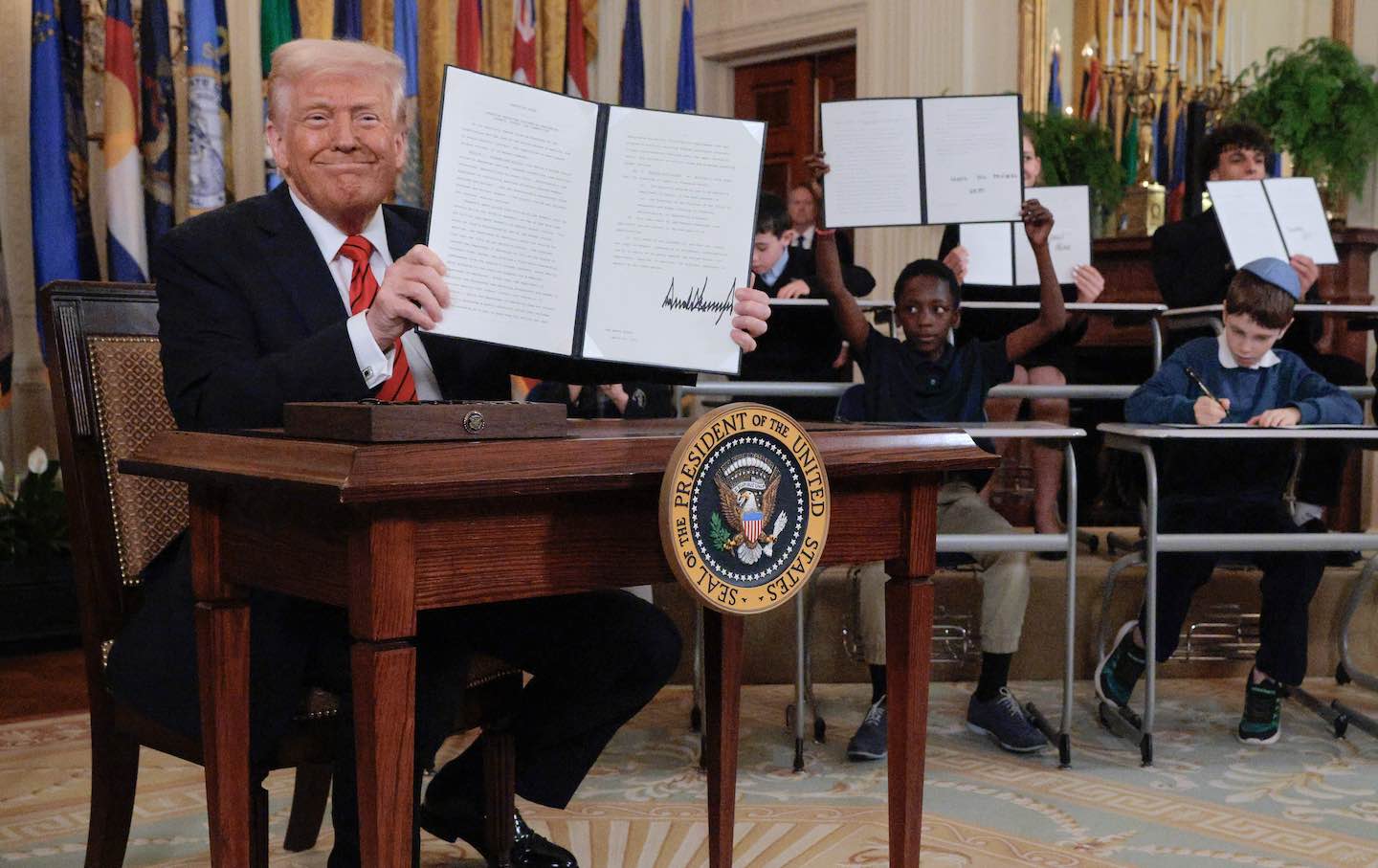
President Donald Trump holds up the signed executive order to reduce the size and scope of the Education Department during a ceremony in the East Room of the White House on March 20, 2025.
(Chip Somodevilla / Getty Images)When President Donald Trump signed an executive order yesterday stating his intention to “begin eliminating the federal Department of Education once and for all,” he was doing more than implementing the standard DOGE agenda of cluelessly targeting phantom government waste. The Education Department, which Congress created in 1979, represents a key fulcrum in the right-wing theology of culture warfare. That’s why dismantling most key functions of the agency is a centerpiece of the Trump administration’s wrecking-ball tour through the administrative state: The agenda of publicly funded education has always been anathema to the modern conservative movement.
Like the other agency death sentences issued by the second Trump administration—targeting other bête noires of the right like the United States Agency of International Development and the Consumer Finance Protection Bureau—the pending cuts to the DOE will hit the most vulnerable populations the hardest. The department disburses $18.4 billion in Title I grants to high-poverty K-12 public schools, and $15.5 billion under a program for students with disabilities. Altogether, DOE grants make up 14 percent of the budgets for the nation’s public schools. The agency also oversees the $1.6 trillion college loan program, which under the new Trump administration will likely devolve to other agencies with little incentive to continue reversing the crushing impact of student debt. The likeliest scenario, says Jeff Hauser of the executive branch watchdog group the Revolving Door Project, is that the fate of student loan relief will be decided by the forces of territorial inertia within the government. This critical authority will probably undergo a version of what’s happened with USAID, whose skeletal remains are now housed mostly within the State Department. “They are going to make cuts that will make mandated functions of the mission of various departments impossible to accomplish in order to take a maximal position prior to litigation,” Hauser says, referencing the coming court challenges to Trump’s order. “Litigation may well lead them to a situation in which the functions are done in an illogical, restructured manner in another department; for example, Commerce or Treasury owning Federal Student Aid’s remaining responsibilities.”
For all the operational chaos ahead, however, the ideological brief behind the assault on the DOE is bracingly simple: to demolish the small-d democratic mission of public schooling in America. That agenda, as advanced in the early American republic, is to sustain democratic civic life by cultivating an informed citizenry—the central aim of 19th-century champions of the American common school such as Horace Mann. But translated into the register of right-wing culture grievance, the conduct of pedagogy in the service of public aims is a cunning expropriation of family sovereignty and parental authority. Historian Rick Perlstein spells out the core logic in a dissection of a 1970s-era tract on alleged faithless liberal indoctrination in the schools, Blackboard Tyranny. Written by Connie Marshner, a former apparatchik of the college-right activist group Young Americans for Freedom who later matriculated to the Heritage Foundation, the book turns the ideals of civic pedagogy on their head to summon forth an image of public schools as a fount of left-wing brainwashing and youthful rebellion:
Mothers have long observed that after the child starts school, the rest of the family starts catching more colds and flus. But other forms of disease are not so evident.
What about the personality traits that start developing? What about the dissatisfaction with family rules and routines? What about boredom with learning loss of curiosity about ideas and the world at large? Why do children suddenly begin to complain about responsibilities toward little brothers or sisters? Why do they resent doing accustomed chores? Why does off-color language or unfamiliar slang suddenly crop up in a child’s conversation?
As childhood yields to preadolescence and adolescence, and the condition gets worse, parents are told that these symptoms indicate normal stages of maturation. But when a mother is told by her high schooler, ‘You don’t know what’s right and wrong for me’ or ‘You don’t really care about me,’ she knows in her heart that it is something more than youthful Sturm und Drang that is causing the anguish. It is not biologically mandated for human offspring to turn against their parents. But all the kids on the block are acting that same way, so Mrs. Middle America figures she must be oversensitive…until something provokes her to take a closer look at her children’s public schools.
In many ways, Marshner’s lament echoes the anti-pool soliloquy that traveling salesman Harold Hill delivers in The Music Man, and the underlying structure of grievance mongering remains the same. The only difference is that, instead of peddling marching band instruments and school uniforms, the right has tirelessly promoted what Trump is now poised to deliver: a completely privatized model of schooling. The successive late-20th-century right-wing scares about school psychologists, gay teachers, and sex ed, down through the latter-day moral panics over critical race theory and DEI administrators, all invoke, as Marshner did, the sacred prerogatives of family and parental control over children and their behavior. But they boil down to the same thing—a model of learning detached from any broader civic aim, and therefore prey to the same private interests that have carved up and throttled the rest of the country’s public sphere.
Linda McMahon, Trump’s pick to head DOE—and now to oversee its pending deconstruction—is ideally suited to usher in a new age of school privatization. A former executive for the World Wrestling Federation, with no experience in education beyond a never-used teaching certificate, McMahon once chaired the central think tank of the MAGA movement, the America First Policy Institute. The policy shop enthusiastically supports privately funded charter schools, despite their decidedly equivocal educational track record, and also promotes education savings accounts (ESAs) to further realign school access on a market-driven grid. And like charter schools, ESAs reinforce, rather than mitigate, the steep inequalities of school systems chiefly funded by property tax payments: by directing lump-sum grants to parents and pupils, they leave them to navigate spending priorities on their own, so that some recipients have spent their allotments on school supplies (or non-school supplies) before they can pay for enrollments. ESAs also short-circuit any public accountability in education funding; since they chiefly benefit private institutions, no governing board can field community complaints or concerns if, say, the schools stop teaching about the country’s racist history, or face declining pass rates and test performances. Like today’s charter-school movement, a massive expansion of ESAs promises to be a playground of fraud and grifting.
Speaking of educational grifts, one recent success story at the DOE prior to Trump’s return to office was to help rein in the predations of the for-profit college racket. The personnel cuts that the Trump White House has already instituted in the department have effectively wiped out its oversight of this fraud-infested sector. “There’s a rule—it’s called the 90-10 rule, under which these schools can get 90 percent of revenue from the government, and in their heyday, the larger for-profit universities got as much as $1 billion in Pell grants and other federal money,” says Aaron Ament, president of the nonprofit advocacy group National Student Legal Defense Network. “In the action announced last week, they have effectively fired every employee at the Office of Student Aid who participated in the oversight of for-profit universities.”
In her confirmation hearings, McMahon herself conceded that the DOE can’t be abolished without a vote from Congress—something that wouldn’t happen even with GOP majorities in both chambers. That’s why Trump is seeking to carry out the hit via massive layoffs and executive order—the same way that USAID and CFPB were hollowed out and abandoned. And it’s why the order is already ticketed for a court challenge, by teachers unions, civil rights groups, and advocacy outfits like Ament’s. Yet the same grim calculus that wiped out USAID and CFPB could prevail here, as a battery of hostile market and ideological actors prepare to transform another regulatory concern into a predator’s ball.
Support independent journalism that does not fall in line
Even before February 28, the reasons for Donald Trump’s imploding approval rating were abundantly clear: untrammeled corruption and personal enrichment to the tune of billions of dollars during an affordability crisis, a foreign policy guided only by his own derelict sense of morality, and the deployment of a murderous campaign of occupation, detention, and deportation on American streets.
Now an undeclared, unauthorized, unpopular, and unconstitutional war of aggression against Iran has spread like wildfire through the region and into Europe. A new “forever war”—with an ever-increasing likelihood of American troops on the ground—may very well be upon us.
As we’ve seen over and over, this administration uses lies, misdirection, and attempts to flood the zone to justify its abuses of power at home and abroad. Just as Trump, Marco Rubio, and Pete Hegseth offer erratic and contradictory rationales for the attacks on Iran, the administration is also spreading the lie that the upcoming midterm elections are under threat from noncitizens on voter rolls. When these lies go unchecked, they become the basis for further authoritarian encroachment and war.
In these dark times, independent journalism is uniquely able to uncover the falsehoods that threaten our republic—and civilians around the world—and shine a bright light on the truth.
The Nation’s experienced team of writers, editors, and fact-checkers understands the scale of what we’re up against and the urgency with which we have to act. That’s why we’re publishing critical reporting and analysis of the war on Iran, ICE violence at home, new forms of voter suppression emerging in the courts, and much more.
But this journalism is possible only with your support.
This March, The Nation needs to raise $50,000 to ensure that we have the resources for reporting and analysis that sets the record straight and empowers people of conscience to organize. Will you donate today?