
How the Truman Scholarship Became the Right’s Latest Battleground
As Republican pressure on education mounts, the fight over the scholarship reveals a broader effort to turn public service into a test of political loyalty.
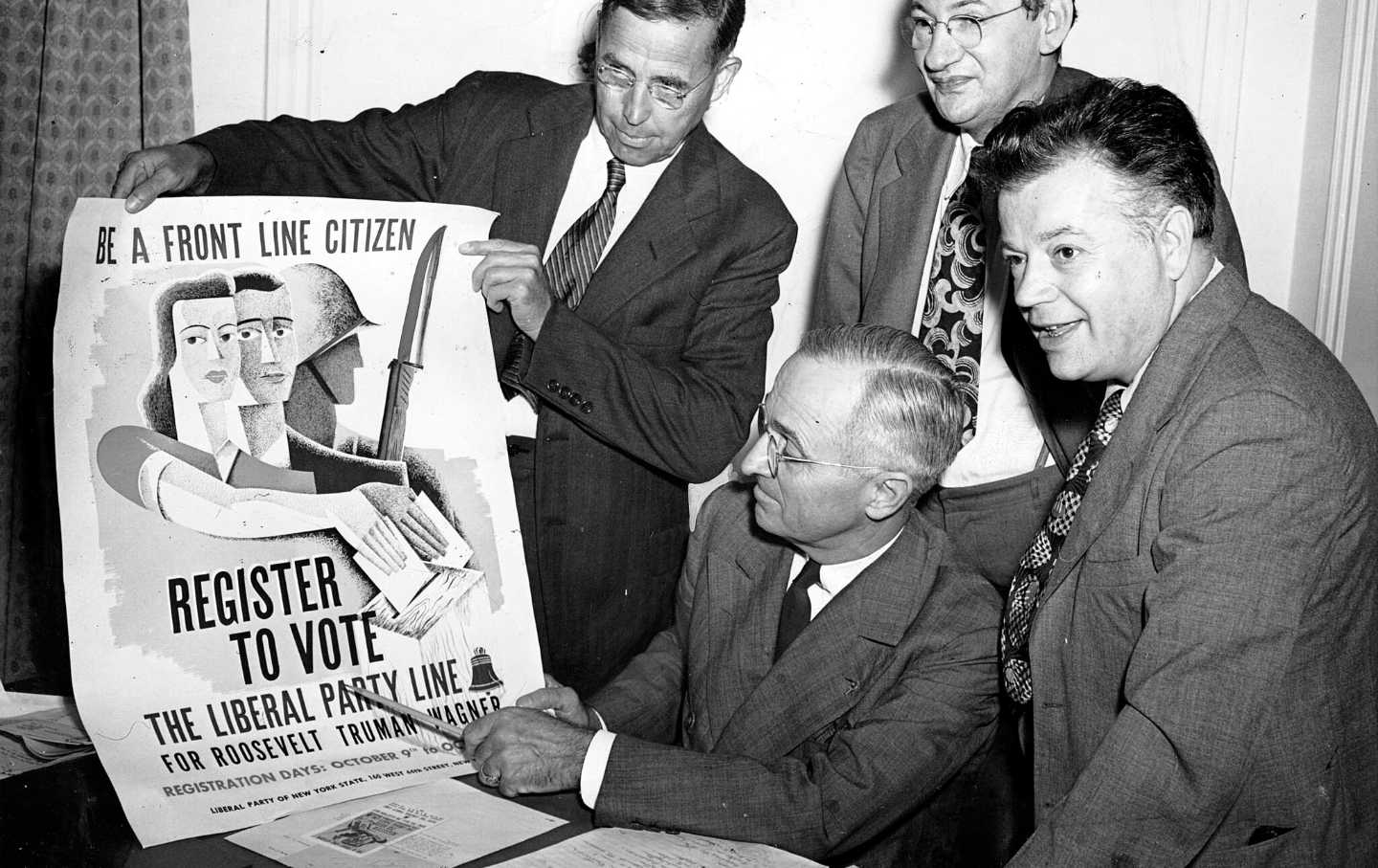
Harry S. Truman looks over a campaign poster urging people to register to vote.
(Wikimedia Commons)
“Shouldn’t the administration intervene when Jewish students are unsafe on campus?” Then came the follow-up: “What if it were Black students being lynched on campus—should the administration intervene then?”
These were questions I was asked during my interview for the Harry S. Truman Scholarship, a national award for college juniors committed to careers in public service. Established by Congress in 1975, the taxpayer-funded scholarship was designed to honor President Truman’s belief that democracy requires principled, well-prepared leaders. Each year, around one student per state is selected to receive funding for graduate school and support in pursuing work in government or the nonprofit sector. Applicants must be nominated by their schools, submit a series of essays, and, if selected as a finalist, sit for a 20-minute interview in their home state—a rapid-fire session meant to test their ability to think on their feet.
But instead of diving into policy, my interview veered sharply toward politics. I was asked about the Trump administration’s targeting of institutions—including my college campus, Columbia University. I later learned I wasn’t alone. Other finalists, particularly from elite schools with visible student protests, were similarly questioned on their views on Israel and Palestine, a topic far removed from what they had written in their applications.
Of course, scholarship panels should ask tough questions. But when candidates are singled out because of their campus affiliations or moral convictions, interviews risk turning into political litmus tests rather than evaluations of character and vision—from expanding healthcare access to defending voting rights—that define their pursuit of public service. I don’t believe I was denied selection for my views, but when service is overshadowed by ideological scrutiny, the process itself becomes weaponized for a partisan agenda.
In May 2024, Representative Virginia Foxx, chair of the House Education and the Workforce Committee, joined other Republican congressional leaders in accusing the Truman Foundation of political bias. In a letter to the Foundation, the lawmakers demanded an explanation for what they cited as a disproportionate “10:1 ratio” between progressive and conservative Truman scholars. The message was clear: Bring the program in line with their definition of fairness—or risk its future.
“Nonpartisan public service” has long been held up as the ideal that our government workers should rise above politics to serve the common good. But when the facts themselves are politicized, does it become partisan to defend voting rights as one party seeks to overturn a presidential election—or to advocate for environmental regulations when the very existence of climate change is denied?
The truth is, public service has never been apolitical. Every policy decision reflects a set of values. These are the values at the root of our social contract; we grant power to the government, and in return, it serves us. But when one party abandons the core principles of our democracy—the pursuit of truth, free speech, the rule of law—the divide is no longer left versus right. It’s whether you believe in the bedrock ideals that sustain our democracy.
Mounting criticism from Republican lawmakers has turned the nonpartisan scholarship into a political battleground. This spring, Speaker of the House Mike Johnson appointed Representative Elise Stefanik—whose viral hearing on campus protests last year led to the resignation of three Ivy League presidents—to the Truman Foundation’s Board of Trustees. The board is composed of 13 members, including eight presidential appointees and four members of Congress from both parties.
For the first time in recent memory, when the 2025 Truman Scholars were announced in April, their bios were absent from the Foundation’s website—presumably out of concern of political backlash. But soon after, Representative Stefanik publicly demanded a review of “troubling and well-documented” left-wing bias at the Foundation, citing dozens of past winners “explicitly committed to left-wing causes” including climate change, LGBTQ+ issues, and immigrant rights. In the letter to the Truman Board of Trustees, she also called for a scholar’s award to be rescinded—labeling the student “Pro-Hamas” based solely on their leadership in a campus organization advocating for Palestinian human rights.
Like universities and private law firms targeted by funding cuts and executive orders, the Truman Foundation faces a wave of existential threats from both outside and within as figures like Stefanik gain influence over its governing board. They claim to be correcting liberal bias, but the real goal is to redefine public service itself, to build a state where working in government requires full allegiance to the ruling party—or immediate removal.
Across the federal government, President Trump is already redefining “merit” as loyalty to his administration and its policies. Federal job applicants must now write about their favorite executive order. Fulbright Program candidates are rejected for mentioning the word “climate change,” and last month, the entire 12-member board resigned, citing White House interference.
This is not just a fight over which students receive prestigious opportunities. It’s a battle over whom our government serves—and how we define service itself. When federal fellowships become political prizes, we return to the spoils system of the 19th century. A government where loyalty is rewarded, and expertise is discarded. It’s a path straight to authoritarianism, and a betrayal of the values at the heart of these taxpayer-funded programs and of our democracy.
Unlike private institutions like Harvard and law firms that have pushed back, the Truman Foundation operates under congressional oversight. But knowing this playbook only raises the stakes—and makes institutional courage more urgent. For young people hoping to pursue a career in public service, the question is clear: Will we have the freedom to serve all Americans, or will loyalty to the ruling party become the price of entry? When loyalty becomes the cost of public service, we betray a core American value: that our government must work for the people, not for any one person or party. If we fail to resist now, we won’t just lose a generation of public servants but the very ideals they were called to serve.
Support independent journalism that does not fall in line
Even before February 28, the reasons for Donald Trump’s imploding approval rating were abundantly clear: untrammeled corruption and personal enrichment to the tune of billions of dollars during an affordability crisis, a foreign policy guided only by his own derelict sense of morality, and the deployment of a murderous campaign of occupation, detention, and deportation on American streets.
Now an undeclared, unauthorized, unpopular, and unconstitutional war of aggression against Iran has spread like wildfire through the region and into Europe. A new “forever war”—with an ever-increasing likelihood of American troops on the ground—may very well be upon us.
As we’ve seen over and over, this administration uses lies, misdirection, and attempts to flood the zone to justify its abuses of power at home and abroad. Just as Trump, Marco Rubio, and Pete Hegseth offer erratic and contradictory rationales for the attacks on Iran, the administration is also spreading the lie that the upcoming midterm elections are under threat from noncitizens on voter rolls. When these lies go unchecked, they become the basis for further authoritarian encroachment and war.
In these dark times, independent journalism is uniquely able to uncover the falsehoods that threaten our republic—and civilians around the world—and shine a bright light on the truth.
The Nation’s experienced team of writers, editors, and fact-checkers understands the scale of what we’re up against and the urgency with which we have to act. That’s why we’re publishing critical reporting and analysis of the war on Iran, ICE violence at home, new forms of voter suppression emerging in the courts, and much more.
But this journalism is possible only with your support.
This March, The Nation needs to raise $50,000 to ensure that we have the resources for reporting and analysis that sets the record straight and empowers people of conscience to organize. Will you donate today?
More from The Nation
Celebrate Kristi Noem’s Firing. But Keep Protesting ICE. Celebrate Kristi Noem’s Firing. But Keep Protesting ICE.
Finally, someone in the administration is paying for their cruelty and incompetence.
We Don’t Need an Autopsy to Tell Us the Democrats Failed on Gaza We Don’t Need an Autopsy to Tell Us the Democrats Failed on Gaza
The DNC is allegedly hiding a report showing that Kamala Harris’s Gaza policy helped cost her the 2024 election. But that report won’t tell us anything we don’t already know.
Texas’s Senate Primary Has Already Made History—and It’s Not Over Yet Texas’s Senate Primary Has Already Made History—and It’s Not Over Yet
Democratic nominee James Talarico is getting national media attention, but the real story is sky-high voter turnout, even amid GOP bids to suppress balloting
Quilted Messages Quilted Messages
Sunbonnets carrying not-so-sunny truths.
How the Theatrics of Mamdani’s Trump Meeting Backfired How the Theatrics of Mamdani’s Trump Meeting Backfired
By pandering to the president’s vanity, the New York mayor reinforced Trump’s image as a strongman commanding deference—an especially bad look on the eve of Trump’s war with Iran

Students in New York Are Going Hungry. How Can Mamdani Help? Students in New York Are Going Hungry. How Can Mamdani Help?
With plans for city-owned grocery stores and a focus on affordability, the new mayoral administration offers fresh hopes of successfully confronting the food crisis among students...

