An Extreme Anti-Immigrant Law Could Threaten Undocumented Youth in Texas
SB 4, which the ACLU called one of the most extreme pieces of anti-immigrant legislation ever enacted, would give Texas police the power to engage in immigration enforcement.
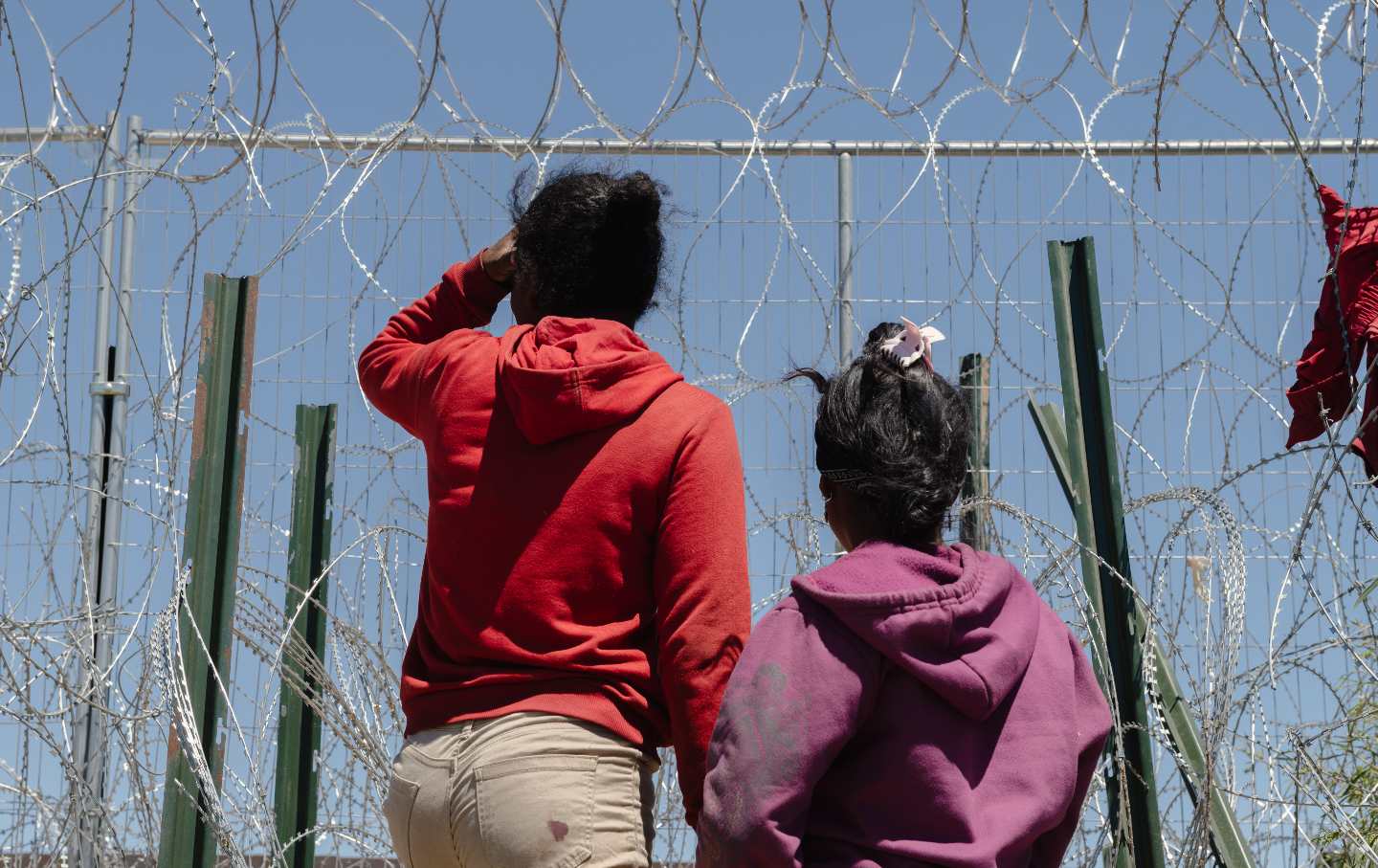
Children look through razor wire after crossing the US-Mexico border.
(Justin Hamel / Getty)
As an undocumented high school sophomore in El Paso, Texas, Sofia has been considering applying exclusively to out-of-state colleges. “I have lived in El Paso since I was a year old. This city has become my home,” she said. “There is no reason I would remain and place myself in so much danger just by existing.”
Sofia was referring to Texas’s Senate Bill 4. Passed in 2022, the law would make unlawful border crossings a state crime and give Texas police officers the power to engage in immigration enforcement, including detaining those suspected of being non-US citizens or having crossed the border without permission. “Police may charge individuals with a new state crime of ‘illegal entry’ to Texas, punishable by up to 6 months in jail,” according to the American Civil Liberties Union.
Initially set to go into effect in March, SB 4 was temporarily delayed in the face of ongoing legal battles around its constitutionality. The ACLU called it “one of the most extreme pieces of anti-immigrant legislation any state legislature has ever enacted,” and filed a lawsuit along with the Texas Civil Rights Project in December to prevent the law from going into effect.
The Department of Justice has since joined the lawsuit, and the US Court of Appeals for the Fifth Circuit Court ruled to keep a block on SB 4 while it unfolds. The process has left Texas’s large immigrant population uncertain and in fear—especially undocumented youth.
Some, like Sofia, are reconsidering remaining in Texas if the bill passes. “This is probably exactly what Texas wants,” said Sofia. “To deter people like me from being here.”
SB 4 follows SB 16, the state’s ban on Diversity, Equity, and Inclusion initiatives, which went into effect on January 1 and prompted many young people to avoid going to Texas colleges. “This is compounded with other recent legislation against the LGBTQ population and women that is going to deter a lot of people from coming to Texas,” said Carlos, a 19-year-old trans man who attended high school in Brownsville, Texas.
Jennifer Babaie, the director of advocacy and legal services at Las Americas Immigrant Advocacy Center, based in El Paso, Texas, said that she has already seen people relocate because of the bill. “Back in March, an advocate [with Las Americas] who was a migrant herself chose to flee to New Mexico.”
“I cannot think of any reason someone would advise an undocumented person to remain in Texas if this bill went into effect,” said Sofia. “When you have an opportunity to leave, like college, that many undocumented people do not get, there is no reason I would not take it.”
Immigrant advocacy groups have criticized the bill for promoting racial profiling. Evelyn, a 20-year-old undocumented student from Honduras, said that the possibility of being pulled over for something minuscule that can turn into something more serious has created “a lot of anxiety, fear, and uncertainty.” Babaie calls the bill “an open license to question whether or not someone fits in. We don’t see or believe it is possible to implement this law without engaging in unlawful racial profiling.”
“The valley is a very Hispanic community,” said Carolina, an 18-year-old from Mattamorros who spent all of high school crossing the border to attend school in Brownsville. Her family consistently crosses the border for work and school and already faces hostile reactions from Customs and Border Protection officials because of their accents and skin color, she says. “If they’re questioning whether you have papers to be here if you look foreign, they would pull people over left and right.”
While going to school in the US, Carlos lived across the border in Matamoros, Mexico. “Even before SB 4, I was always so scared of forgetting my passport because that was the only thing that would keep me safe. Sometimes I worried that might not be enough,” he said. “Today, that’s even more possible.”
Support independent journalism that does not fall in line
Even before February 28, the reasons for Donald Trump’s imploding approval rating were abundantly clear: untrammeled corruption and personal enrichment to the tune of billions of dollars during an affordability crisis, a foreign policy guided only by his own derelict sense of morality, and the deployment of a murderous campaign of occupation, detention, and deportation on American streets.
Now an undeclared, unauthorized, unpopular, and unconstitutional war of aggression against Iran has spread like wildfire through the region and into Europe. A new “forever war”—with an ever-increasing likelihood of American troops on the ground—may very well be upon us.
As we’ve seen over and over, this administration uses lies, misdirection, and attempts to flood the zone to justify its abuses of power at home and abroad. Just as Trump, Marco Rubio, and Pete Hegseth offer erratic and contradictory rationales for the attacks on Iran, the administration is also spreading the lie that the upcoming midterm elections are under threat from noncitizens on voter rolls. When these lies go unchecked, they become the basis for further authoritarian encroachment and war.
In these dark times, independent journalism is uniquely able to uncover the falsehoods that threaten our republic—and civilians around the world—and shine a bright light on the truth.
The Nation’s experienced team of writers, editors, and fact-checkers understands the scale of what we’re up against and the urgency with which we have to act. That’s why we’re publishing critical reporting and analysis of the war on Iran, ICE violence at home, new forms of voter suppression emerging in the courts, and much more.
But this journalism is possible only with your support.
This March, The Nation needs to raise $50,000 to ensure that we have the resources for reporting and analysis that sets the record straight and empowers people of conscience to organize. Will you donate today?