
Sacramento Keeps Throwing Money at Its Housing Crisis. It’s Not Getting Any Better.
The city and the county have been at odds over policy to address the problem. Meanwhile, encampments keep springing up.
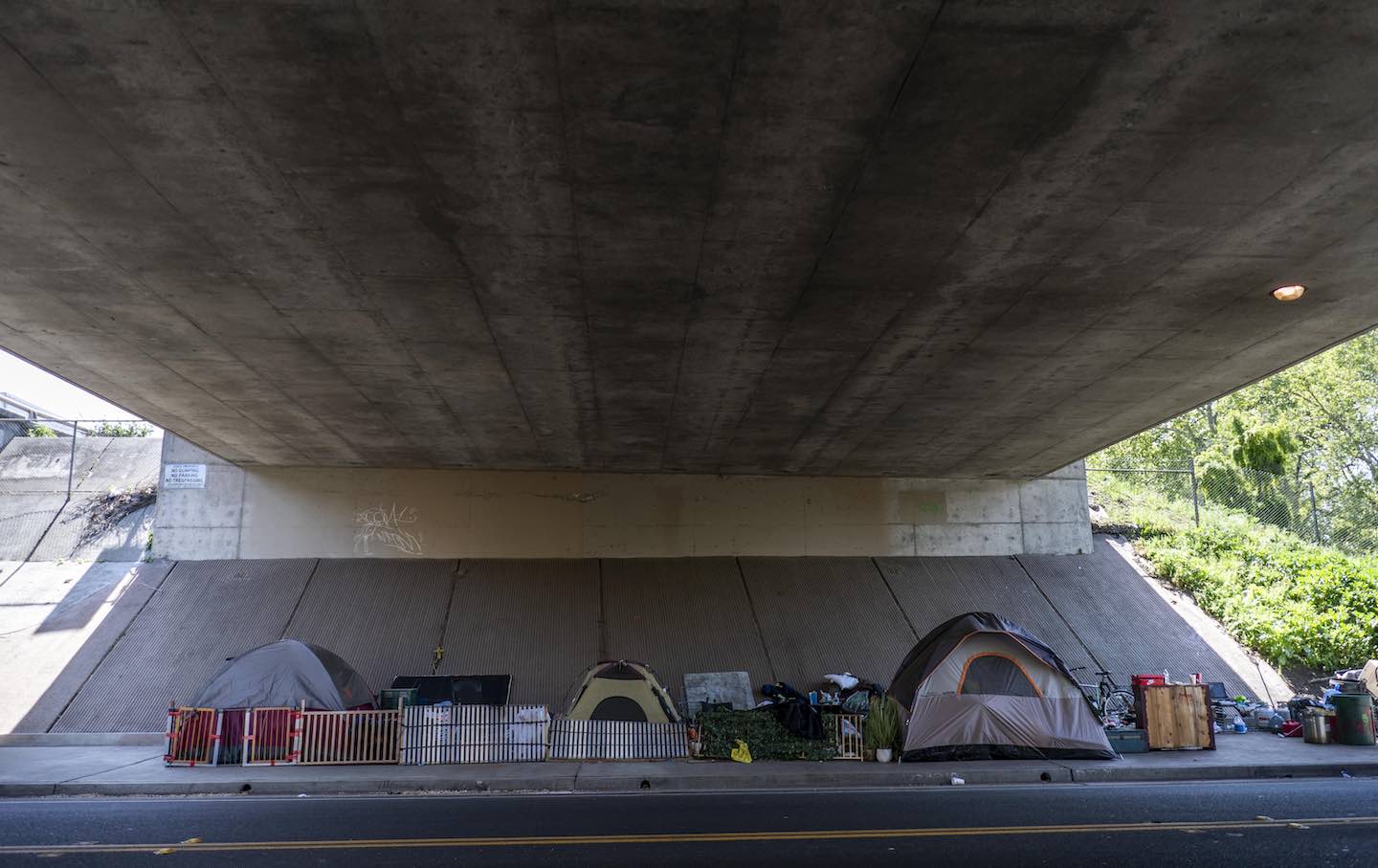
An encampment of tents underneath the I-5 freeway in Sacramento, April 2022.
(Melina Mara / The Washington Post)Sacramento County Earlier this week, pulled out of an agreement with the city of Sacramento to create a $1.3 million Safe Ground parking lot, in which up to 30 vehicles lived in by some of the county’s nearly 10,000 homeless residents could park without fear of being approached by law enforcement and forced to move on. The county pulled out after the city conducted sweeps along the stretch of road containing the vehicles that the county hoped to move into the safe space, scattering the homeless residents to the four winds. No one had bothered to inform the county of this move ahead of time.
It’s the latest example of the dysfunctional city-county relationship around housing issues and comes hard on the heels of the county district attorney’s suing the city for letting encampments spill out into more and more residential neighborhoods, and for failing to provide anywhere near enough alternative housing for the thousands of homeless residents. The county and the city are, not surprisingly, now at what seems to be permanent loggerheads over housing policy. Meanwhile, there’s a growing frustration among the general public about the shantytowns that have taken over large parts of the central city. The city is caught in what seems like an endless game of whack-a-mole—sweeping homeless dwellers out of one neighborhood, placing huge boulders in swept areas to stop them from repatching their tents, and then being summoned by irate residents the next neighborhood over to deal with the newly arrived nomads. Absent from the mix seems to be serious public policy innovation and any sense of the necessity of speed in addressing the crisis.
Sacramento’s numbers are overwhelming. The 2022 point-in-time count found that on any given night there were 9,300 homeless in the county, up from 5,570 just three years earlier. Meanwhile, there were only 2,614 shelter beds.
Since 2022, the homeless numbers have, almost certainly, gotten worse, though until the next point-in-time count that assumption will likely remain speculative. While both the city and the county are finally making something of an effort to increase the number of shelter beds and the number of Safe Grounds for those living in tents and cars, as well as to encourage developers to build more affordable housing units, the problem remains daunting.
Four out of five people living on the streets reported to the point-in-time count investigators that they have been chronically homeless for more than a year. And nearly six out of 10 of the homeless are disabled or have other chronic health conditions. One-third of the region’s homeless population is African American, despite the fact that less than 11 percent of the county’s total population is African American. A growing proportion of the homeless are over the age of 55. At every level, society’s inequalities are magnified by Sacramento’s shameful numbers around homelessness.
All told, Sacramento’s rate of homeless per 100,000 residents is now almost double that of San Francisco—which has long served as the poster child for those concerned with the metastasizing homelessness crisis.
Up to 80 percent of the region’s homeless are thought to be seriously mentally ill or addicted to drugs. These days, untreated mental illness is frequently on full display in the city’s streets and public places. On Tuesday, for example, my son and I were having a coffee at a local café when an apparently psychotic man sitting on a bench just outside began masturbating in full view of the entire café clientele. I wish I could say such a spectacle was an absolute rarity, but, truth be told, these days, it’s not. Despite California’s progressive chops, there has been a catastrophic collapse in the social compact around housing and mental health care services in many Western cities; despite the billions of dollars now pouring into efforts to tackle homelessness, the problems are seemingly getting worse, not better.
Sacramento is now in the middle of a mayoral race. All four of the leading candidates—a public health advocate, an ex-council member, an ex-assemblyman, and an ex-state senator—are generally progressive, though one, Dr. Flo Cofer, a public health expert with DSA leanings, is running to the left of the other three. For Cofer, the cascading housing crisis represents policy failure compiled onto policy failure. She is scathing about the city council’s refusal to endorse a rent control initiative in 2020, about the lack of will to install public bathrooms, which the homeless could access, around the city, and about the revolving door between the county jail system and the shantytowns dotting Sacramento’s streets. “What we’ve had is the cost of housing outpace people’s ability to pay for it,” she told me when we talked in January. “For every one person we rehouse, three more become unhoused.”
To tackle the immediate crisis, Cofer is advocating a short-term expansion of the number of Safe Ground campsites around the city, while, in the long term, she wants large-scale investments in supportive services and affordable housing. She urges an end to sweeps of encampments, and a diminution of the role of law enforcement vis-à-vis the homeless.
It’s unlikely that Cofer will win the mayor’s race; the public is increasingly impatient with visible homelessness, and the doctor’s embrace of a massively expanded network of city-sponsored campsites, with each council district hosting at least one facility, is unlikely to find favor with a majority of voters. Indeed, in a debate sponsored by the Sacramento Bee earlier this week, Cofer was the only candidate to offer unqualified support for the Safe Ground concept.
I have to admit, I’m ambivalent, at best, about devoting significant resources to setting up large Safe Grounds in the city, even if they come with water and electricity hookups, bathrooms, and the sorts of vital on-site supportive services and counseling that Cofer advocates. Where they’ve been tried in Sacramento in the recent past, the sites have rapidly acquired a reputation for chaos and danger: Support services haven’t kept up with need; the surrounding area has become a magnet for other unhoused individuals; and social disorder has followed in their wake. Urban campgrounds dotted around the city, sanctioned or otherwise, are a sorry substitute for wraparound services, for desperately needed inpatient mental health systems, for supportive housing for those who could make a go of it if they had a roof over their heads and people to help them navigate life’s complexities, for new public housing, for expanded affordable housing.
The longer I live in Sacramento, the more jaundiced I get about the efforts of California’s cities, some genuine, others half-hearted, to tackle the overlapping housing, substance abuse, and mental health crises that are devouring many of the state’s urban centers. For myriad reasons, when it comes to housing and mental health care, California, with nearly one-third of all the unhoused people in the country, is continuing to fail where other states and cities have started to find pathways to success. (Reno, two hours’ drive east of Sacramento, has had tremendous success recently in halving its on-the-streets homeless population—more on that in another column. Minneapolis has also had marked success in tackling homelessness.) I’ve lived in a lot of places over the years, but this is the first city I’ve been in where a man pulls down his pants and starts masturbating in front of a café in broad daylight, and most patrons just shrug and keep sipping their espressos, as if the sordid spectacle is simply an expected part of daily life. There’s something entirely broken in that panorama, something no number of Safe Grounds or tolerated tent cities will fix.
Support independent journalism that does not fall in line
Even before February 28, the reasons for Donald Trump’s imploding approval rating were abundantly clear: untrammeled corruption and personal enrichment to the tune of billions of dollars during an affordability crisis, a foreign policy guided only by his own derelict sense of morality, and the deployment of a murderous campaign of occupation, detention, and deportation on American streets.
Now an undeclared, unauthorized, unpopular, and unconstitutional war of aggression against Iran has spread like wildfire through the region and into Europe. A new “forever war”—with an ever-increasing likelihood of American troops on the ground—may very well be upon us.
As we’ve seen over and over, this administration uses lies, misdirection, and attempts to flood the zone to justify its abuses of power at home and abroad. Just as Trump, Marco Rubio, and Pete Hegseth offer erratic and contradictory rationales for the attacks on Iran, the administration is also spreading the lie that the upcoming midterm elections are under threat from noncitizens on voter rolls. When these lies go unchecked, they become the basis for further authoritarian encroachment and war.
In these dark times, independent journalism is uniquely able to uncover the falsehoods that threaten our republic—and civilians around the world—and shine a bright light on the truth.
The Nation’s experienced team of writers, editors, and fact-checkers understands the scale of what we’re up against and the urgency with which we have to act. That’s why we’re publishing critical reporting and analysis of the war on Iran, ICE violence at home, new forms of voter suppression emerging in the courts, and much more.
But this journalism is possible only with your support.
This March, The Nation needs to raise $50,000 to ensure that we have the resources for reporting and analysis that sets the record straight and empowers people of conscience to organize. Will you donate today?
More from The Nation
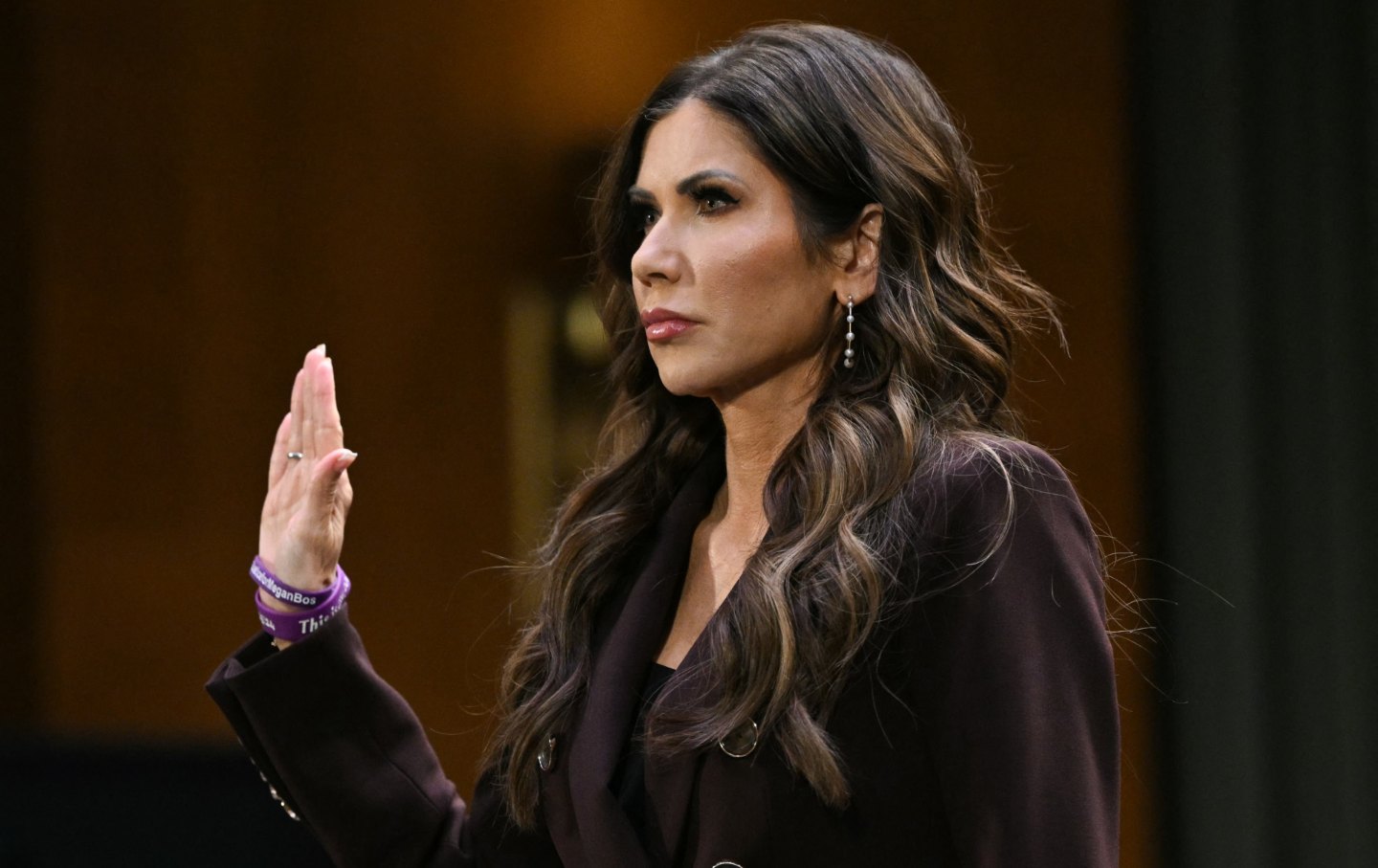
Celebrate Kristi Noem’s Firing. But Keep Protesting ICE. Celebrate Kristi Noem’s Firing. But Keep Protesting ICE.
Finally, someone in the administration is paying for their cruelty and incompetence.

We Don’t Need an Autopsy to Tell Us the Democrats Failed on Gaza We Don’t Need an Autopsy to Tell Us the Democrats Failed on Gaza
The DNC is allegedly hiding a report showing that Kamala Harris’s Gaza policy helped cost her the 2024 election. But that report won’t tell us anything we don’t already know.

Texas’s Senate Primary Has Already Made History—and It’s Not Over Yet Texas’s Senate Primary Has Already Made History—and It’s Not Over Yet
Democratic nominee James Talarico is getting national media attention, but the real story is sky-high voter turnout, even amid GOP bids to suppress balloting
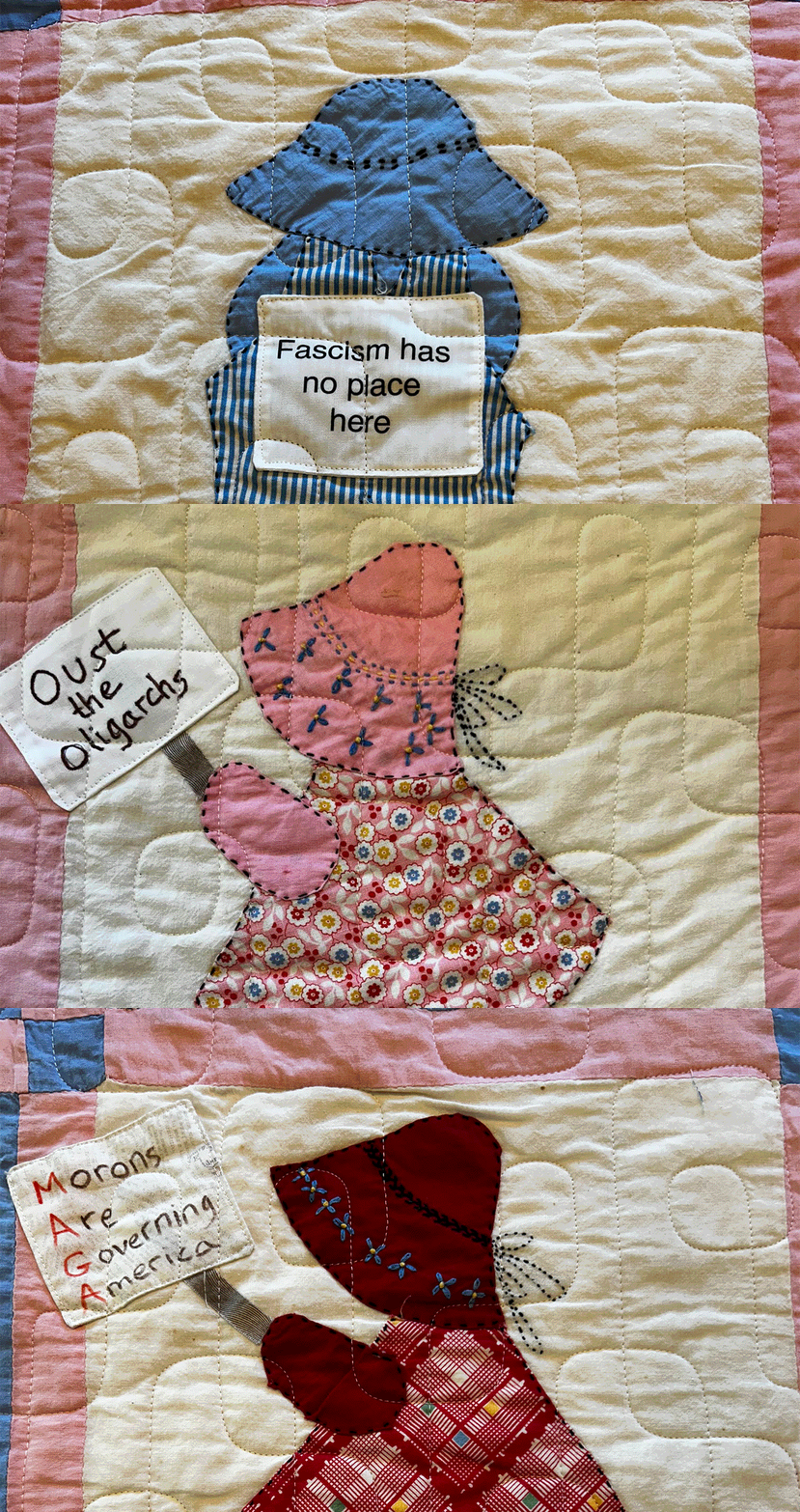
Quilted Messages Quilted Messages
Sunbonnets carrying not-so-sunny truths.

How the Theatrics of Mamdani’s Trump Meeting Backfired How the Theatrics of Mamdani’s Trump Meeting Backfired
By pandering to the president’s vanity, the New York mayor reinforced Trump’s image as a strongman commanding deference—an especially bad look on the eve of Trump’s war with Iran

Students in New York Are Going Hungry. How Can Mamdani Help? Students in New York Are Going Hungry. How Can Mamdani Help?
With plans for city-owned grocery stores and a focus on affordability, the new mayoral administration offers fresh hopes of successfully confronting the food crisis among students...

