A GOP Scheme to Steal a North Carolina Supreme Court Seat Has Been Foiled
A Trump-appointed federal judge rejected a bizarre GOP attempt to disenfranchise voters after they cast their ballots.
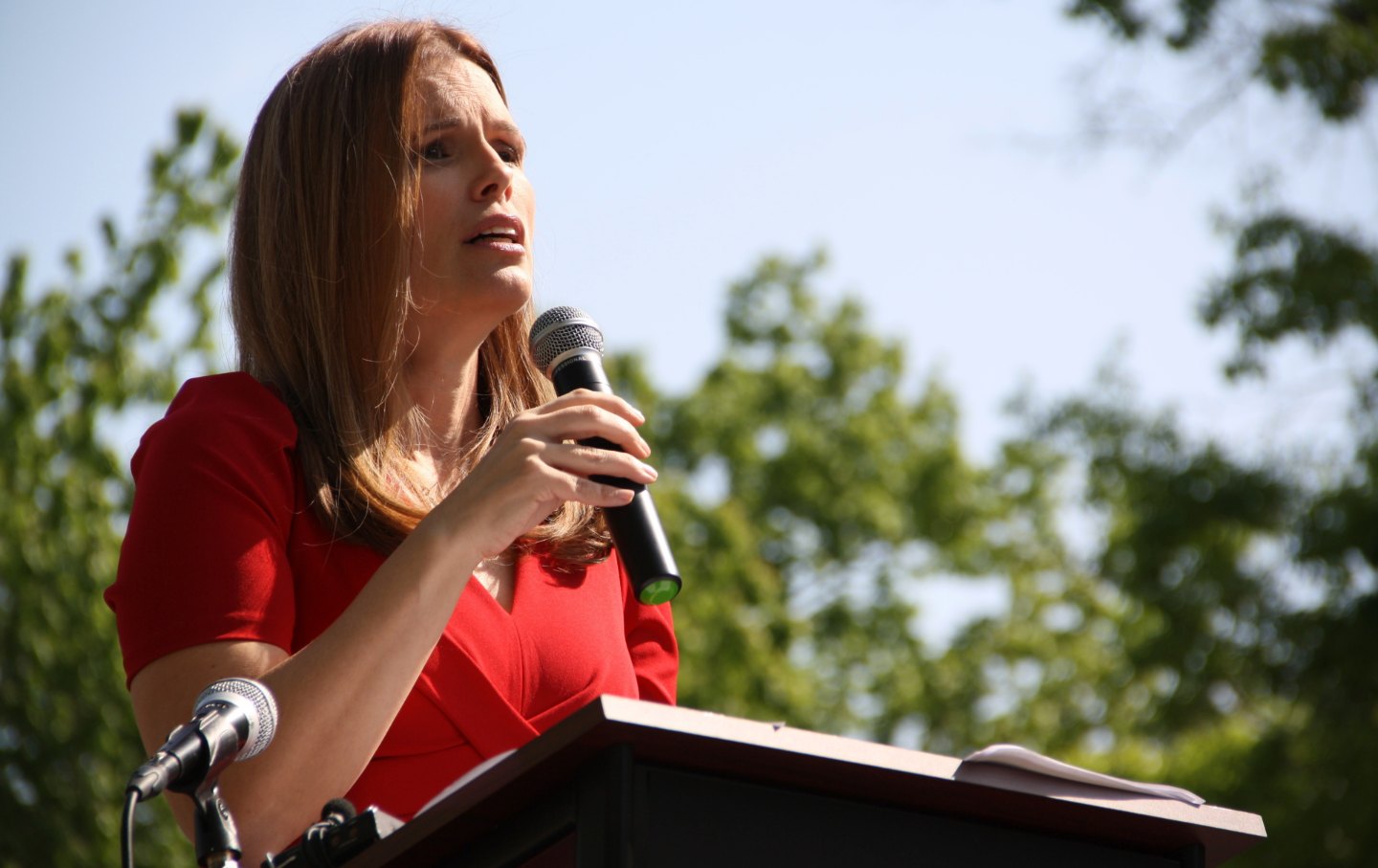
Democratic Associate Justice Allison Riggs speaks to protesters at a rally in Raleigh, North Carolina, on Monday, April 14, 2025.
(Makiya Seminera / AP)Republicans lost a high-stakes contest for a seat on the North Carolina Supreme Court in November. But the race was close, and so, in the great election-denying tradition of Donald Trump, Jefferson Griffin, the defeated Republican court candidate, refused to concede defeat. Instead, Griffin launched what legal scholar Nicholas Stephanopoulos referred to as “an unprecedented effort to change the results of a statewide election.” That effort initially included an attempt to challenge as many as 65,000 legitimately cast ballots, in a blatant embrace of postelection disenfranchisement as an electoral strategy. The GOP’s North Carolina gambit raised widespread concern nationally, as it suggested that Republicans, under the influence of Trump and presidential aides who have shown increasing disregard for democratic norms, were prepared to engage in ever-more-blatant attempts to reject the will of the people.
But, on Monday, a Trump-appointed federal jurist, Chief US District Judge Richard Ernest Myers II, crushed the North Carolina initiative with a ruling that absolutely rejected GOP schemes to “change the rules of the game after it had been played.”
The effort to overturn the election of Supreme Court Allison Riggs, a Democratic appointee who narrowly won a full eight-year term on the North Carolina court in November, got further than it ever should have because the Republican majority on that high court embraced an effort by Griffin to challenge overseas ballots that had been cast by voters from historically Democratic counties.
Griffin and his judicial allies were hoping to toss out enough ballots to upend Justice Riggs’s 734-vote victory. The scheme drew rebukes from experts on election law in North Carolina and across the country, who recognized that Justice Riggs was right when she said, “Efforts to disenfranchise military and overseas voters in North Carolina are toxic for our democracy. They would set a precedent that losing candidates in any election, anywhere in the US, can change the laws of an election to benefit them even after they’ve lost.”
That broader view of the threat that a precedent from North Carolina might play in disrupting high-stakes court contests and other races across the country made the fight a major focus of voting rights advocates. In a review of the case published in February, Alicia Bannon, the director of the Judiciary Program at the Brennan Center for Justice, explained, “Griffin is seeking to undo what’s been a North Star in election law: You can’t change the rules of an election after the fact. Several justices on the North Carolina Supreme Court, however, have signaled openness to his claims. It’s a test for the judiciary that puts in stark relief the role that courts play in supporting—or eroding—democratic norms. A ruling in Griffin’s favor could also open the door to similar gamesmanship in other states.”
Judge Myers recognized what was at stake when he explained in his ruling Monday that the North Carolina “case concerns whether the federal Constitution permits a state to alter the rules of an election after the fact and apply those changes retroactively to only a select group of voters, and in so doing treat those voters differently than other similarly situated individuals.”
The Trump-appointed judge’s determination that the Constitution does not permit such abuses settled things by ordering North Carolina’s election board to respect the ballots that were cast in November and to certify Justice Riggs as the winner. Judge Myers added a stern rebuke for election deniers who seek to retroactively invalidate votes after they have been legally cast. “You establish the rules before the game,” he wrote of election standards. “You don’t change them after the game is done.”
The election of Justice Riggs—a veteran civil rights lawyer who worked with the Voting Rights Program at the Southern Coalition for Social Justice before she was appointed to the high court in 2023 by former Democratic Governor Roy Cooper—to a full term does not change the makeup of the North Carolina court, where Republicans retain a 5–2 majority. It does, however, increase the prospect that future elections in a state where Democrats are surging could tip the court’s balance.
Even more importantly, the North Carolina result protects core democratic values at a time when they have never been more under siege.
Democratic National Committee chair Ken Martin hailed the North Carolina result as a “righteous victory for democracy and a clear defeat of political gamesmanship,” explaining, “For 200 days, Republicans in North Carolina sought to overturn the will of the people, hijack a state Supreme Court seat, and systematically undermine basic faith in our elections. Jefferson Griffin’s relentless assault on reality has come to an end and Justice Allison Riggs will finally take her rightful place on the North Carolina Supreme Court.”
For her part, Justice Riggs said Wednesday, “It’s been my honor to lead this fight—even though it should never have happened—and I’m in awe of the North Carolinians whose courage reminds us all that we can use our voices to hold accountable any politician who seeks to take power out of the hands of the people.”
Support independent journalism that does not fall in line
Even before February 28, the reasons for Donald Trump’s imploding approval rating were abundantly clear: untrammeled corruption and personal enrichment to the tune of billions of dollars during an affordability crisis, a foreign policy guided only by his own derelict sense of morality, and the deployment of a murderous campaign of occupation, detention, and deportation on American streets.
Now an undeclared, unauthorized, unpopular, and unconstitutional war of aggression against Iran has spread like wildfire through the region and into Europe. A new “forever war”—with an ever-increasing likelihood of American troops on the ground—may very well be upon us.
As we’ve seen over and over, this administration uses lies, misdirection, and attempts to flood the zone to justify its abuses of power at home and abroad. Just as Trump, Marco Rubio, and Pete Hegseth offer erratic and contradictory rationales for the attacks on Iran, the administration is also spreading the lie that the upcoming midterm elections are under threat from noncitizens on voter rolls. When these lies go unchecked, they become the basis for further authoritarian encroachment and war.
In these dark times, independent journalism is uniquely able to uncover the falsehoods that threaten our republic—and civilians around the world—and shine a bright light on the truth.
The Nation’s experienced team of writers, editors, and fact-checkers understands the scale of what we’re up against and the urgency with which we have to act. That’s why we’re publishing critical reporting and analysis of the war on Iran, ICE violence at home, new forms of voter suppression emerging in the courts, and much more.
But this journalism is possible only with your support.
This March, The Nation needs to raise $50,000 to ensure that we have the resources for reporting and analysis that sets the record straight and empowers people of conscience to organize. Will you donate today?