
Michigan Just Became the First State in 6 Decades to Scrap an Infamous Anti-Union Law
Democrats, empowered by voters in 2022, overturned a “right to work” law as part of a sweeping pro-labor agenda that’s a model for other states.
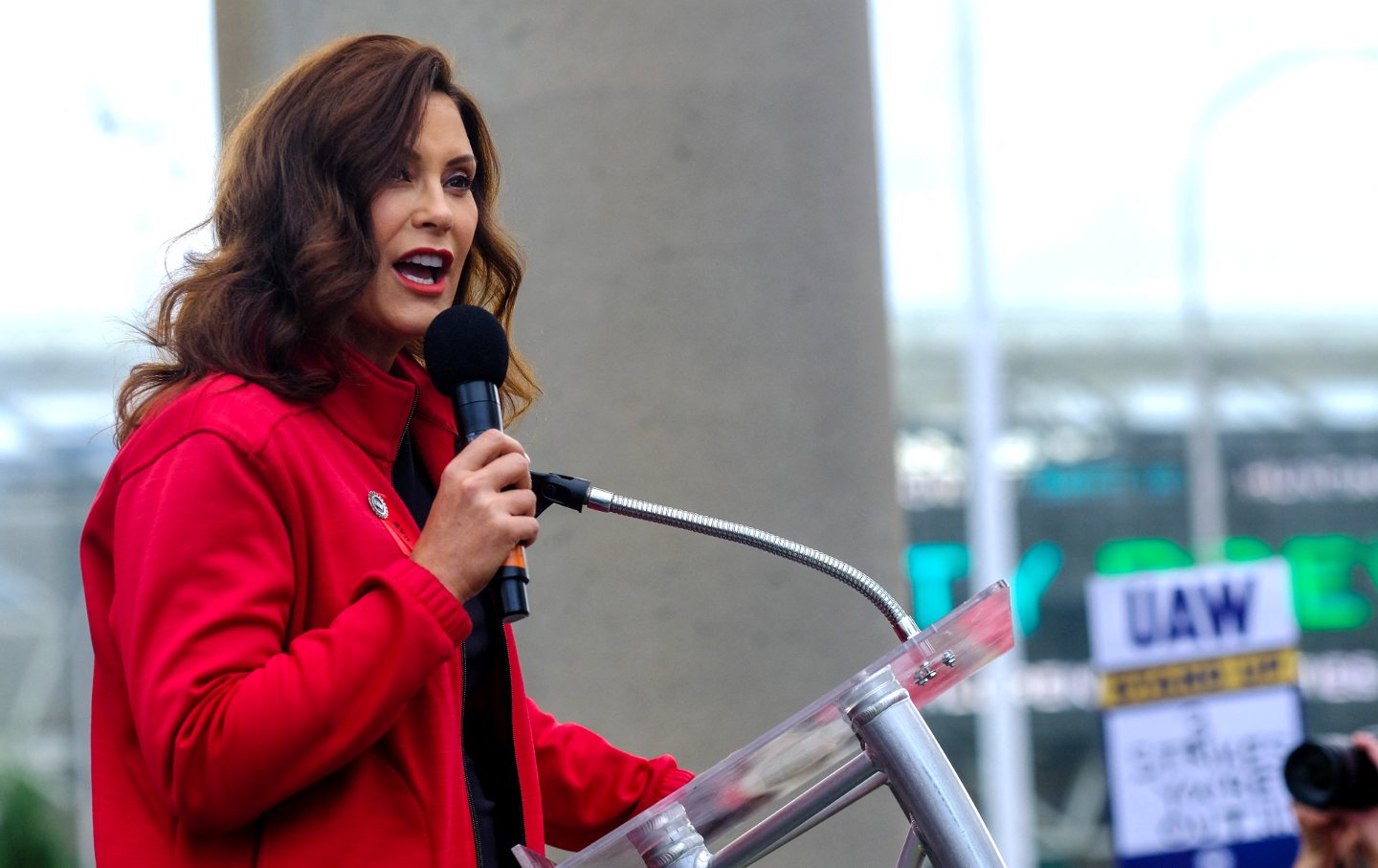
Michigan Governor Gretchen Whitmer speaks to members of the United Auto Workers (UAW) union during a rally in Detroit, Mich., on September 15, 2023.
(Matthew Hatcher / AFP via Getty Images)Detroit—For the first time in almost 60 years, a state has formally overturned a so-called “right to work” law, clearing the way for workers to organize new union locals, collectively bargain, and make their voices heard at election time.
This week, Michigan finalized the process of eliminating a decade-old “right to work” law, which began with the shift in control of the state legislature from anti-union Republicans to pro-union Democrats following the 2022 election. “This moment has been decades in the making,” declared Michigan AFL-CIO President Ron Bieber. “By standing up and taking their power back, at the ballot box and in the workplace, workers have made it clear Michigan is and always will be the beating heart of the modern American labor movement.”
In addition to formally scrapping the anti-labor law on Tuesday, Michigan also restored prevailing-wage protections for construction workers, expanded collective bargaining rights for public school employees, and restored organizing rights for graduate student research assistants at the state’s public colleges and universities. But even amid all of these wins for labor, it was the overturning of the “right to work” law that caught the attention of unions nationwide.
Starting in the formerly segregated states of the South—where such laws were rapidly enacted around the end of World War II to thwart the Congress of Industrial Organizations’ “Operation Dixie” campaign to organize multiracial unions across the region—this most destructive form of anti-labor legislation was later adopted in Western states, where mining unions had historically been strong, and finally spread in the 2010s to the industrialized heartlands of the Great Lakes Region.
Now, the tide has begun to turn—beginning in a state with a rich labor history. And that’s got the attention of union activists and working-class people nationwide.
“As of today, Michigan is no longer a ‘right to work’ state,” announced the Teamsters union, in social media postings that featured a party hat and confetti. The Service Employees International Union celebrated the news as a “BIG WIN!,” tweeting, “After a decade of organizing and voting for change, Michigan workers just officially won the repeal of the state’s so-called ‘Right to Work’ law. This is the power we have when we unite at work, in the streets, and at the ballot box!”
At a time when the labor movement is showing renewed vigor—and notching a string of high-profile victories, including last year’s successful strike by the United Auto Workers union against the Big Three carmakers, the historic UPS contract victory by the Teamsters, the SAG-AFTRA strike win in a struggle over abuses of AI technology in particular and the future of work in general, and the explosion of grassroots union organizing at workplaces across the country—the overturning of Michigan’s “right to work” law and the implementation of a sweeping pro-union agenda provides tangible evidence of how much has changed in recent years for workers and their unions.
If there was a low point for the American labor movement in recent decades, there’s a good case to be made that it came in 2012, when Michigan adopted the “right to work” law that had been promoted by wealthy and corporate-friendly Republican Governor Rick Snyder and approved by a Republican-controlled state legislature. The anti-labor legislation, historically associated with Southern states, was now on the books in the state where Depression-era sit-down strikers helped give birth to the powerful UAW and where unions had from the 1930s onward done a better job of organizing than almost anywhere else in the country.
The implementation of Michigan’s “right to work” law came shortly after Indiana, also a historically strong union state, enacted a similar measure, and shortly before another Great Lakes manufacturing state, Wisconsin, did the same. The movement to undermine the ability of workers to organize and collectively bargain was on the march in this period, after Wisconsin Governor Scott Walker, with support from right-wing donors such as the Koch brothers, attacked public-sector unions in a high-profile 2011 struggle. Republican politicians like Mitt Romney, the party’s 2012 presidential nominee, were promising to “fight for right-to-work laws” nationwide. In the US Senate, Kentucky Republican Rand Paul would eventually attract 30 cosponsors for his “National Right-to-Work Act.”
By the mid-2010s, 27 states had “right to work” laws on the books.
But then, as a new generation of workers embraced “Fight for 15” organizing to raise wages, and campaigns to sign up workers at Starbucks and Amazon began to take off, the corporate-sponsored crusade to enact “right to work” measures stalled. New Hampshire’s legislature blocked a proposed “right to work” law in 2017 (and again in 2021), despite the fact that the measure was promoted by Republican Governor Chris Sununu. And in 2018, Missouri voters rejected a “right to work” referendum by a 67-33 margin.
Preventing anti-union legislation from being enacted and implemented is one thing, however. Actually overturning an existing law is something else altogether.
But that’s what happened in Michigan after 2022 voting saw the reelection of Governor Gretchen Whitmer, a labor ally, and—thanks to the overturning of gerrymandered legislative district maps that had favored the GOP—the election of Democratic majorities in the state House and state Senate. For the first time in four decades, the Democrats controlled all the major levers of power in Michigan, and they used them to implement a sweeping pro-labor agenda. That was a significant shift for Michigan, to be sure. But it was also an indication of what could be done in other states across the Great Lakes region, and nationwide.
Popular
“swipe left below to view more authors”Swipe →“Michigan Democrats took full control of the state government for the first time in 40 years. They used that power to repeal the state’s ‘right to work’ law,” explained a delighted former US secretary of labor Robert Reich, who added, “This is why we have to show up for our state and local elections.”
More from The Nation
Will the GOP’s Big Money Save Jon Husted in Ohio? Will the GOP’s Big Money Save Jon Husted in Ohio?
Former senator Sherrod Brown is leading in most polls, but a tidal wave of spending may prop up the struggling incumbent.

James Talarico Is Preaching a Gospel of Pluralism James Talarico Is Preaching a Gospel of Pluralism
He’s not the only progressive doing it.

Even Republicans Are Waking Up to Trump’s Corruption Even Republicans Are Waking Up to Trump’s Corruption
And, somewhat shockingly, so are Democratic elites.


Mamdani Can No Longer Avoid the Issue of the NYPD Mamdani Can No Longer Avoid the Issue of the NYPD
The mayor has been able to put difficult questions about policing on the back burner—until now.

Why Democratic Leaders Keep Waging War on the Young Why Democratic Leaders Keep Waging War on the Young
The party's silver-haired establishment is caught up in an existential culture war.

