JD Vance Is the Future of MAGA
Even before votes were cast, the mantle of election denial passed from Donald Trump to to his running mate.
I filed this in mid-October, but the outcome of the 2024 election will presumably be known by the time you read these words. What’s already clear, though, is how rapidly Donald Trump’s Republican Party is accelerating toward a decisive point at which elections simply don’t matter anymore—the dream that the authoritarian American right cleaves to as it fantasizes about turning America into a more lavishly armed and funded version of Viktor Orbán’s Hungary.
That project, like much of the rest of the MAGA agenda, has fallen to the Trump movement’s designated heir apparent, JD Vance. The Ohio senator Trump tapped as his running mate has performed many stunning reversals and acts of intellectual self-cancellation in his new role as MAGA ideology czar, but the most distressing of these has been his emergence as an election denier.
Mind you, Vance’s brand of election denialism isn’t the vulgar, smash-the-system variety promoted by the Kari Lakes and Tina Peterses of the world. No, like his other works of demagogic pandering—the pet-eating blood libels in Springfield, Ohio, or the proposals for intrastate menstrual surveillance—Vance’s assault on the conduct of our elections takes the form of the “just asking questions” ploy of the debate-schooled podcaster.
Tellingly, Vance has rarely raised the subject himself, but he was frequently queried about it in press interviews after he failed to offer a clear answer to a question in the vice presidential debate about the outcome of the presidential balloting in 2020. And in such settings, he typically engages in another podcaster’s dodge—a feeble show of whataboutism. During Vance’s now-infamous appearance on the New York Times podcast The Interview, host Lulu Garcia-Navarro asked him five times whether he believed that Trump lost the 2020 election. After the second inquiry, he parried with the suggestion that Big Tech companies had connived to suppress the leaked materials from Hunter Biden’s laptop, a favorite MAGA lament that, even if it were proved true, is several universes removed in significance from an election lie that fomented an attempted coup. Along with his various dodges, Vance reverted to the robotic talking point he had intoned from the debate stage: that the obsession with the 2020 vote is a relic of the past, and that he’s focused on “the future.” At MAGA gatherings, however, Vance has proved more forthright: When a voter at a Pennsylvania rally asked him whether he believed Trump lost in 2020, he replied: “I think there are serious problems with 2020. So did Trump lose the election? Not by the words I would use.”
Yet the whole point of democratic elections is that they’re not settled by the words you would use: The process is there to deliver an unambiguous outcome, and anyone who derogates it on the basis of a result they dislike, as Trump and Vance have, is not abiding by the most basic demands of democratic governance. That’s why it would have been a great service for the interviewers who have pressed Vance on the 2020 results to pose the crucial follow-up question: Would an across-the-board indictment of the balloting also mean that Republican senators and House representatives, together with governors and state lawmakers, also have won office illegitimately? Or does alleged fraud and malfeasance apply only when you lose?
This failure to follow the full logic of election denialism is what allows Vance’s feckless whataboutism to thrive. In the same fashion, none of Vance’s press interlocutors asked him the equally obvious follow-up question to his vacuous claim that he’s only thinking about the future: Doesn’t the claim that 2020 was rigged set the stage for the same corrosive vigilantism to reject the outcomes of future elections? Put another way, the whole sordid antidemocratic campaign of lies that led to the January 6 insurrection is the future for any Republican Party in which JD Vance plays a leadership role.
The great irony here is that Vance himself had dismissed the brunt of the J6 conspiracy theory in real time, in yet another podcast interview, uncovered by CNN. “I think that when Biden is inaugurated, people will, you know, more or less accept it and it’ll be on to the next fight,” Vance said.
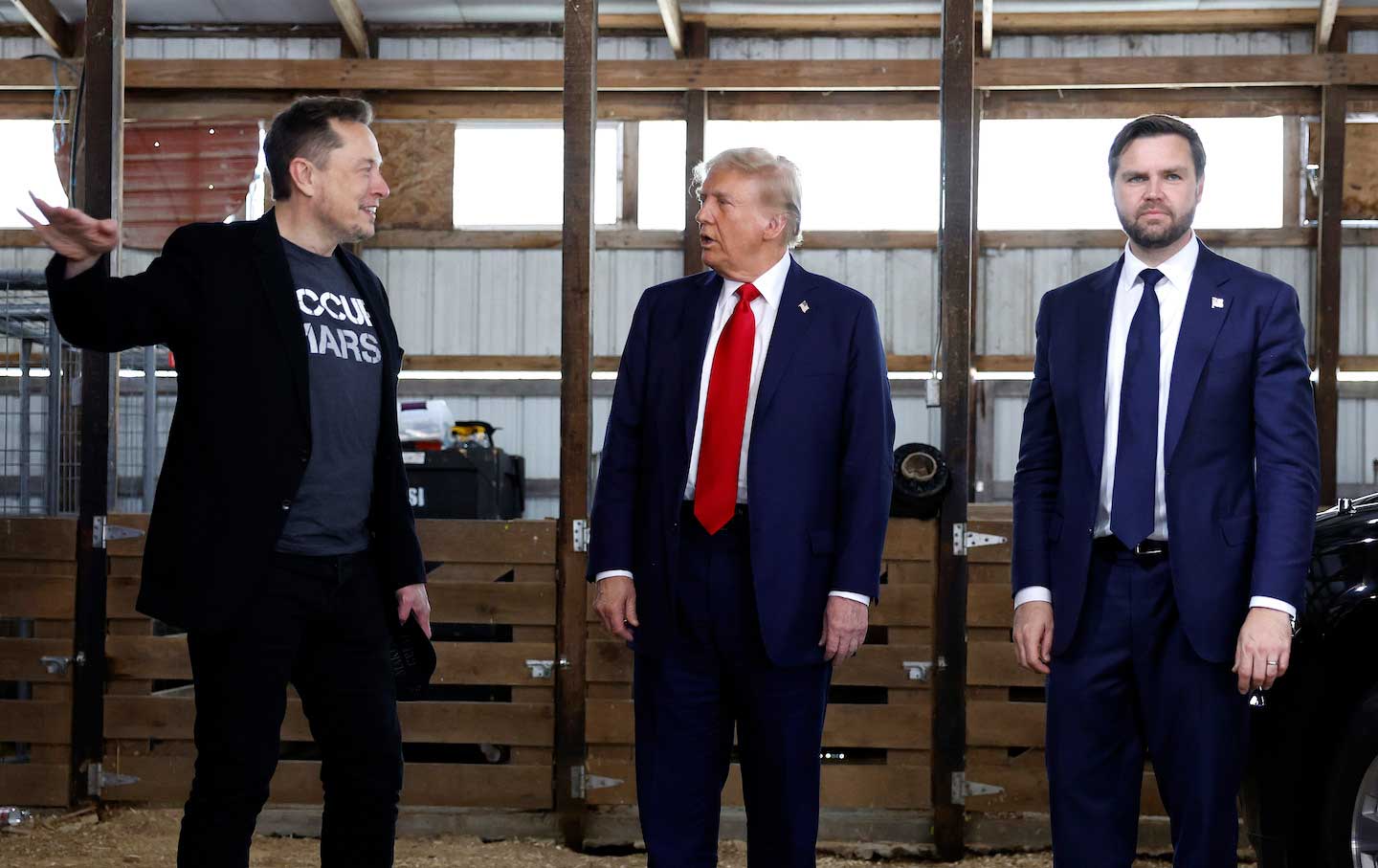
Presumably this past heresy is why Vance continually claims to be focused on the future. Like his extensive record as a die-hard Never Trumper during the 2016 election cycle, it’s a bad look for a MAGA political chieftain. Funny thing about that, though: Vance’s opposition to the man who would become his boss furnished the main line of analysis in the 271-page dossier that Trump campaign officials compiled on Vance when they vetted him for the VP slot. And when the investigative reporter (and former Nation correspondent) Ken Klippenstein leaked that document, the Trump-Vance campaign conspired with Big Tech mogul Elon Musk to suppress it. That is to say, when Vance is confronted with his history of election denialism, his go-to counterclaim (“Big Tech censored us!”) turns out to be something his own campaign engaged in, to his own personal benefit. Viktor Orbán couldn’t have drawn the whole thing up any better.
Support independent journalism that does not fall in line
Even before February 28, the reasons for Donald Trump’s imploding approval rating were abundantly clear: untrammeled corruption and personal enrichment to the tune of billions of dollars during an affordability crisis, a foreign policy guided only by his own derelict sense of morality, and the deployment of a murderous campaign of occupation, detention, and deportation on American streets.
Now an undeclared, unauthorized, unpopular, and unconstitutional war of aggression against Iran has spread like wildfire through the region and into Europe. A new “forever war”—with an ever-increasing likelihood of American troops on the ground—may very well be upon us.
As we’ve seen over and over, this administration uses lies, misdirection, and attempts to flood the zone to justify its abuses of power at home and abroad. Just as Trump, Marco Rubio, and Pete Hegseth offer erratic and contradictory rationales for the attacks on Iran, the administration is also spreading the lie that the upcoming midterm elections are under threat from noncitizens on voter rolls. When these lies go unchecked, they become the basis for further authoritarian encroachment and war.
In these dark times, independent journalism is uniquely able to uncover the falsehoods that threaten our republic—and civilians around the world—and shine a bright light on the truth.
The Nation’s experienced team of writers, editors, and fact-checkers understands the scale of what we’re up against and the urgency with which we have to act. That’s why we’re publishing critical reporting and analysis of the war on Iran, ICE violence at home, new forms of voter suppression emerging in the courts, and much more.
But this journalism is possible only with your support.
This March, The Nation needs to raise $50,000 to ensure that we have the resources for reporting and analysis that sets the record straight and empowers people of conscience to organize. Will you donate today?