
The MAGA Aesthetic Is Beginning to Rot
The stable of imagery associated with the far-right insurgency no longer seems as fresh as it did when Trump first donned his red cap.
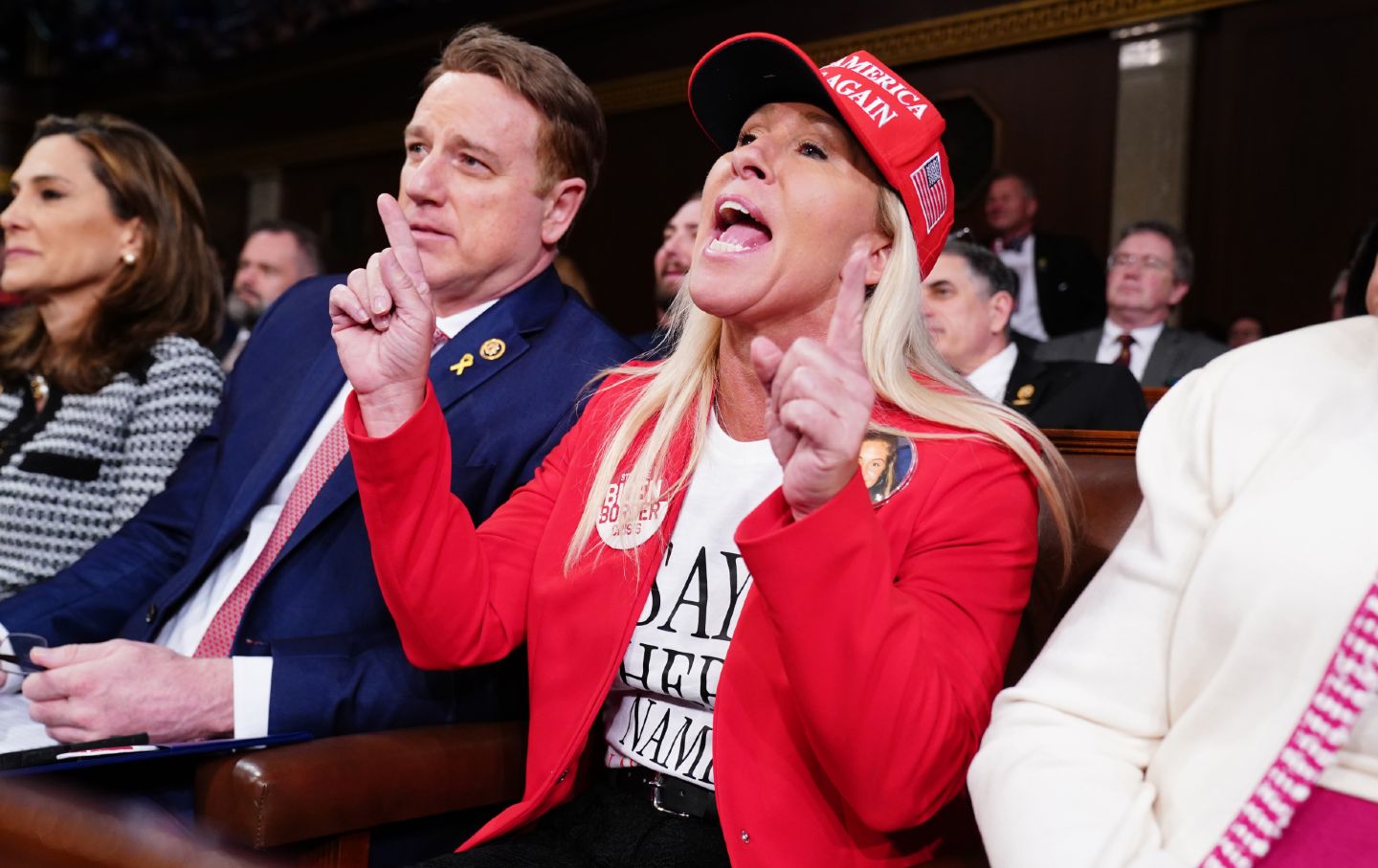
Representative Marjorie Taylor Green, a Republican from Georgia, in the House Chamber during a State of the Union address at the US Capitol in Washington, D.C., on March 7, 2024.
(Shawn Thew / EPA / Bloomberg via Getty Images)For headline writers and Beltway pundits, the takeaway from last week’s State of the Union address was clear: Despite ongoing speculation about President Joe Biden’s cognitive decline, he delivered a pugnacious, energetic, and policy-driven speech, which served as the unofficial debut of his 2024 reelection pitch. But beyond the forensic attention devoted to Biden’s delivery from the podium, there was another pronounced theme amid the SOTU pageantry: the corresponding enfeeblement of the MAGA aesthetic, which played such a central role in Donald Trump’s surprise election to the presidency in 2016.
The MAGA brand crisis was telegraphed most dramatically in the immediate run-up to the speech, as Biden did the traditional presidential slow-walk toward the podium, greeting assembled lawmakers along the way. Georgia GOP Representative Marjorie Taylor Greene approached Biden wearing a red MAGA hat and handed the president a badge commemorating Laken Riley, the Georgia nurse allegedly murdered by a suspect who entered the country illegally. Greene also sported a “Say Her Name” T-shirt, again in reference to Riley. When Biden espied Greene’s ensemble, he delivered an astonished double take as eloquent as any line in his speech.
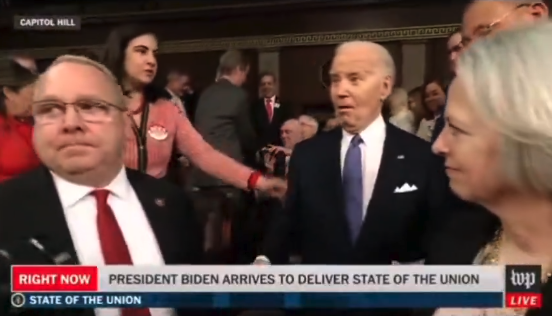
Biden’s shock no doubt stemmed in part from the knowledge that such overt electioneering is illegal in the Capitol. More than that, though, it registered a broader truth: The stable of imagery associated with the right-wing Trump insurgency is showing signs of wear and tear. Where Trump-branded messaging and merchandise once had the power to upend establishment mores and expectations, they now feel like the political equivalent of a rock ensemble’s county fair tour: a purely formalist effort to satisfy the nostalgic longings of a diminishing fan base.
What was most telling about Greene’s stunt wardrobe was the date on the hat: Instead of being minted for the looming 2024 general election, it came from Trump’s 2020 reelection campaign, which—despite the lies of Trump, Greene, and other MAGA leaders— he lost decisively. And make no mistake: Greene, a perfect specimen of do-nothing right-wing congressional service, lives for these camera-ready moments of political theater. She certainly didn’t descend to the same level of sartorial carelessness back when she dressed as a Chinese spy balloon.
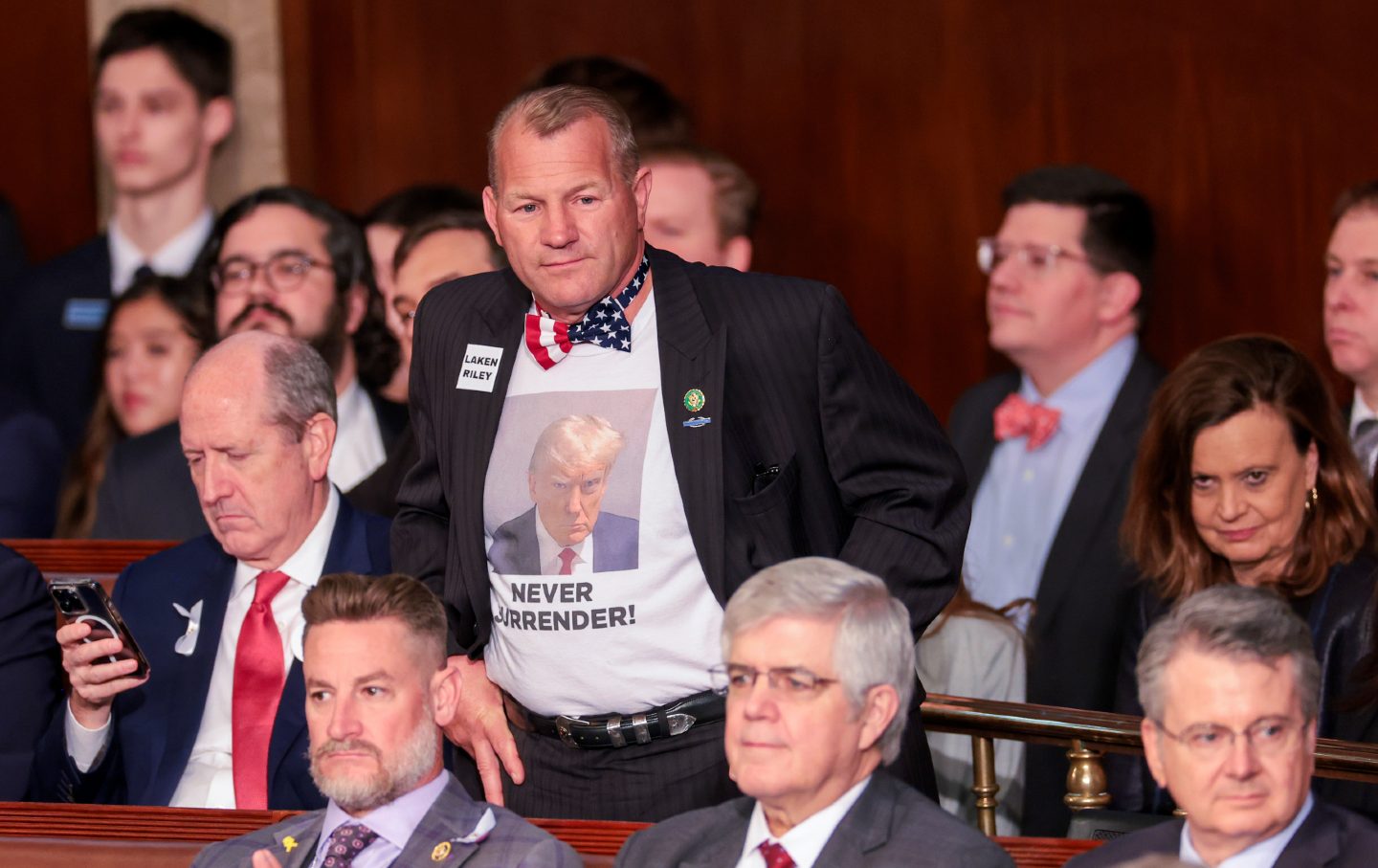
Amazingly, Greene’s get-up wasn’t even the most outlandish clothes-themed show of MAGA sympathies in the chamber. That honor fell to Texas Representative Troy Nehls, who wore a “Never Surrender” T-shirt featuring Trump’s mugshot and displayed a Laken Riley badge of his own on his lapel. To pull the look together, he sported an American flag bow tie. The outfit didn’t evoke a fearless mustering of Real American patriots so much as a Chippendale dancer gone to seed.
To better understand why MAGA iconography is now misfiring, it’s useful to review the original nature of its appeal. The MAGA brand is familiar to anyone who’s watched a half-hour cable TV infomercial: It’s a mass-produced, rather carelessly assembled, badge of self-improvement doubling as a pronouncement on the parlous state of the American republic. It promises the same instant boons to well-being that you’d get from B-grade TV hosts hawking diet gummies or snuggle blankets. The fact that so much of official MAGA ideology is so deeply incoherent is testimony to the many ways that Trumpism is a brand first, and a political affiliation as something of an afterthought.
The central feature of MAGA iconography is largely the same symbolism that drove Donald Trump’s merchandising empire: a canny melding of the proletarian and gaudy that typically goes by the euphemism “aspirational” in the imagineering laboratories of Madison Avenue. One theme of Trump’s public career has been his full embrace of a maximally self-enamored nouveau-riche aesthetic as he navigated his way from outer-borough landlord to Manhattan real-estate kingpin. During the long run of Trump’s reality-TV franchise The Apprentice, the many voyeuristic shots of his Trump Tower penthouse apartment—the same spread that he fraudulently tripled in size on loan documents to hoodwink lenders—showcased a relentlessly gaudy, flamboyant, and wealth-flaunting vision of the world. Every inch of the palace seemed to be gilded, especially the bathroom, calling to mind Fran Leibowitz’s arch dismissal of Trump as “a poor person’s idea of a rich person.”
During the 2016 election cycle, the same class-fused imagery was presented from the other end of the spectrum, immortalized in the red trucker cap emblazoned with the Trump campaign slogan, “Make America Great Again.” The hat’s loud, confrontational color echoed Trump’s trademark elongated power tie, and when Trump himself donned his signature headgear at rallies, the fantasy of untrammeled power that he sold to his movement was complete: It simultaneously said “he’s one of us,” and “we could be just like him.”
Liberal commentators were put off by the vulgar display—which, of course, was part of the point. Democratic detractors of the hat typically fixated on the hypocrisy of its manufacture—like other Trump gear, it was made at least in part from materials sourced in China, the great bogeyman of Trumpian trade tirades and economic-nationalist appeals. But such caviling overlooked the broader, and pointedly inclusive, nature of the Trump campaign’s iconography. Where liberal critics read MAGA regalia as divisive and insular, it actually represented a welcoming gesture from the leaders of a right-wing movement who formerly telegraphed their ideological purity, during the Tea Party’s heyday, by cosplaying as colonial revolutionaries.
But just as Trumpism itself has curdled into a brackish series of glosses on its founding resentments, the MAGA aesthetic has gone sour. The indiscriminate nature of MAGA rancor has, of course, been embodied by movement founder Trump, who can often be heard railing about the seemingly interchangeable perfidy of windmills, toilets, Bette Midler, Jack Smith, and Rosie O’Donnell. Trump spent his SOTU evening trying to cough out a “play by play” of Biden’s speech on his glitchy Truth Social account. After initially deriding Biden as “angry, mentally disturbed,” Trump mostly focused on Biden’s amped-up delivery and the frequency of his coughs. Like Greene and Nehls’s fashion statements, Trump’s insult-comic delivery felt phoned in.
Against all odds, things got worse with Alabama Senator Katie Britt’s awful official GOP response. Britt’s aesthetic miscues had less to do with her wardrobe than with the setting chosen for her speech: an eerily spare kitchen table, to leadenly symbolize the Republican Party’s deep concern for the struggles of ordinary working Americans. She opened her remarks in the same didactic domestic vein, saying that her work in the Senate wasn’t her most important job; that distinction, of course, fell to her duties as a wife and as a mother to her young children, Bennett and Ridgeway.
Britt didn’t give her husband an introductory mention, which was probably the right strategic choice, given that Wesley Britt is a former NFL player and a lobbyist for one of Alabama’s biggest influence-peddling shops, which donated $30,000 to Katie Britt’s 2022 Senate campaign. Britt’s strategically savvy choice of mate complicates her account of how she lived her own version of the American dream as the daughter of two small-business owners—as did the senator’s fresh-out-of-college gig as chief of staff to Senator Richard Shelby, whose seat she went on to claim.
Britt’s delivery was so cloying and artificial that it put to rest most of the conspiratorial speculation on the right that Biden had been chemically enhanced for his performance; whatever shit the president might have been on couldn’t hold a candle to Britt’s supply. Throughout her remarks, her face was frozen into a ghastly cheerleader’s rictus—an effect that became especially gothic as she doted with unseemly relish on the details of alleged immigrant rape, sex-trafficking, and other mayhem. (What’s more, Britt’s central immigrant horror story turned out to be a repurposed saga of cartel-driven sexual abuse in Guadalajara dating from the second George W. Bush administration, which she dishonestly and cynically presented as an American calamity, authored by the immigration policies of Joe Biden.) Her voice also modulated from the pained whisper of Sarah McLauchlin ASPCA ads to barks of Palinesque indignation over the specter of TikTok’s communistic brainwashing of the nation’s screen-addled youth.
The net impression, in short, was that Britt was a MAGA version of a Battlestar Galactica cylon: an untended AI generator left too long in a neglected food-preparation space with the collected works of the white nationalist guru Peter Brimelow and Trumpist intellectual toady Charlie Kirk. The mood of elite-choreographed unreality wasn’t helped by Britt’s own Twitter post showing her and her family in the same kitchen, shorn of any signs of use or habitation, under the creepy legend, “To the American people: Our future starts around kitchen tables just like this. With moms and dads just like you.” It was a confusing message, with undertones that uncomfortably called to mind Get Out and other horror films built on narratives of entrapment by superficially normal-to-elite families. In one respect, though, Britt’s post served as a perfect exemplar of the MAGA aesthetic, circa 2024: an infomercial for nothing at all.
Support independent journalism that does not fall in line
Even before February 28, the reasons for Donald Trump’s imploding approval rating were abundantly clear: untrammeled corruption and personal enrichment to the tune of billions of dollars during an affordability crisis, a foreign policy guided only by his own derelict sense of morality, and the deployment of a murderous campaign of occupation, detention, and deportation on American streets.
Now an undeclared, unauthorized, unpopular, and unconstitutional war of aggression against Iran has spread like wildfire through the region and into Europe. A new “forever war”—with an ever-increasing likelihood of American troops on the ground—may very well be upon us.
As we’ve seen over and over, this administration uses lies, misdirection, and attempts to flood the zone to justify its abuses of power at home and abroad. Just as Trump, Marco Rubio, and Pete Hegseth offer erratic and contradictory rationales for the attacks on Iran, the administration is also spreading the lie that the upcoming midterm elections are under threat from noncitizens on voter rolls. When these lies go unchecked, they become the basis for further authoritarian encroachment and war.
In these dark times, independent journalism is uniquely able to uncover the falsehoods that threaten our republic—and civilians around the world—and shine a bright light on the truth.
The Nation’s experienced team of writers, editors, and fact-checkers understands the scale of what we’re up against and the urgency with which we have to act. That’s why we’re publishing critical reporting and analysis of the war on Iran, ICE violence at home, new forms of voter suppression emerging in the courts, and much more.
But this journalism is possible only with your support.
This March, The Nation needs to raise $50,000 to ensure that we have the resources for reporting and analysis that sets the record straight and empowers people of conscience to organize. Will you donate today?
More from The Nation
Celebrate Kristi Noem’s Firing. But Keep Protesting ICE. Celebrate Kristi Noem’s Firing. But Keep Protesting ICE.
Finally, someone in the administration is paying for their cruelty and incompetence.
We Don’t Need an Autopsy to Tell Us the Democrats Failed on Gaza We Don’t Need an Autopsy to Tell Us the Democrats Failed on Gaza
The DNC is allegedly hiding a report showing that Kamala Harris’s Gaza policy helped cost her the 2024 election. But that report won’t tell us anything we don’t already know.
Texas’s Senate Primary Has Already Made History—and It’s Not Over Yet Texas’s Senate Primary Has Already Made History—and It’s Not Over Yet
Democratic nominee James Talarico is getting national media attention, but the real story is sky-high voter turnout, even amid GOP bids to suppress balloting
Quilted Messages Quilted Messages
Sunbonnets carrying not-so-sunny truths.
How the Theatrics of Mamdani’s Trump Meeting Backfired How the Theatrics of Mamdani’s Trump Meeting Backfired
By pandering to the president’s vanity, the New York mayor reinforced Trump’s image as a strongman commanding deference—an especially bad look on the eve of Trump’s war with Iran

Students in New York Are Going Hungry. How Can Mamdani Help? Students in New York Are Going Hungry. How Can Mamdani Help?
With plans for city-owned grocery stores and a focus on affordability, the new mayoral administration offers fresh hopes of successfully confronting the food crisis among students...

