Why Only Republicans Have Free Speech
The Supreme Court protects the rights of the rich and conservative—to heck with almost everyone else.
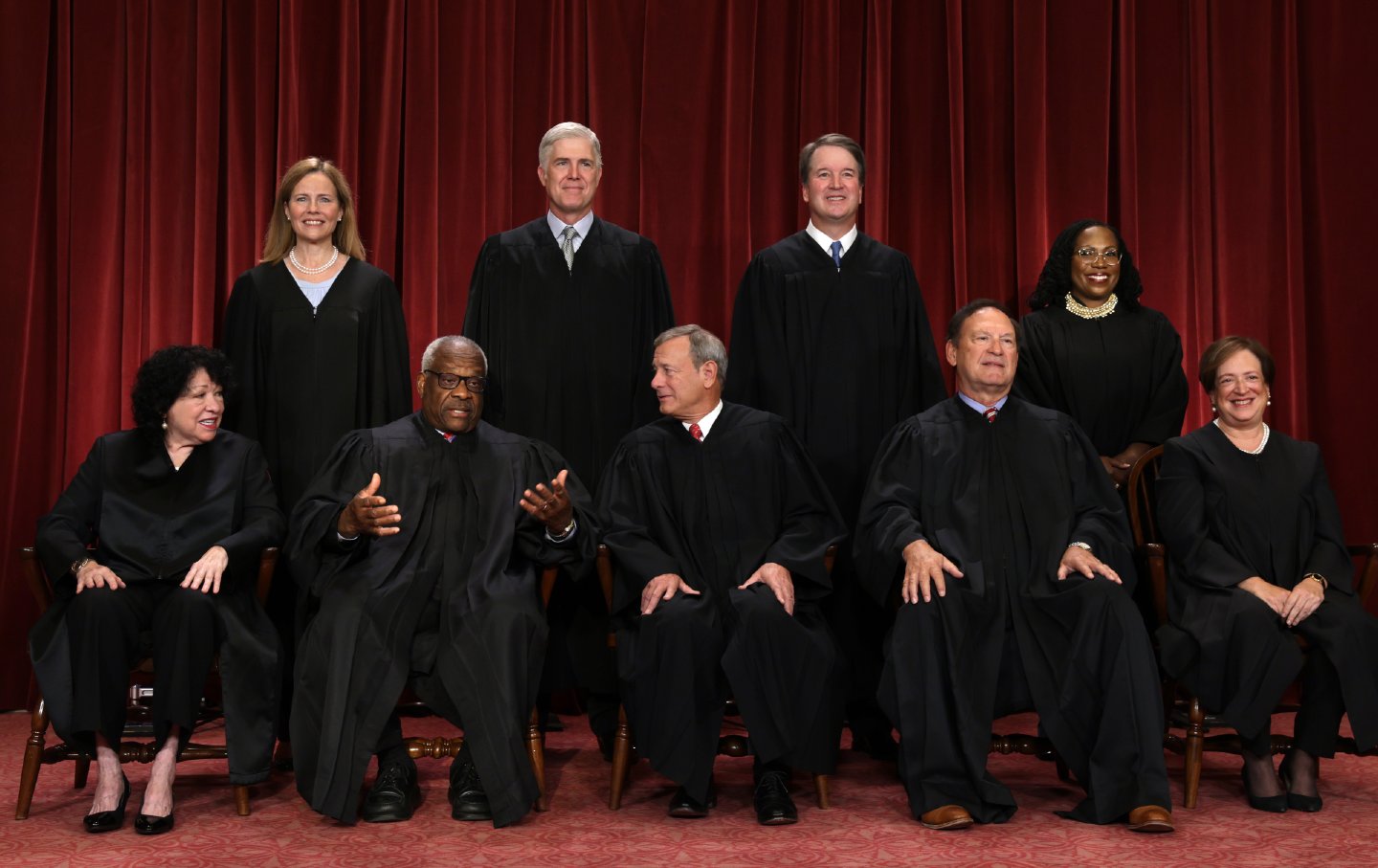
United States Supreme Court justices pose for their official portrait on October 7, 2022, in Washington, DC.
(Alex Wong / Getty Images)
The Republican justices seem to think that some people get free speech while others do not. Because this is a court driven by conservative grievance, it seems to think that people have a right to say conservative things the Republican justices like, but no similar right to say things criticizing conservatives. Speech is good when the speech is money that tends to favor Republican causes, but speech is not good when the speech favors Democratic causes—such as speech from unions or speech that supports rights for racial minorities and the LGBT community. The court protects the rights of an entitled minority, to heck with almost everyone else.
The court has treated some speech (criticism of wealthy conservatives) as bad, even while it insists that other speech (spending by wealthy conservatives) is good. In one such case, Americans for Prosperity Foundation v. Bonta (Americans for Prosperity Foundation is an arm of the petrochemical Koch family network), the court invalidated a California law that required nonprofits to disclose major donors to the state. The justices struck down the requirement because of the risk that donor information would be disclosed to the public, which might subject donors to, get ready for this, verbal accusations of wrongdoing. During the arguments, Justice Clarence Thomas framed the problem this way: “Do you think it would be reasonable for someone who wants to make a substantial contribution to an organization that has been accused of being racist or homophobic or white supremacist, that in this environment that they would be chilled?” The question suggests donors will be deterred from supporting an organization that has been accused of homophobia or racism. It depicts some speech as a problem (accusations of racism or homophobia against conservative organizations) while protecting other speech (monetary contributions to conservative organizations).
The court has also treated contributions to unions as fundamentally different from contributions to corporations. It invalidated fair-share fees for public sector unions, which allow public employers to collect fees from nonunion employees. The court said fair-share fees might result in nonunion employees financially supporting messages that they do not support. But the same is true of corporate political expenditures, since corporate employees and shareholders might not agree with all of a corporation’s expressive activity and political spending. Yet that doesn’t seem to bother the Republican justices. In another case about unions, the Republican justices said that unions’ speech can sometimes be… a little too much to warrant First Amendment protection. The court struck down a law that allowed union organizers to talk to farmworkers on farmland for three hours a day, for fewer than half the days in a year. It concluded that unions’ speech could overwhelm the property owners’ control over their land (and workers). Apparently, it’s not fine to overwhelm wealthy capital interests, but wealthy interests get to overwhelm everybody else when it comes to political spending. That’s just equality, duh!
Or take Justice Samuel Alito’s apparent concern with how some people (specifically, people who are not Republicans) spend their money. In a 2020 keynote address to the Federalist Society, Justice Alito claimed that “in certain quarters, religious liberty is fast becoming a disfavored right” and pointed out that “when states have considered or gone ahead and adopted their own versions of RFRA [the Religious Freedom Restoration Act], they have been threatened with punishing economic boycotts.” Why would economic boycotts, where individuals and businesses chose not to support states with certain kinds of laws, be a problem? The court’s campaign finance decisions suggest there is a First Amendment right to spend money on political causes even when that spending might overpower everyone else’s. Apparently, that’s OK when it is Republicans’ spending drowning out everyone else’s, but it’s not okay when other people’s spending drowns out Republicans’.
The Republican justices seem to think that they, as Republicans, are also entitled to be insulated from criticism. The Supreme Court is “being hammered daily,” Justice Alito whined to The Wall Street Journal, and “nobody, practically nobody is defending us.” Alito has insisted certain speech is unacceptable based on its content—like anything that criticizes the court too strongly. “Saying or implying that the Court is becoming an illegitimate institution or questioning our integrity crosses an important line,” according to the justice. He has said critics’ mere use of certain words such as the “term ‘shadow docket’” “feeds unprecedented efforts to intimidate the Court.” Speaking at a conference, Justice Alito mocked people who said mean things about his opinion overruling Roe v. Wade. He singled out former English prime minister Boris Johnson, who criticized Dobbs but “paid the price.” (Johnson resigned amid an ethics investigation.) In his keynote address to the Federalist Society, Alito called some Democratic senators’ amicus brief “bullying” and berated a post from a Harvard law professor’s blog. During one recent oral argument, he “joked” about how the court’s “public information officer… maybe… whenever they [the press] write something that we don’t like, she can call them up and curse them out.”
It’s not just the justices who think this. In 2012, Leonard Leo pulled some maneuvers to funnel money from his organizations to Virginia (Ginni) Thomas (the wife of Justice Thomas) via Kellyanne Conway’s consulting organization (Conway was later Trump’s campaign manager and counselor to President Trump). Leo told Conway that there should be “no mention of Ginni, of course.” When the financial exchange eventually came to light, Leo said, “Knowing how disrespectful, malicious, and gossipy people can be, I have always tried to protect the privacy of Justice Thomas and Ginni.” Say it again: Speech funding conservative causes is good while speech criticizing conservatives is bad—duh!
Alito has not even limited himself to one whiny appearance in the opinion pages of The Wall Street Journal. A month after he defended his free private-jet trip in the Journal, he shared some thoughts in an interview with the Journal. One of the journalists Alito spoke to was a lawyer who represented Leonard Leo in the DC attorney general’s investigation into Leo’s organizational network. At the time of the interview, the lawyer was also participating in a tax case the court was set to hear. Justice Alito told the reporter/lawyer, “I know this is a controversial view, but I’m willing to say it.… No provision in the Constitution gives them [Congress] the authority to regulate the Supreme Court—period.”
All the power the court has accumulated over the past two centuries and more is apparently not enough. It must be good to be king.
Support independent journalism that does not fall in line
Even before February 28, the reasons for Donald Trump’s imploding approval rating were abundantly clear: untrammeled corruption and personal enrichment to the tune of billions of dollars during an affordability crisis, a foreign policy guided only by his own derelict sense of morality, and the deployment of a murderous campaign of occupation, detention, and deportation on American streets.
Now an undeclared, unauthorized, unpopular, and unconstitutional war of aggression against Iran has spread like wildfire through the region and into Europe. A new “forever war”—with an ever-increasing likelihood of American troops on the ground—may very well be upon us.
As we’ve seen over and over, this administration uses lies, misdirection, and attempts to flood the zone to justify its abuses of power at home and abroad. Just as Trump, Marco Rubio, and Pete Hegseth offer erratic and contradictory rationales for the attacks on Iran, the administration is also spreading the lie that the upcoming midterm elections are under threat from noncitizens on voter rolls. When these lies go unchecked, they become the basis for further authoritarian encroachment and war.
In these dark times, independent journalism is uniquely able to uncover the falsehoods that threaten our republic—and civilians around the world—and shine a bright light on the truth.
The Nation’s experienced team of writers, editors, and fact-checkers understands the scale of what we’re up against and the urgency with which we have to act. That’s why we’re publishing critical reporting and analysis of the war on Iran, ICE violence at home, new forms of voter suppression emerging in the courts, and much more.
But this journalism is possible only with your support.
This March, The Nation needs to raise $50,000 to ensure that we have the resources for reporting and analysis that sets the record straight and empowers people of conscience to organize. Will you donate today?