
Kamala Harris Is Bringing Blue-State Politics to the Campaign Trail
In California, Republicans have mostly lost their grip on the electorate. Harris’s presidential run has brought that attitude to the national stage.
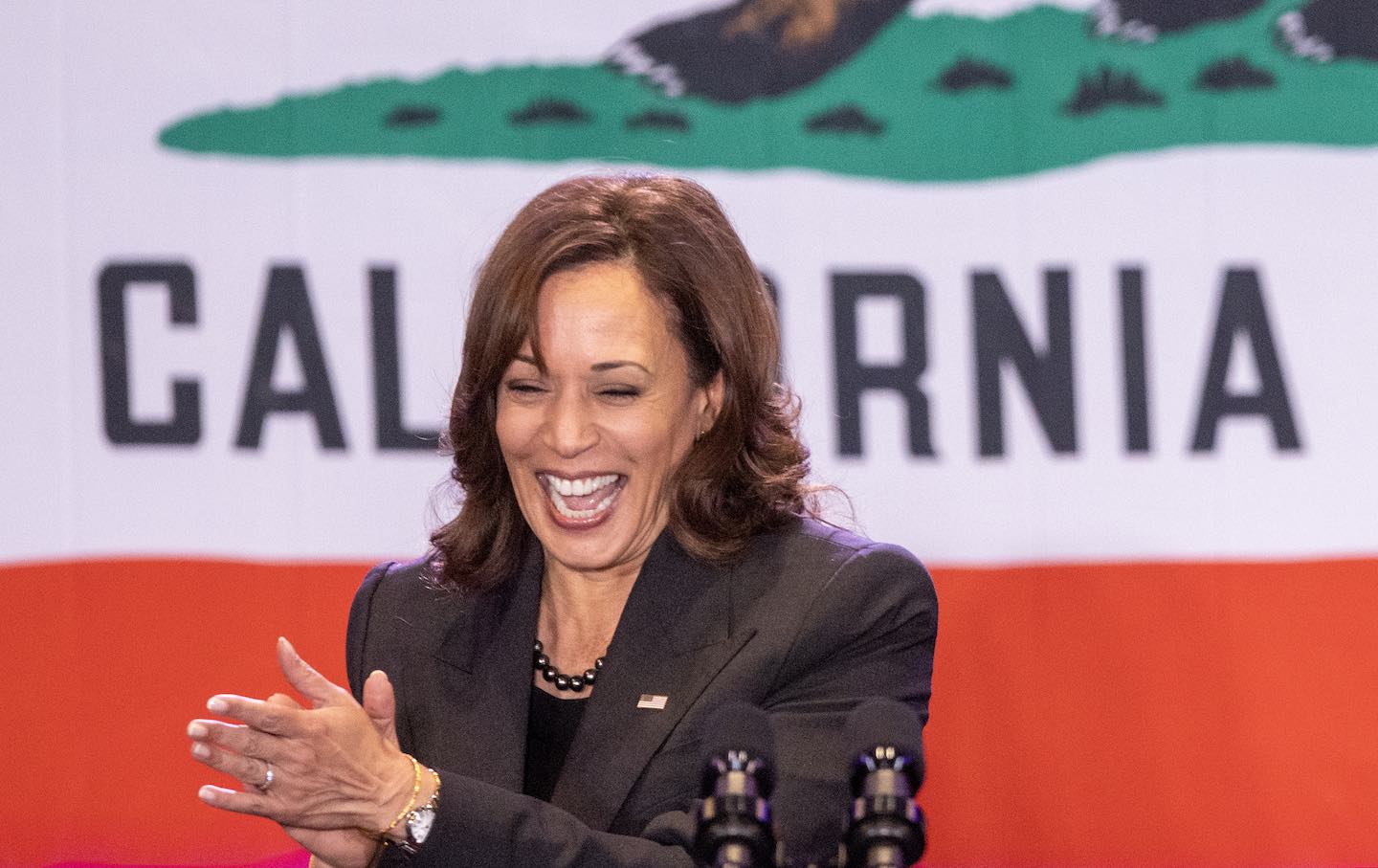
Vice President Kamala Harris campaigns for Democrats and Los Angeles mayoral candidate Representative Karen Bass at a Get Out the Vote event on the campus of UCLA on the eve of Election Day on November 7, 2022, in Los Angeles, California.
(David McNew / Getty Images)
With the dust still settling on the unprecedented transfer of the Democratic presidential nomination from President Joe Biden to his vice president, Kamala Harris, personality-driven breakdowns of this moment and its meaning continue to multiply across the punditsphere. We’re told that Harris is a stunningly effective communicator of the party’s message—perhaps far better suited to a general election campaign than to the 2020 primaries she rapidly bailed out of. We’re urged to appreciate her fitness as a lifelong prosecutor in pressing the case against a presidential opponent now convicted of 34 felony counts and awaiting trials and verdicts on 50 or so more—not to mention her effective role as the Biden White House’s point person on reproductive rights to galvanize Democrats behind their most effective campaign issue. We’re informed that Harris’s prowess on the stump has already cowed Donald Trump into backing out of a planned debate, while sending him frantically poring through his insult-comic repertoire for some derisive nickname to send fresh two-minute hates pulsing through the MAGA body politic.
All these diagnoses of the Harris boomlet have something to recommend them, but they still fail to account for the central virtue of the newly launched Harris campaign: its straightforward, combative approach to defeating Trump and his decade-long takeover of right-wing politics. Harris’s brash (if not, strictly speaking, brat) offensive against the GOP is rooted in something broader and deeper than her own character, or her popcult appeal; It is, in large part, traceable to the California political scene that launched her career. In many ways, Harris is a political messenger who reaches the electorate from the far side of Trumpism—a Golden State leader who came of political age in the aftermath of California’s demagogic anti-immigration crusade of the 1990s, and who saw the state Republican Party that orchestrated it dispatched to a generation of political irrelevance. The Democratic standard-bearer now brandishing a series of press releases aggressively enumerating the lies and fringe obsessions of the Trump-Vance ticket and bearing the message that the Republican Party is just plain “weird” learned early on just how to exploit the glaring weaknesses of a state GOP operation unable to overcome its own legacy of xenophobic reaction.
The saga began in 1994, with the reelection campaign of California Republican Governor Pete Wilson. As the national GOP veered hard right under the leadership of bomb-throwing House Speaker Newt Gingrich, Wilson sensed new opportunity in the ethnic cum nationalist tensions unleashed in the Golden State during the early ’90s recession. Wilson’s campaign rallied behind Proposition 187, a state ballot initiative seeking to block undocumented immigrants from receiving basic services from the state and to supersede federal border enforcement initiatives. “They keep coming,” the narrator in one of Wilson’s most notorious immigration-themed ads intones at the outset, over grainy footage of border chaos, before the governor himself appears on camera to announce, “Enough is enough.” After Prop. 187 won overwhelming approval, Wilson cruised to reelection.
This ugly moment turned out to be the high-water mark of Republican clout in California over the past three decades. Within three years, the provisions of Prop. 187 were overturned in court as clear violations of 14th Amendment protections, and within four, Wilson’s career in public life was over. Apart from Arnold Schwarzenegger’s governorship—a moderate exception proving the rule—Republicans haven’t held significant state office in California since.
Not all of the GOP’s misfortunes in the Golden State are directly traceable to the failures of Prop. 187; the party was also slow to adapt to the state’s postindustrial information economy, and traditionally right-leaning suburban constituencies now skewed liberal on a host of issues, from gay rights to climate change to reproductive rights. Not surprisingly, Latino voters, one of the state’s fastest-growing demographics, were also spurred into a surge of activism by the Prop. 187 campaign, and less surprisingly still, they broke firmly Democratic. “The story of California post-187 is that there was a battle within the existing hierarchy,” says Zoltan Hajnal, a political science professor at the University of California, San Diego. “Part of the white power structure was using the issue of immigration to retain control. But then the demographics changed so dramatically that the movement of Latino voters to the Democratic Party permanently changed the state’s politics.”
By the time Kamala Harris announced her candidacy for San Francisco DA in 2003, she was running for office in a one-party town in a one-party state. Significantly, she ran to the right of her chief primary opponent, the incumbent Terence Hallinan—though she and Hallinan both supported San Francisco’s policy of bypassing prosecution of many immigration offenses under its status as a sanctuary city.
California’s broader plunge into deep-blue political consensus meant that only state Democrats brokered successful legislation and mounted effective statewide campaigns. (Schwarzenegger was, again, the exception, as an early GOP advocate for climate mitigation and now one of the party’s most vocal Never Trump advocates; himself an immigrant from Austria, he also tacked toward the center on immigration after supporting Prop. 187 and a federal wall at the San Diego–Tijuana border.) That gave Harris additional room to position herself as a pragmatic law-enforcement official when she ran for state attorney general in 2010. She took no position on Prop. 47, the state’s failed 2014 initiative to downgrade many victimless felony offenses into misdemeanors, as well as a 2016 referendum that sanctioned early prison release for many convicted criminals.
Such difference-trimming calculation was disappointing for many California advocates of criminal-justice reform, while also prefiguring a similar mood of caution in Harris’s first Senate run in 2016 against former Democratic representative Loretta Sanchez. That race was an early marquee entry in the state’s novel “jungle primary” system pitting the primary cycle’s two top vote getters against each other, regardless of party affiliation. The odd dynamics of that intraparty fight left Sanchez vying for Republican support with law-and-order and antiterrorist rhetoric, with Harris once more lining up establishment Democratic support, including an endorsement from the retiring incumbent, Barbara Boxer, and again sidestepping high-profile controversy.
Harris’s long apprenticeship in an all-but exclusive Democratic state political operation might seem at first glance to be a weakness in the pending confrontation with Trump for the presidency; her résumé suggests that she’s something of a hothouse flower, nurtured under a bank of azure-blue heat lamps. Yet among the many paradoxes of our present age of negative partisanship is that Harris’s brand of uniparty discipline is far better suited to the task of defeating the MAGA putsch on the right than Joe Biden’s sentimental allegiance to the household gods of deferential bipartisanship. That’s because statewide Democratic leaders in California have for nearly 30 years imbibed the core article of faith that their Republican counterparts are simply not serious political brokers, or especially good at their jobs. (All you have to do to nail that point down is to cite the case of the state’s fallen “young gun” of the right, former House speaker Kevin McCarthy, a onetime Trump toady now spearheading a personal “revenge tour” against his Freedom Caucus pursuers.)
Coming from a state in which the GOP has elected over and over again to shoot itself in the foot, Harris didn’t need to undertake a crash course in messaging to call out Trump and Vance on grounds of terminal weirdness; she merely had to rely on the abundant formative lessons of her political career. Nor have her stark and effective depictions of the MAGA movement as an arch foe of basic American freedoms and her callouts to the bankruptcy of its posturing on economic populism involved any solemn jeremiads about imperiled formal democracy or errant civic virtue; instead, they hinge on a vision of fringe extremists as, well, fringe—an urgent threat to an already embattled social democracy, to be sure, but also firmly exiled from the precincts of normie politics.
“I think having the experience [with immigration] helps her be more comfortable with this issue, and you can see it in other issues, too,” Hajnal says. “She’s trying to be a conventional Democrat…who will maybe throw a bone or two to progressive concerns. It’s a mixed strategy that mostly seems to be working so far.”
So as you wade through all the many think pieces in the making about the unique forces and strategically minded savants now coming together to craft Harris’s fresh and original campaign message, pause for a moment and savor this irony: A successful Harris campaign for the presidency may owe a prime debt of gratitude to the proto-Trumpian rancor of Pete Wilson.
Support independent journalism that does not fall in line
Even before February 28, the reasons for Donald Trump’s imploding approval rating were abundantly clear: untrammeled corruption and personal enrichment to the tune of billions of dollars during an affordability crisis, a foreign policy guided only by his own derelict sense of morality, and the deployment of a murderous campaign of occupation, detention, and deportation on American streets.
Now an undeclared, unauthorized, unpopular, and unconstitutional war of aggression against Iran has spread like wildfire through the region and into Europe. A new “forever war”—with an ever-increasing likelihood of American troops on the ground—may very well be upon us.
As we’ve seen over and over, this administration uses lies, misdirection, and attempts to flood the zone to justify its abuses of power at home and abroad. Just as Trump, Marco Rubio, and Pete Hegseth offer erratic and contradictory rationales for the attacks on Iran, the administration is also spreading the lie that the upcoming midterm elections are under threat from noncitizens on voter rolls. When these lies go unchecked, they become the basis for further authoritarian encroachment and war.
In these dark times, independent journalism is uniquely able to uncover the falsehoods that threaten our republic—and civilians around the world—and shine a bright light on the truth.
The Nation’s experienced team of writers, editors, and fact-checkers understands the scale of what we’re up against and the urgency with which we have to act. That’s why we’re publishing critical reporting and analysis of the war on Iran, ICE violence at home, new forms of voter suppression emerging in the courts, and much more.
But this journalism is possible only with your support.
This March, The Nation needs to raise $50,000 to ensure that we have the resources for reporting and analysis that sets the record straight and empowers people of conscience to organize. Will you donate today?
More from The Nation
Celebrate Kristi Noem’s Firing. But Keep Protesting ICE. Celebrate Kristi Noem’s Firing. But Keep Protesting ICE.
Finally, someone in the administration is paying for their cruelty and incompetence.
We Don’t Need an Autopsy to Tell Us the Democrats Failed on Gaza We Don’t Need an Autopsy to Tell Us the Democrats Failed on Gaza
The DNC is allegedly hiding a report showing that Kamala Harris’s Gaza policy helped cost her the 2024 election. But that report won’t tell us anything we don’t already know.
Texas’s Senate Primary Has Already Made History—and It’s Not Over Yet Texas’s Senate Primary Has Already Made History—and It’s Not Over Yet
Democratic nominee James Talarico is getting national media attention, but the real story is sky-high voter turnout, even amid GOP bids to suppress balloting
Quilted Messages Quilted Messages
Sunbonnets carrying not-so-sunny truths.
How the Theatrics of Mamdani’s Trump Meeting Backfired How the Theatrics of Mamdani’s Trump Meeting Backfired
By pandering to the president’s vanity, the New York mayor reinforced Trump’s image as a strongman commanding deference—an especially bad look on the eve of Trump’s war with Iran

Students in New York Are Going Hungry. How Can Mamdani Help? Students in New York Are Going Hungry. How Can Mamdani Help?
With plans for city-owned grocery stores and a focus on affordability, the new mayoral administration offers fresh hopes of successfully confronting the food crisis among students...

