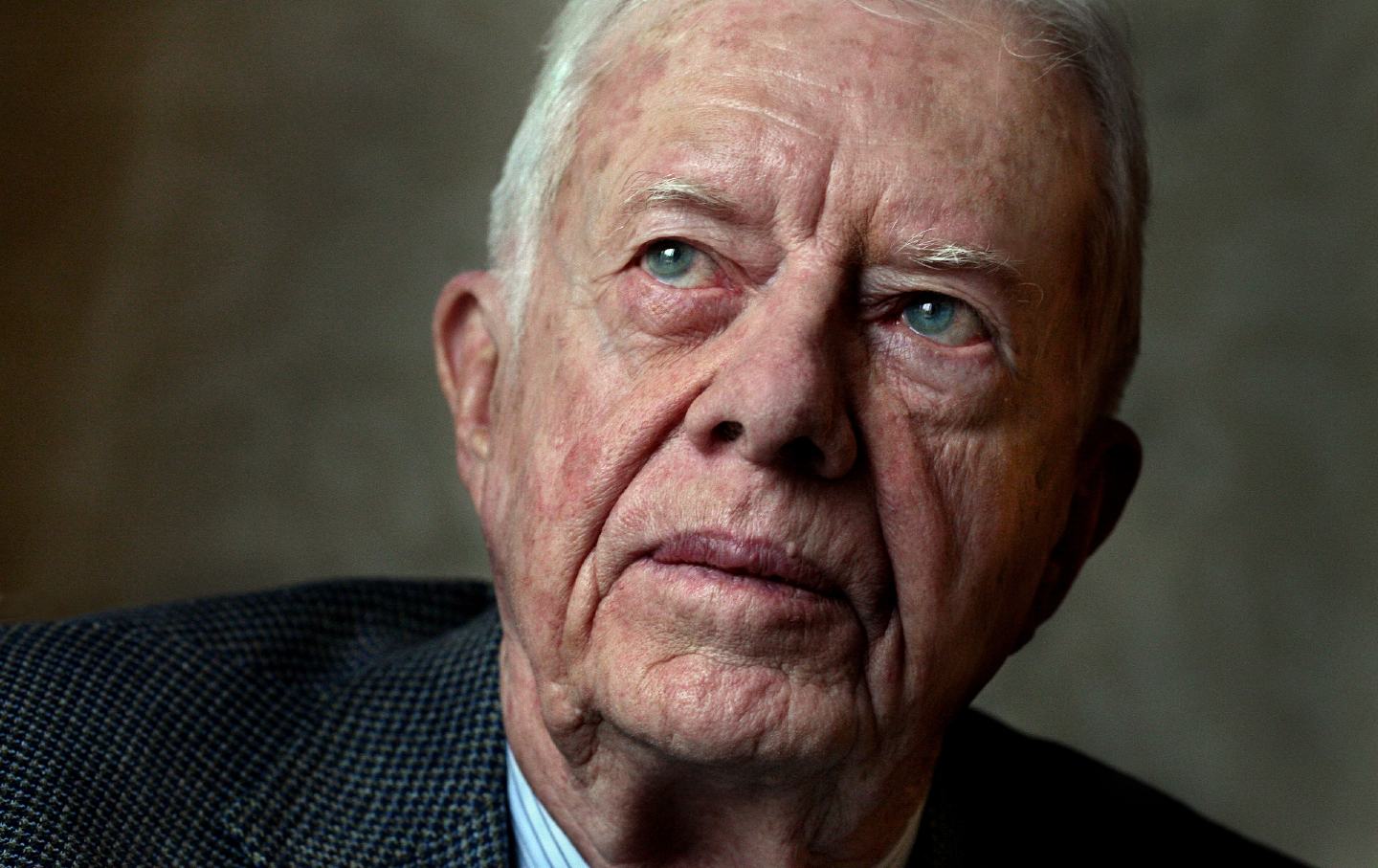
Jimmy Carter in Washington, DC, on November 28, 2006.
(Michael Williamson / The The Washington Post via Getty Images)
Jimmy Carter turned 100 today, making him the oldest ever former president. And, in Carter’s case, age and wisdom do go together.
While his presidency, which began almost five decades ago, had its ups and down, his post-presidency has been characterized by bold truth-telling that—while frequently controversial—has placed him on the right side of history.
Carter’s wisdom has been on display in recent months, as he has indicated that he plans to cast an enthusiastic vote to make Kamala Harris the first woman, and only the second Black American, to serve as president.
While past presidents have been cautious about engaging in discussions about choosing their successors and about the issues that those successors must wrestle with, Carter has a long record of jumping into the big debates. And, in so doing, upsetting the status quo.
He cast a vote in 2016 for Senator Bernie Sanders, for instance, and he has in recent years been outspoken about the need for progressive initiatives such as a single-payer “Medicare for All” healthcare system.
Carter’s boldest advocacy, of course, has been on behalf of a new approach by the United States government to the Middle East—an approach that respects the need for the United States to be a honest player in the region where he did more than any other president to promote peace.
Since Carter left the White House in 1981, successive presidents have gotten more wrong than right in the region, where the threat of all-out war is now mounting and where the Israeli assault on Gaza has killed more than 40,000 Palestinians—most of them women and children—since the October 7, 2023, Hamas-led attacks. Over the years, I have had a chance to interview former president Carter several times. In recognition of his 100th birthday, and his wisdom, here is a portion of an interview from 2007, in which we discussed his 2006 book, Palestine Peace Not Apartheid, and Jonathan Demme’s 2007 documentary, Jimmy Carter Man From Plains, which chronicled his controversial tour on behalf of that book.
—John Nichols
John Nichols: Early in the documentary, you refer to US media coverage of the Middle East as “abominable” and entirely lacking in objectivity. Did you see yourself as doing battle with the media on the book tour?
Jimmy Carter: I was presenting a point of view that the American media rarely have a chance to cover. It would be almost inconceivable for any member of the House or Senate, Republican or Democrat, or any person campaigning for president, Republican or Democrat, to make the statements that I’ve made concerning the plight of the Palestinians or Israel withdrawing to its 1967 borders with modifications, or things of that kind. So this was a new opportunity for them to cover the Mideast issue from a completely—I’d say almost unprecedented—perspective.
JN: Do you think you moved the political debate forward?
JC: Oh, no. It would be amazing for me to hear any candidate for president even mention it—even begin to address these issues in a serious way.
JN: It is accepted today that a former president may, if he is willing to take some hits, say bold things about the Middle East but that candidates for president can’t. Isn’t that our crisis?
JC: That was one of the reasons I wrote the book—and it is the reason I continue to talk about these issues. I saw a complete dearth of any sort of substantive debate. For six years, now seven years, there hasn’t been a single day of substantive negotiations between Israel and either Syria or the Palestinians. I wanted to precipitate some movement on the peace process and also bring the issue to the forefront. In other countries, by the way—I’ve been to Ireland and England and other countries in Europe lately—there is a pretty intense debate. But over here, zero.
JN: You entered the national political consciousness in 1975 and 1976 as “the man from Plains,” the peanut farmer with few ties to Washington mounting an outsider campaign. Could you—same background, same scenario—run successfully for president today?
JC: No. It wouldn’t be possible. In the first place, in 1975 and ’76, I didn’t have any money. We ran a campaign with my family, basically. We had seven of us every day campaigning in different places. We didn’t even have enough money to stay in a hotel or motel. Then, President Ford and I both in the general election just ran on the $1-per-person checkoff. We didn’t receive any contributions for the general election. That technique, that situation, is completely passé now.
JN: Did winning the presidency as an outsider free you to try new approaches in the Middle East?
JC: Definitely. There were two things: I didn’t owe anybody anything when I got in office, so I could speak freely. I could act freely. The other part was that I didn’t worry so much about the question, what do you do when you get in office to be reelected? And I have to say that I neglected that part of my political career.
JN: You didn’t calculate carefully enough.
JC: No. I really thought the peace treaty between Israel and Egypt would be enough to solidify my political support. But there are so many nuances of that issue that it didn’t work out that way. Israel and Egypt remain at peace, however. There is consolation in that, and I hope a good message to the next president. It is possible for an American president to advance the peace process, to achieve meaningful progress. It is also necessary—more necessary now than it has ever been.