The Insurrection Is Far From Over
The grim legacy of January 6 lives on in today’s Republican Party.
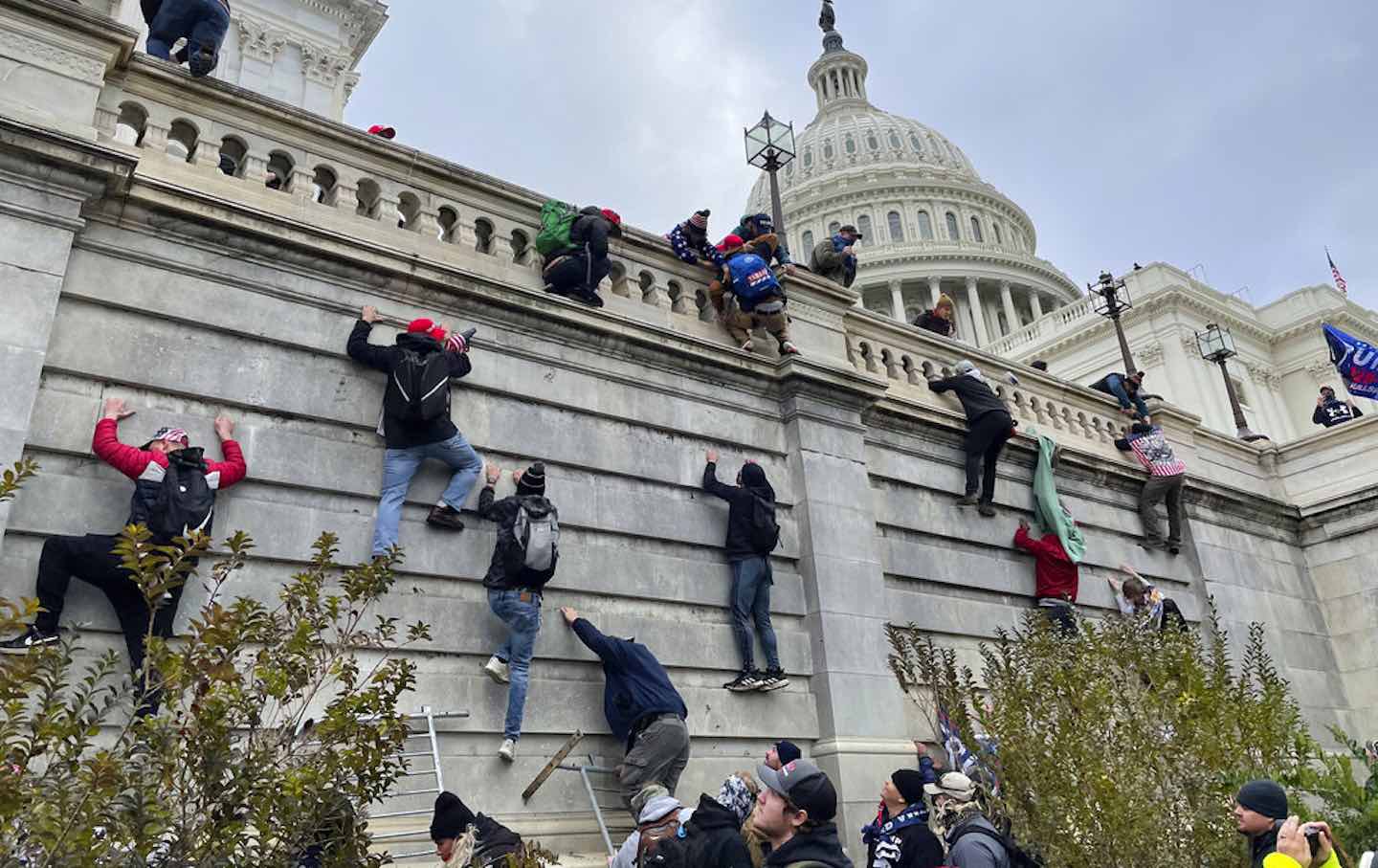
The United States Capitol in Washington, D.C., being breached on January 6, 2021.
(STRF / STAR MAX / AP)The failed coup of January 6, 2021, now marking its third anniversary, shows no sign of outgrowing the terrible twos. Thanks to America’s overlapping chronic conditions of historical amnesia and rapid-fire revisionism, a landmark assault on the basic operations of government, with the explicit aim of overturning a free and fair election to install an authoritarian aspiring dictator into power for life, has become a litmus test for holding office among a militant Republican base. The imprint of January 6 revisionism is on display everywhere in American public life. There was the ominously strong plurality of election deniers seeking office in the 2022 midterms. There was the House GOP conference’s decision to elevate eight election-denying candidates in a field of nine as it voted to appoint a new speaker last fall. (Needless to say, the eventual winner, Mike Johnson, both filed an amicus brief in support of the bogus Trump challenge to the 2020 results and voted to decertify them on January 6.) There was the relentless shilling of election lies in the right-wing media, with Tucker Carlson and Mike Liddell leading the initial charge, and Dinesh D’Souza and the Epoch Times peddling long-form fanciful, paranoid, blame-shifting accounts of how and why the failed putsch unfolded. This agitprop campaign has yielded impressive results: According to a new Washington Post/UMD poll, 25 percent of all Americans now believe that the FBI instigated the insurrection, with one-third of Republicans endorsing that lunatic claim.
One key tell in all this unhinged mythmaking was that, for all the heavy-breathing invocations of deep-state choreographing of the insurrection, neither Trump nor any of the lead MAGA propagandists on the case have named a single alleged Lux Luthor figure knitting all the threads of conspiracy together. To be sure, the right-wing grievance-sphere abounds with drive-by insinuations lobbed at prominent public figures such as President Joe Biden, Attorney General Merrick Garland, and FBI Director Chris Wray, but these are always blindingly vague and comically evidence-free. There’s a simple reason for this, beyond the imaginary character of the whole crusade: Affixing actual names and practices to the litany of stab-in-the-back allegations creates dire legal exposure for the accusers. That lesson’s been driven home in the sprawling industry of fallacious right-wing charges of election fraud that enabled the insurrection, in judgments that have so far cost Fox News $787 million and Trump attorney cum fascist carnival barker Rudy Giuliani $148 million.
The other first-order logical travesty of the January 6 truther movement is that, by some recondite miracle in an election cycle allegedly rife with dastardly voter fraud and fixing, all results that broke in favor of Republican candidates were preserved in an ethically immaculate state. This fabulist brand of ballot activism should have been laughed out of public discourse the moment that the Trump administration’s own election fraud commission, led by Kansas MAGA legal mouthpiece Kris Kobach, disbanded in a massive crescendo of evidentiary face-planting. Yet, as we’re now seeing in the GOP primary polls, legal, court-sanctioned refutations of MAGA social myth only feed the movement’s martyrology and unappeasable sense of righteous grievance. The grim legacy of January 6 is that an entire fascist movement nestled in the heart of one of the nation’s major parties is more determined than ever to seize state power in order to exact revenge in defense of a flagrant lie.
“Fascism is about the destruction of the rule of law,” says Maryland Democratic Representative Jamie Raskin, the House manager for Trump’s post–January 6 impeachment and a lead member of the Select Committee to Investigate the January 6th attack on the United States Capitol. “And they are just demolishing the rule of law however they can. That’s why Section 3 of the 14th Amendment is so important. Even Trump supporters seem to concede that the language of Section 3 is on point.”
Section 3, of course, forbids anyone found to have participated in an anti-government insurrection from holding office. It’s almost never been enforced over the past 150 years, thanks to the collapse of Radical Reconstruction and the ensuing restoration of white herrenvolk democracy in the country. But as Raskin notes, the recent decisions in Maine and Colorado to revoke Trump’s ballot entry under Section 3, however they might translate into long-term political strategy, supply a powerful reminder of just what actually did happen on January 6, and the ongoing existential threat the movement surrounding it represents to American democracy. “I’d make the argument that Section 3 is all about fortifying and strengthening democracy,” Raskin says. “There are multiple ways of being disqualified from running for president. You can be too young—anybody under 35, like AOC or Maxwell Frost, isn’t allowed to run. You could be not a native-born citizen, which takes out Arnold Schwarzenegger. And then you can be an insurrectionist. That disqualification affects probably fewer than a dozen officials, who were elected officials who swore an oath to uphold the Constitution. That’s a category that’s not morally arbitrary, like age or where you were born. You put yourself in that category—and that’s exactly what Trump has done.”
Another pronounced irony here is that the Section 3 cases, and the other court challenges to Trump’s bid to overturn the election in D.C. district court and Fulton County, Ga., represent the very sort of legal remedy that a major contingent of Republican senators claimed to support when they fatally decided to vote against Trump’s conviction in the post–January 6 Senate trial.
“The 6 Jan attack on the Capitol was far more dangerous than most realize,” Sen. Marco Rubio wrote on Twitter just ahead of his vote to acquit. “And we have a criminal justice system in place to address it.” Texas Senator John Cornyn took up the same sententious and ultimately disingenuous cry, saying, “Given that the Constitution makes legal offenses committed while in office subject to investigation and prosecution as warranted, after a President is no longer in office, I believe that is the Constitutional method of accountability.” Predictably, Jack Smith’s indictment of Trump in Washington elicited a resounding blast of silence from this same cohort—most notably Senate minority leader Mitch McConnell, who delivered a speech blasting Trump for his role in fomenting the insurrection, only to fold like a cheap card table at the time of the impeachment vote. “One has to believe that McConnell and the other Republicans who could not summon up the courage to do the right thing at trial are regretful,” Raskin says. “The Republican establishment keeps waiting for someone else to do the right thing.”
Raskin also stresses the urgency of the pending court proceedings against Trump on charges relating to January 6 and other matters. “These cases have to go forward, especially the Jack Smith insurrection case,” he says. “Trump should not be allowed to run out the clock with a bunch of frivolous arguments. It’s going to be important to see whether courts can do their job. I think that how the Supreme Court deals with Section 3 of the 14th Amendment is crucial. For a bunch of originalists and textualists, this should be an easy case. The text is unambiguous, and the original purpose was clear: to stop people who had held public office and engaged in insurrection from ever coming back into power.”
At the same time, the courts—and this Supreme Court in particular—are hardly the cavalry you’d want to rely on in today’s mounting conditions of democratic emergency. “Really, it requires every institution in society to do its job,” Raskin says. “That includes the courts, the House and the Senate, and the state governments. But above all, it requires the people.”
Support independent journalism that does not fall in line
Even before February 28, the reasons for Donald Trump’s imploding approval rating were abundantly clear: untrammeled corruption and personal enrichment to the tune of billions of dollars during an affordability crisis, a foreign policy guided only by his own derelict sense of morality, and the deployment of a murderous campaign of occupation, detention, and deportation on American streets.
Now an undeclared, unauthorized, unpopular, and unconstitutional war of aggression against Iran has spread like wildfire through the region and into Europe. A new “forever war”—with an ever-increasing likelihood of American troops on the ground—may very well be upon us.
As we’ve seen over and over, this administration uses lies, misdirection, and attempts to flood the zone to justify its abuses of power at home and abroad. Just as Trump, Marco Rubio, and Pete Hegseth offer erratic and contradictory rationales for the attacks on Iran, the administration is also spreading the lie that the upcoming midterm elections are under threat from noncitizens on voter rolls. When these lies go unchecked, they become the basis for further authoritarian encroachment and war.
In these dark times, independent journalism is uniquely able to uncover the falsehoods that threaten our republic—and civilians around the world—and shine a bright light on the truth.
The Nation’s experienced team of writers, editors, and fact-checkers understands the scale of what we’re up against and the urgency with which we have to act. That’s why we’re publishing critical reporting and analysis of the war on Iran, ICE violence at home, new forms of voter suppression emerging in the courts, and much more.
But this journalism is possible only with your support.
This March, The Nation needs to raise $50,000 to ensure that we have the resources for reporting and analysis that sets the record straight and empowers people of conscience to organize. Will you donate today?