Why Can’t Top Democrats Just Say “No War With Iran”?
The response to what could be the biggest geopolitical disaster of the 21st century is foot-dragging, silence, and sleepy, feigned opposition long after the deed is done.
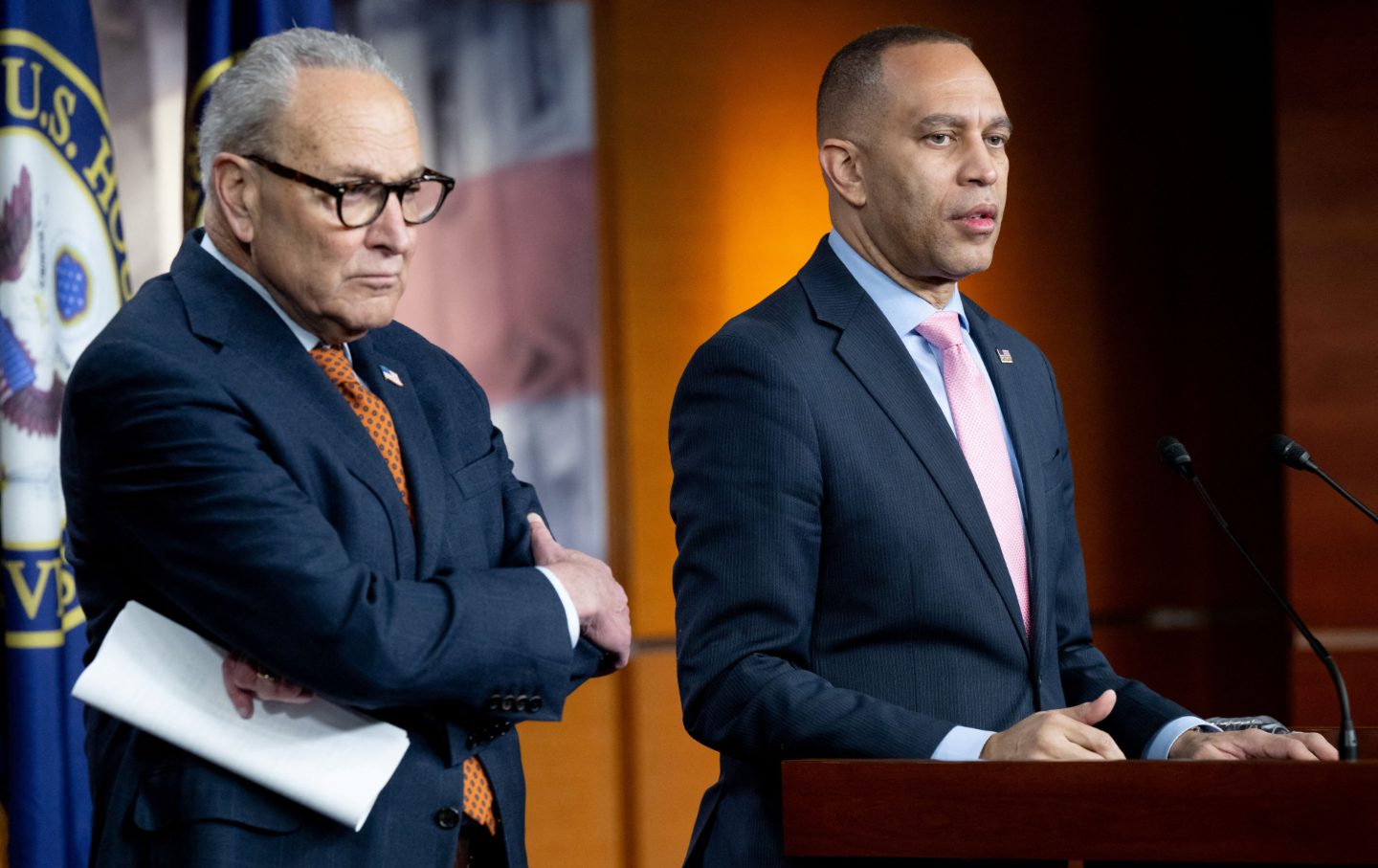
Senate minority leader Chuck Schumer (L), Democrat of New York, and US House minority leader Hakeem Jeffries (R), Democrat of New York, hold a press conference on Capitol Hill in Washington, DC, on January 8, 2026.
(Saul Loeb / AFP via Getty Images)As the US and Israel wage a catastrophic war on Iran, the leadership of the ostensible opposition party in Washington is failing to muster an urgent, anti-war message, instead resorting to limited process critiques and vague handwringing. While the war expands across the region, and the death toll mounts—including at least 180 people incinerated at a primary school in Minab, most of them young girls—the Democratic response to what could end up being the biggest geopolitical disaster of the 21st century is foot-dragging, silence, and sleepy, feigned opposition long after the deed is done.
On February 28, the day the US and Israel launched their latest attack, Senate Democratic Leader Chuck Schumer, one of the top two most powerful Democrats in the country, issued a press statement that scolded the administration over its failures to fulfill its obligations to the legislative branch but did not take a definitive position on the war itself. “The administration has not provided Congress and the American people with critical details about the scope and immediacy of the threat,” he said.
At times, Schumer seemed to play both sides, expressing critiques that could be read as either pro-war or anti-war, depending on one’s proclivities. “When I talked to Secretary Rubio, I implored him to be straight with Congress and the American people about the objectives of these strikes and what comes next,” he said. “Iran must never be allowed to attain a nuclear weapon but the American people do not want another endless and costly war in the Middle East when there are so many problems at home.”
Schumer did call for the Senate to “reassert its constitutional duty by passing our resolution to enforce the War Powers Act,” referring to efforts in both the House and Senate to compel a congressional vote on authorization for the war on Iran. While holding such a vote is an important way for legislators to assert some kind of authority over the president’s unilateral and illegal war, it is not enough at this critical juncture to be merely in favor of members of Congress going on the record: we need lawmakers to publicly and formally oppose the war.
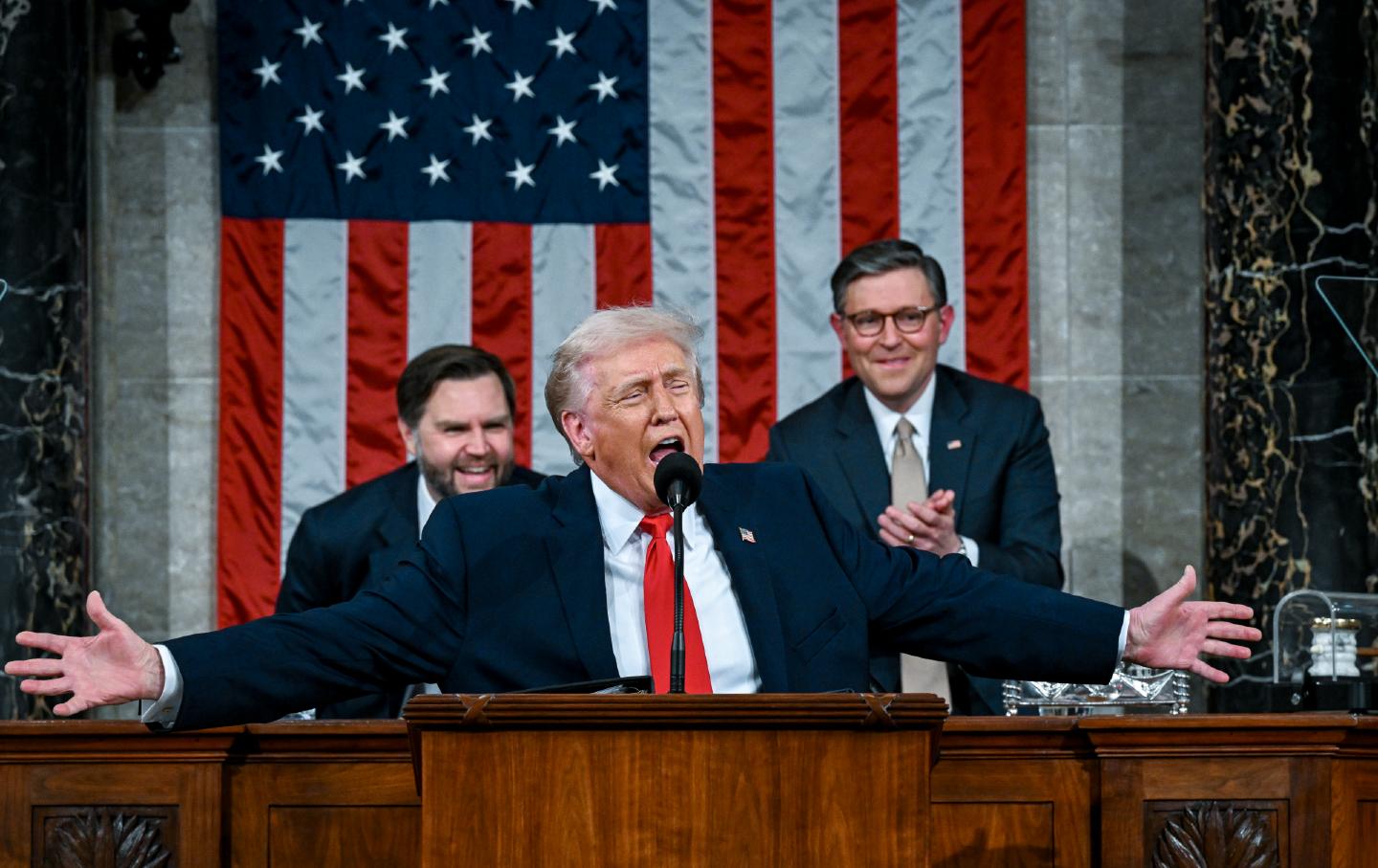
Even if Trump had consulted Congress in the proper manner, the war would still be a flagrant violation of international law and a catastrophe in moral and policy terms—just as the Iraq War, which Schumer voted to authorize in 2003, was. Top leaders have a duty to loudly and clearly oppose the war in and of itself, not just appeal to the domestic legal particulars by which it is being waged. The War Powers Resolution ought to be a vehicle for delivering an unequivocal message of “stop this war now,” not a means of deflecting responsibility by referencing poor procedure.
House Democratic Minority Leader Hakeem Jeffries hasn’t been much better than Schumer. Appearing March 1 on WBLS Open Line, he did gesture slightly more strongly at the idea that the war on Iran should not happen, but he still failed to say clearly that the war must end now: “There should be no preemptive need to go after Iran right now related to their nuclear program if you just said to the American people a few months ago that it’s gone. So you either lied then or you’re lying now. And, by the way, this whole notion of regime change—nobody’s feeling that. Now, the Ayatollah was a bad actor. We get that. But we can’t start wars all across the world because we disagree with the people who are in leadership, however bad they may be.”
And though Jeffries, like Schumer, vocalized his support for the War Powers resolution in the House, he dragged his feet for eight critical days before doing so. The New York Times broke the news that Trump was deploying the largest armada in over 20 years to surround Iran on February 18. From that day until February 26—when Jeffries and Schumer belatedly signed off on the War Powers vote a week after it was first proposed—neither Jeffries nor Schumer issued a single press release or social media post about the pending attack. When they finally did, to arrange for votes either this Monday or Tuesday, the war was long underway, and dozens of Iranian officials, including their head of state, the Ayatollah Ali Khamenei, had already been killed.
All of this would be concerning even if the war had majority support (again, as the Iraq War did at its outset). But it’s important to understand just how unpopular this war is with the US public overall—particularly Democrats, on whose behalf Democratic leadership ostensibly works. Before Trump’s unprovoked attack on February 28, only 7 percent of Democrats supported a war on Iran. After the attack, the number was still 7 percent, with 74 percent opposed. This is 3 points lower than the percent of Democrats, 10 percent, who think Trump rightfully won the 2020 election. The broader public isn’t much more enthusiastic; a Reuters poll on Monday found just 27 percent overall approval for the US-Israeli strikes, with 43 percent opposed and 29 percent unsure. If Democratic leadership equivocated on whether Biden stole the 2020 election, our media would rightfully insist they had lost their minds. But when leadership refuses to take a firm position that nearly three-quarters of their voters do, at a ratio of 10 to 1, it’s treated as business as usual.
There is reason to be concerned that Democratic leaders are deliberately delaying meaningful opposition. Journalist Aída Chávez reported on February 24 that House Foreign Affairs Committee Democrats had tried to delay a vote on Reps. Ro Khanna and Thomas Massie’s Iran war powers resolution, and that these efforts contributed to a significant delay, pushing the vote until after the war had already begun. This is consistent with reporting by Ryan Grim, Jeremy Scahill, and Murtaza Hussain for Drop Site on February 20 that in June 2025, when Trump was mulling a previous strike on Iran, “a substantial number of Senate Democrats believed Iran ultimately needed to be dealt with militarily.” According to an unnamed congressional aide, Democrats knew the war would be a political catastrophe. “That’s precisely why they wanted Trump to be the one to do it,” Drop Site reports.
There is a debate to be had about what kind of action is appropriate in the face of an unjust war of aggression being waged jointly by the most heavily funded military in the world and the only nuclear weapons power in the Middle East. For those who were elected to represent the US, the lowest bar is to at least register opposition: make it known, make it clear, do whatever you can do to throw sand in the gears until something changes.
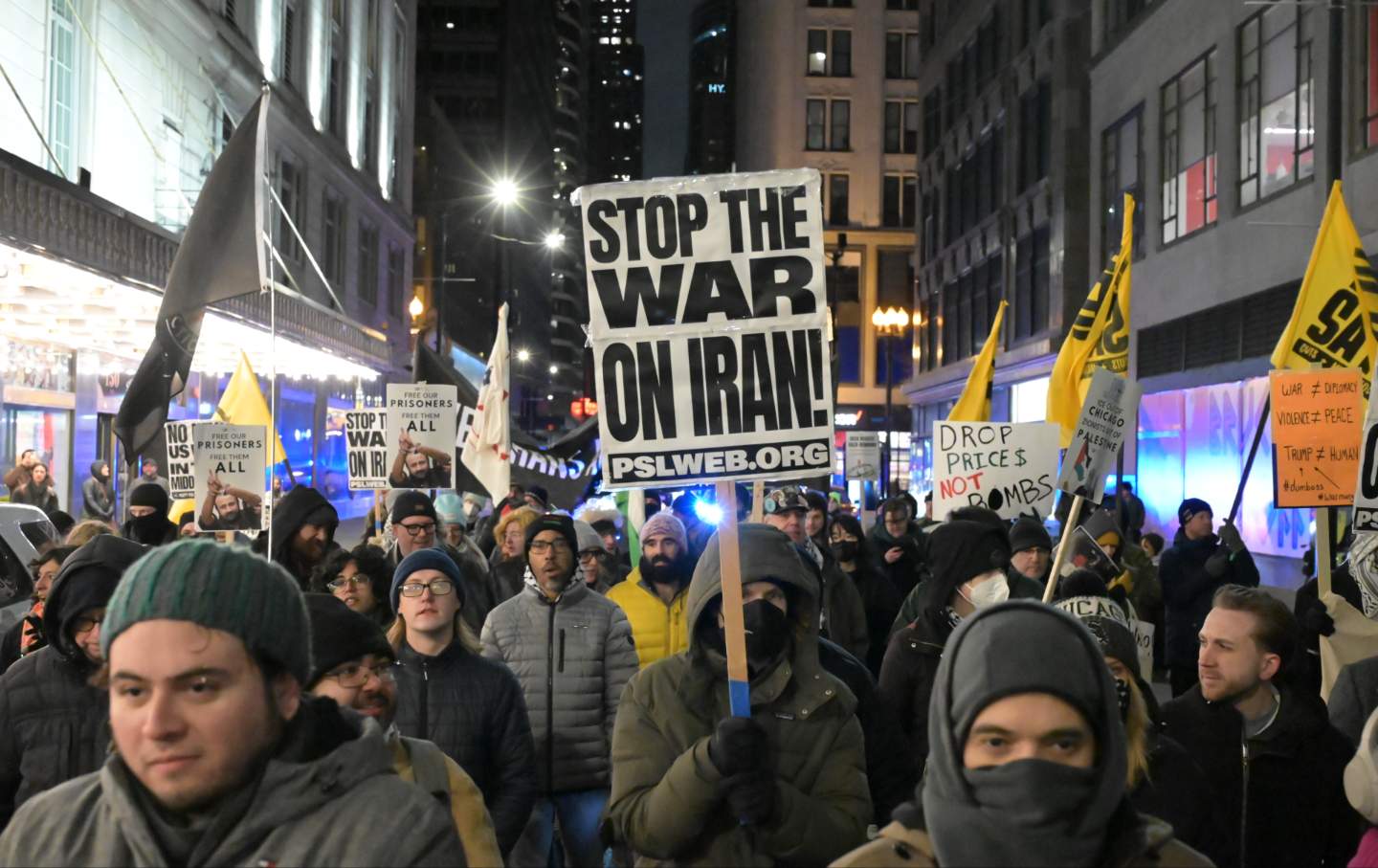
Calling for a vote for every member in Congress to go on record days into a rapidly expanding war, without even saying whether you’re against the war itself, does not meet the bare minimum standard of an opposition party supposedly concerned with upholding international and domestic law. Just as in the lead up to the Iraq War, people are out in the streets in cities and towns across the US to register their opposition to this war. “We call for an end to the bombing and the economic warfare of sanctions that has affected the Iranian working-class the most for decades,” Grassroots Global Justice Alliance proclaimed in a February 28 statement. The least elected representatives can do is say “no” out loud as the Trump administration hurls the world into the hell of an expanding war.
Rep. Rashida Tlaib’s statement, released Feb. 28, shows us it’s possible. “Congress must stop the bloodshed by immediately reconvening to exert its war powers and stop this deranged president,” she said. “But let’s be clear: warmongering politicians from both parties support this illegal war, and it will take a mass anti-war movement to stop it.”
It’s not enough to check the box, to do the bare minimum, to reinforce every argument for war only to balk at the process and ask whether there’s a “plan” for after the myriad war crimes have already been committed. The only way to read this half-hearted response from the Democratic Party leadership is de facto support. Inertia was serving the interest of the pro-war consensus and the Israel lobby that lavishes funding on both Schumer and Jeffries (Jeffries is by far the largest recipient of pro-Israel money in the House). But this is a position only 7 percent of their constituents support. So they did the next best thing: delay, hand-wring, remain conspicuously silent for over a week, and then—once the dogs of war had duly slipped—rush to look vaguely opposed to an attack that 93 percent of their constituents do not support.