
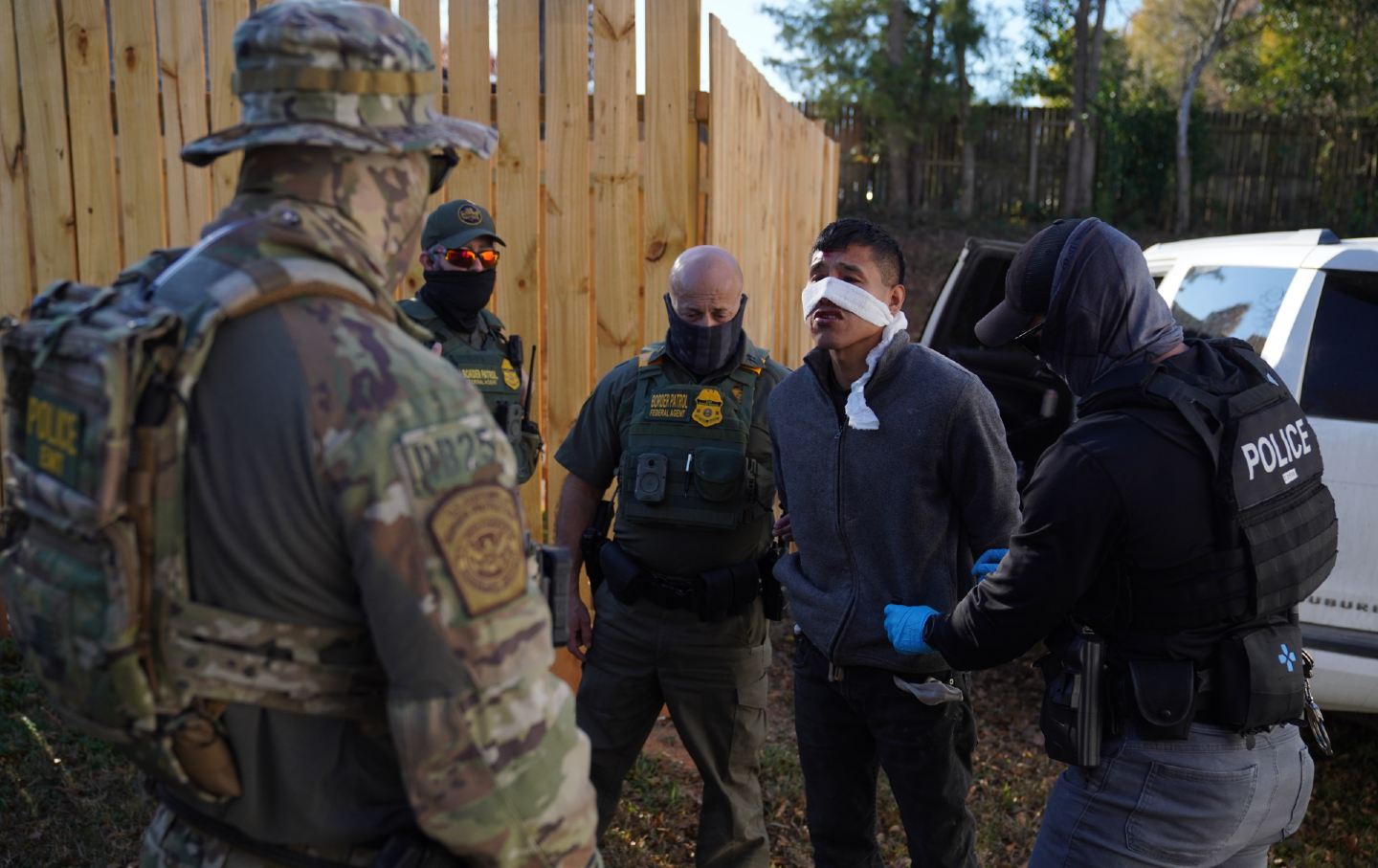
United States Border Patrol gave city leaders in Charlotte, North Carolina, just two days’ notice before unleashing “Operation Charlotte’s Web” on November 15, the latest in a series of immigration operations targeting Democratic cities.
Secrecy and confusion seemed to be part of the playbook. When Border Patrol agents began appearing in Durham and Raleigh, more than two hours away from Charlotte, the mayors of both cities said they had no idea it was coming. A week into the operation, Democratic Governor Josh Stein wrote a stinging letter to the Department of Homeland Security, stating, “State officials have received no notice of planned immigration enforcement actions since these operations began.”
North Carolinians may have been largely kept in the dark about US Customs and Border Patrol’s immigration action, but Siembra NC, a Latino group founded in 2017 in response to the first Trump administration’s attacks on immigrants, was ready.
Siembra NC was at the center of a counter-movement that saw thousands quickly mobilize in churches, neighborhoods, and schools across North Carolina. The day before Board Patrol arrived in Charlotte, Siembra NC launched a widely shared website—OJO Obrero, or “Lookout, Workers”—mapping confirmed sightings of CBP agents and arrests.
They also began training an army of volunteers across the state to monitor Border Patrol activity and ensure the safety of immigrant communities. On the very day agents were raiding neighborhoods and workplaces, Siembra NC hosted a “Safe to School, Safe to Work, Safe to Worship” training that drew 400, sharing information on how to identify agents, organize neighborhood patrols, and de-escalate conflict. Word spread quickly: In the next few days, more than 1,000 volunteers packed Methodist and Presbyterian churches in Charlotte. When Border Patrol showed up in Durham and Raleigh, hundreds more signed up for trainings there. Just over a week after the raids began, Siembra NC reported that more than 4,000 patrol volunteers had been trained across the state, giving concerned North Carolinians a concrete way to channel their fear and outrage.
“People go to a training, take a shift, become shift leads, train other people,” said Nikki Marín Baena, the daughter of Colombian immigrants and codirector of Siembra NC. “Lots of people are suddenly able to take action quickly to help people get home safely, to help kids get home from school.”
While Marín Baena and Siembra NC say the raids of the past week are unique—the “highest alert situation we’ve ever faced”—it’s also a scenario they’ve been preparing for. The group has been organizing in Latino neighborhoods and workplaces to fight wage theft and connect community members. Before Border Patrol arrived this month, they had also trained more than 2,000 volunteers for their ICE Watch hotline to respond to US Immigration and Customs Enforcement activity.
Trump and CBP certainly seemed eager to bring their law-and-order and anti-immigrant crusade to the battleground state of North Carolina. Charlotte, a genteel banking city with under 3 million people in its metro area, has seen violent crime plummet 20 percent since last year. But this summer, Trump turned the fatal stabbing of a Ukrainian woman on a commuter train into a national MAGA cause célèbre, painting the city as a lawless war zone, attacking Charlotte’s Black mayor, Vi Lyles, and declaring that “the woman’s death is now on the hands of the Democrats.”
Charlotte is also a microcosm of North Carolina’s fast-changing demographics. Mecklenburg County, where Charlotte is based, has seen its Latino population grow more than 50 percent since 2010, and its Asian communities swell by 83 percent.
As Charlotte’s newcomers have become part of the city’s fabric, Trump’s anti-immigrant rhetoric in his first term helped fuel a backlash: In 2018, Mecklenburg Sheriff Gary McFadden was one of five Black Democrats in North Carolina elected on a platform of refusing to cooperate with ICE. McFadden told NPR that the latest operation was payback, because “we were very vocal about protecting our citizens and residents here and stood at the door each time immigration came in.” (Earlier this year, North Carolina’s Republican legislature passed a bill requiring localities to cooperate with federal immigration agencies.)
Leading Border Patrol’s operation in North Carolina has been Greg Bovino, the bombastic agent who’s spearheaded the agency’s immigration-crackdown roadshow from Los Angeles to Chicago and now Charlotte. Bovino, who grew up in western North Carolina, is known for his swaggering hype videos, like the one released on X the day his team moved to Charlotte: “This is our fucking country,” Bovino bellowed, surrounded by armed CBP agents. “Nobody tells us where to go, when to go, how to go in our fucking country.”
Bovino’s emergence as the face of Trump’s anti-immigration crusade has marked an important shift. After activist and political pushback, observers noted that ICE was forced to dial back some of its worst excesses and be more careful about who it targeted and how it operated. For Steven Miller, Trump’s homeland security adviser, and Kristi Noem, the secretary of homeland security, this threatened to undermine the administration’s goal of arresting 3,000 immigrants a day. When ICE didn’t meet those numbers, according to immigration reporter Nick Miroff of The Atlantic, Miller and Noem “started replacing the leaders of ICE regional offices with Border Patrol commanders,” giving CBP unprecedented latitude to conduct aggressive military-style operations across the country.
Popular
“swipe left below to view more authors”Swipe →In Chicago, the dangers of Border Patrol’s freewheeling, combative approach became clear. CBP invaded schools and churches, previously viewed as off-limits “sensitive areas.” Despite claims that they were only targeting dangerous criminals—“the worst of the worst”—DHS’s own records released in response to a lawsuit revealed that 97 percent of the 614 immigrants arrested there had no criminal record.
And in an eye-opening 233-page ruling released last week, a US district judge dismantled the claims used by Bovino and CBP to justify their heavy-handed tactics in Chicago, which included pepper-spraying peaceful clergy and tear-gassing children. In one case, agents claimed protesters had thrown fireworks at them; video footage later revealed that the explosions were from Border Patrol’s own flash-bang grenades. “At some point,” Judge Sarah Ellis concluded after an inventory of dozens of misrepresentations by border patrol officials, “it becomes difficult, if not impossible, to believe almost anything that [DHS] represent[s].”
Over the last week, North Carolina organizers have been in regular contact with their Chicago counterparts, comparing neighborhood safety and training strategies. Siembra NC invited Chicago activists to host two virtual trainings last week—which were attended by hundreds of volunteers across North Carolina—to share lessons about how to coordinate local committees, counter misinformation, and prevent burnout.
“It was really helpful to talk to the people in Chicago about the importance of place-based organizing, being really specific about people in a particular neighborhood,” said Marín Baena. The Chicago organizers also helped Siembra NC see “the importance of decentralization, really tapping into volunteers to lead and take responsibility.”
After over a week of chaotic confrontations and more than 370 arrests, the future of Border Patrol’s operations in North Carolina is as murky as when it started. On November 20, Charlotte Mayor Lyles wrote on social media, “It appears that US Border Patrol has ceased its operations in Charlotte”; later the same day, DHS spokeswoman Tricia McLoughlin replied, “Wrong. Operation Charlotte’s Web isn’t ending anytime soon.”
North Carolinians are now left to navigate the uncertainty, and devastating fallout of the last week. More than 56,000 students in Mecklenburg County stayed home from school the first two weekdays of the Charlotte operation, and 45,000 absences were reported in just one day in Wake County, home of Raleigh. Construction and other workplaces emptied and stores closed, causing workers and businesses to lose income; as Marín Baena says, “We may never know the true economic cost to our state.” Information about who has been detained and where they are is scarce; Siembra NC has a solidarity fund to help cover expenses for families that have lost their primary breadwinner.
Siembra NC is still training safety patrols in preparation for future enforcement actions. They’ve also recruited 200 employers to sign on as 4th Amendment Workplaces, part of a national movement to protect workers from warrantless searches and arrests.
Ultimately, the group has its eyes on a bigger prize: mobilizing its working-class Latino members and allies to shift the political balance of power at the local, state, and national level. Siembra NC says that in 2024, their field teams registered more than 5,000 voters and knocked on more than 125,000 doors of Latinos in the run-up to the elections. Their outreach among the state’s more than 327,000 registered Latinos—at a time when Latino voters nationally are turning against Trump’s GOP—will be critical in the 2026 midterms, which includes a marquee US Senate race in North Carolina between Democratic former governor Roy Cooper and staunch Trump ally and former Republican National Committee chair Michael Whatley. As Edwin Peacock III, a moderate Republican who lost a Charlotte City Council race to a Democrat earlier this month, told Politico, the raids could leave “a real sour aftertaste” with voters—“I don’t see this cloud moving away.” “We have to do the work of taking care of our people, and we have to do the work of helping them navigate the system,” Marín Baena says. “And we also want to build the kind of political power to ensure that this does not happen again.”
Become a Sustaining Donor This September
Between the reemergence of right-wing red-baiting and Donald Trump’s use of the chilling National Security Presidential Memorandum–7 to criminalize left political organizing, we’re seeing McCarthyism reborn before our eyes.
This assault on democracy cannot be ignored or wished away. Resisting it requires bravery in the face of threats and repression, a steadfast commitment to the truth, and the unwavering belief that we can—and will—overcome this darkness.
We must have an independent media that sets the record straight, unearths corruption and abuses of power, and advances a politics of justice and dignity for all if we’re to win this fight.
That’s why I’m writing to you today. This September, The Nation needs to add 100 monthly donors to sustain our progressive journalism. Your contribution makes the next investigative report, the next truth-speaking column, and the next pathbreaking essay all possible.
I hope you’ll support our work with a recurring donation today. If you donate $10 or more a month, we’ll send you a brand new “Hands Off the Free Press!” sticker to recognise your commitment to our cause. Please, donate today.
Onward,
Katrina vanden Heuvel
Editor and Publisher, The Nation
More from The Nation

CEOs Are Losing Control of AI CEOs Are Losing Control of AI
With no slowdown from Trump’s administration.
Gina Hinojosa: “We Flip Texas, and It’s Over” Gina Hinojosa: “We Flip Texas, and It’s Over”
Talking to Texas gubernatorial candidate Gina Hinojosa about what redistricting could mean and how a new generation of Democrats is speaking more directly to voters.

Trump Wants to Keep Journalists Out of the White House. He Should Get His Wish. Trump Wants to Keep Journalists Out of the White House. He Should Get His Wish.
The president has banned MS NOW, CNN, and Politico from attending press briefings. The rest of the media should respond with a boycott.

The GOP’s Incredible Shrinking Senate Map The GOP’s Incredible Shrinking Senate Map
Trump has so badly damaged the Republican Party’s brand that strategists are contemplating bitter fights—and losses—in races they’d been banking on as sure things.

Bernie Sanders: “People Are Sick and Tired of the Status Quo. People Want Change” Bernie Sanders: “People Are Sick and Tired of the Status Quo. People Want Change”
Exclusive: Read the text of a major foreign-policy address delivered by the independent senator at Riverside Church.

Even Republicans Are Figuring Out That Pete Hegseth Is a Disaster Even Republicans Are Figuring Out That Pete Hegseth Is a Disaster
Hegseth was always a horrible choice for defense secretary. At long last, some in the GOP are admitting it.

