Did the Supreme Court Just Grow a Spine?
The court’s ruling ordering Trump not to deport a group of Venezuelan immigrants was an unprecedented rebuke. Are they finally taking back power?
There is an oft-used idiom in my community: “Stop playing in my face.” It can be loosely translated as “Sir, your lies mock my intelligence. Desist from these obvious falsehoods or I shall be roused to combat.”
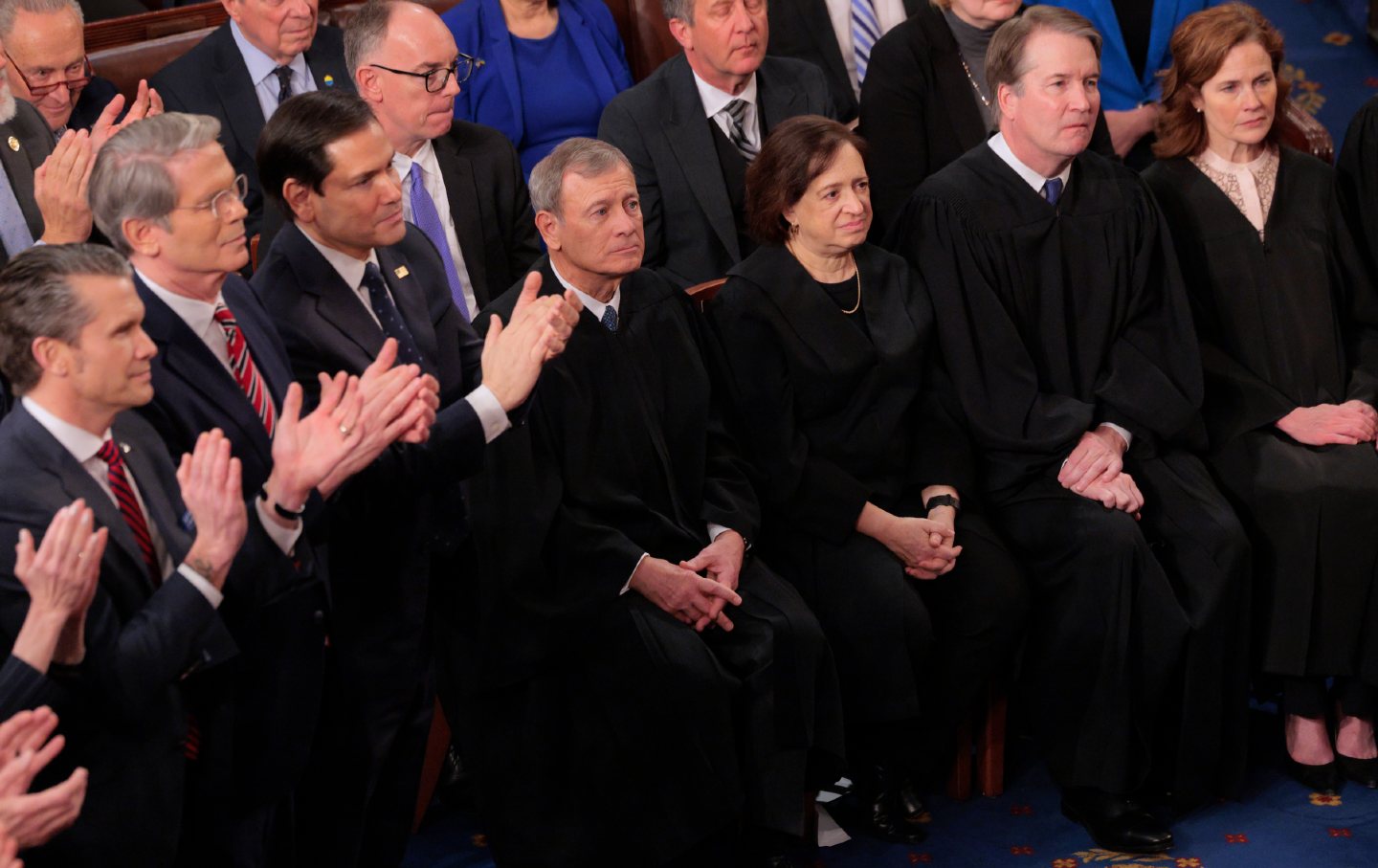
At 1 o’clock on the morning of Saturday, April 19, the Supreme Court issued a terse, one-paragraph order that amounted to John Roberts telling Donald Trump to stop playing in his face. The court, by a presumed vote of 7–2, ordered Trump to halt a number of planned deportations to El Salvador of immigrants being held in Texas. I believe this is the first time that a majority of Supreme Court justices have gotten pissed at the Trump administration’s lawless refusal to follow basic court orders. If the court is ever going to fight for constitutional principles in the face of fascist overreach, it might be here and now.
The order was issued in a case called A.A.R.P v. Trump (no relation to the old folks nonprofit), which involves Trump’s use of the Alien Enemies Act to deport people without due process. The procedural backstory of how this case got in front of the Supreme Court is complicated, but important.
On April 7, the court issued a ruling in Trump v. J.G.G., a case that also involves Trump’s spurious use of the Alien Enemies Act and that has gotten a lot of attention because the Republican judge presiding over it in the district court, James Boasberg, has tried to slow Trump’s mass deportations. When it was appealed to the Supreme Court, the court ruled that the Trump administration had to provide potential deportees with reasonable and timely notice of their deportation, and be given clear instructions on how they could challenge their abductions.
Following that case, the ACLU was able to get a number of temporary restraining orders (TROs) halting Trump’s mass deportations in three regions: the Southern District of New York, the District of Colorado, and, critically, the Southern District of Texas. The ACLU also asked for a TRO in the Northern District of Texas, but that application (called A.A.R.P. v. Trump to get a sense of where this is going), was denied by Trump-appointed Judge James Hendrix.
Trump seemed to comply with the TROs. But on April 18, reports surfaced that Venezuelan nationals were being “loaded onto buses” headed toward northern Texas—almost certainly as a way to get around the TROs in other districts. As bad, the immigrants received only 24-hours notice of their impending removal—and that notice was written in English (despite the fact that the majority speak only Spanish) and did not include instructions on how to appeal.
In response, the ACLU renewed its objection to the denial of a TRO in Northern Texas and filed emergency appeals with the Court of Appeals for the Fifth Circuit (the extremist, MAGA appellate court that covers Texas) and with the Supreme Court.
Given recent experience, I went to bed on April 18 fairly certain that, by the time I woke up, another group of people would have been illegally deported to El Salvador, never to be heard from again, while the Supreme Court twiddled its thumbs and redirected the ACLU back to the Fifth Circuit. That’s been the hallmark of the Supreme Court’s capitulation to the Trump administration this term: First, it delays; then, it hides behind procedure. Back during the Biden era, when the court didn’t like something, it would move quickly, via its “emergency” or “shadow” docket, to stop the administration from acting. But with Trump, the court takes its time, forcing everybody to appeal to the proper courts, in the proper order, while allowing Trump to continue acting (often lawlessly) until the Supreme Court finally gets around to making a determination.
But that’s not what happened here. Instead, the court acted with alacrity, even urgency, and essentially ordered Trump to turn the buses around at one in the morning. The Supreme Court moved so quickly that it issued its order before the Fifth Circuit could make up a pro-Trump argument, before the Trump administration could reply to the ACLU’s appeal, and even before the court’s two dissenting justices (Clarence Thomas and Samuel Alito) could write a dissent. Alito’s dissent was issued the next evening, and it made all of the procedural arguments Roberts usually goes for and Alito usually ignores when it suits their political positions to do so.
The court’s decision to issue this ruling when it could have opted to hide behind technicalities and courtesies tells me that the justices who ruled in the majority were fed up with Trump’s games. Trump was attempting to make an end run around the Supreme Court’s authority, and not only did the court tell him “no,” it told him “no” in the middle of the night, without even letting his lawyers or his Manchurian justices (Thomas and Alito) spit out their objections. On Holy Saturday, the court kept its eyes on the good news, instead of getting distracted by all of Trump’s rotten Easter eggs. The majority told Trump to stop playing in their face.
The ruling is really the first time I can think of when the court didn’t let Trump get away with legal time arbitrage—by which I mean it didn’t let him take advantage of the fact that the executive branch can move faster than the judicial branch and make its policies a reality before the court can weigh in on its legality. And Trump, clear as I can tell, actually complied. The buses were turned around. The victims in A.A.R.P. are still in the United States, for now. They likely wouldn’t be if the court had waited until Monday morning to issue the same ruling. They likely wouldn’t be even if the court had merely let Alito dawdle on his keyboard through the weekend to write his dissent.
Of course, nobody should be claiming victory just yet. First of all, the court has merely issued a procedural restraint. It still hasn’t gotten close to ruling on the merits of whether Trump can use the Alien Enemies Act as the excuse to carry out mass deportations, and the betting money says the hyper-conservative court will still eventually allow Trump to banish whomever he wants. And while Trump seemed to follow this late-night Supreme Court order, there’s no guarantee that he’ll follow the next one. It’s likely that the Trump administration simply didn’t expect the court to pull a 1 am order out of its hat: next time, the attorneys will be ready for it and have some obviously specious argument ready for why its victims can still be deported. The Trump administration has already gotten around lower-court orders by claiming, without evidence, that the abductees were deported before the court was able to file papers ordering the government to stop. I imagine that’s a trick it will use to try to evade compliance with the Supreme Court, before long.
Popular
“swipe left below to view more authors”Swipe →Still, to put this all in a broader context, the only other time the legal world waits for late-night or early-morning Supreme Court orders telling the government what it can or cannot do is in the context of death penalty cases. Death row inmates are consistently in the position of waiting for a ruling on their final appeal while their executioners sadistically hit “refresh” on their computers, hoping for the go-ahead to murder them. Supreme Court justices (even the ones I hate) are known to take their roles as the final arbiters of life or death seriously, and regularly work late into the night dealing with emergency appeals from the condemned.
Issuing an order at 1 am on Saturday is a pretty clear indication that the justices understood that their ruling was, in fact, a matter of life or death. It’s an indication that they knew that the people being herded onto buses in North Texas were being sent to their doom.
This time, this court, which so often hides behind procedural technicalities, refused to let Trump get away with murder. This time, maybe for the first time, a majority of the court understood that justice delayed would amount to justice denied.
Become a Sustaining Donor This September
Between the reemergence of right-wing red-baiting and Donald Trump’s use of the chilling National Security Presidential Memorandum–7 to criminalize left political organizing, we’re seeing McCarthyism reborn before our eyes.
This assault on democracy cannot be ignored or wished away. Resisting it requires bravery in the face of threats and repression, a steadfast commitment to the truth, and the unwavering belief that we can—and will—overcome this darkness.
We must have an independent media that sets the record straight, unearths corruption and abuses of power, and advances a politics of justice and dignity for all if we’re to win this fight.
That’s why I’m writing to you today. This September, The Nation needs to add 100 monthly donors to sustain our progressive journalism. Your contribution makes the next investigative report, the next truth-speaking column, and the next pathbreaking essay all possible.
I hope you’ll support our work with a recurring donation today. If you donate $10 or more a month, we’ll send you a brand new “Hands Off the Free Press!” sticker to recognise your commitment to our cause. Please, donate today.
Onward,
Katrina vanden Heuvel
Editor and Publisher, The Nation
More from The Nation

How Joe Biden Helped Cause a Genocide in Gaza How Joe Biden Helped Cause a Genocide in Gaza
An interview with reporter Akbar Shahid Ahmed about his new book, “Crossing the Red Line.”

A Premature Farewell to the Ignominious Speaker Mike Johnson A Premature Farewell to the Ignominious Speaker Mike Johnson
If Democrats win the House in the midterms, as expected, Mike Johnson won’t hold the gavel in any meaningful way again.

Transphobia Isn’t Winning Votes. But It Is Making Our Lives Much Worse. Transphobia Isn’t Winning Votes. But It Is Making Our Lives Much Worse.
Trans people must now live out another election cycle knowing our friends, family, coworkers, and neighbors are being flooded with agitprop designed to dehumanize us.
Zohran Mamdani Hosts the World Zohran Mamdani Hosts the World
In a meeting with mayors from around the globe, Mamdani argued that the left must fix everyday problems—or the right will find someone to scapegoat for them.