
Shed No Tears for Ron DeSanctimonious
Donald Trump doesn’t just defeat his rivals. He humiliates and obliterates them.
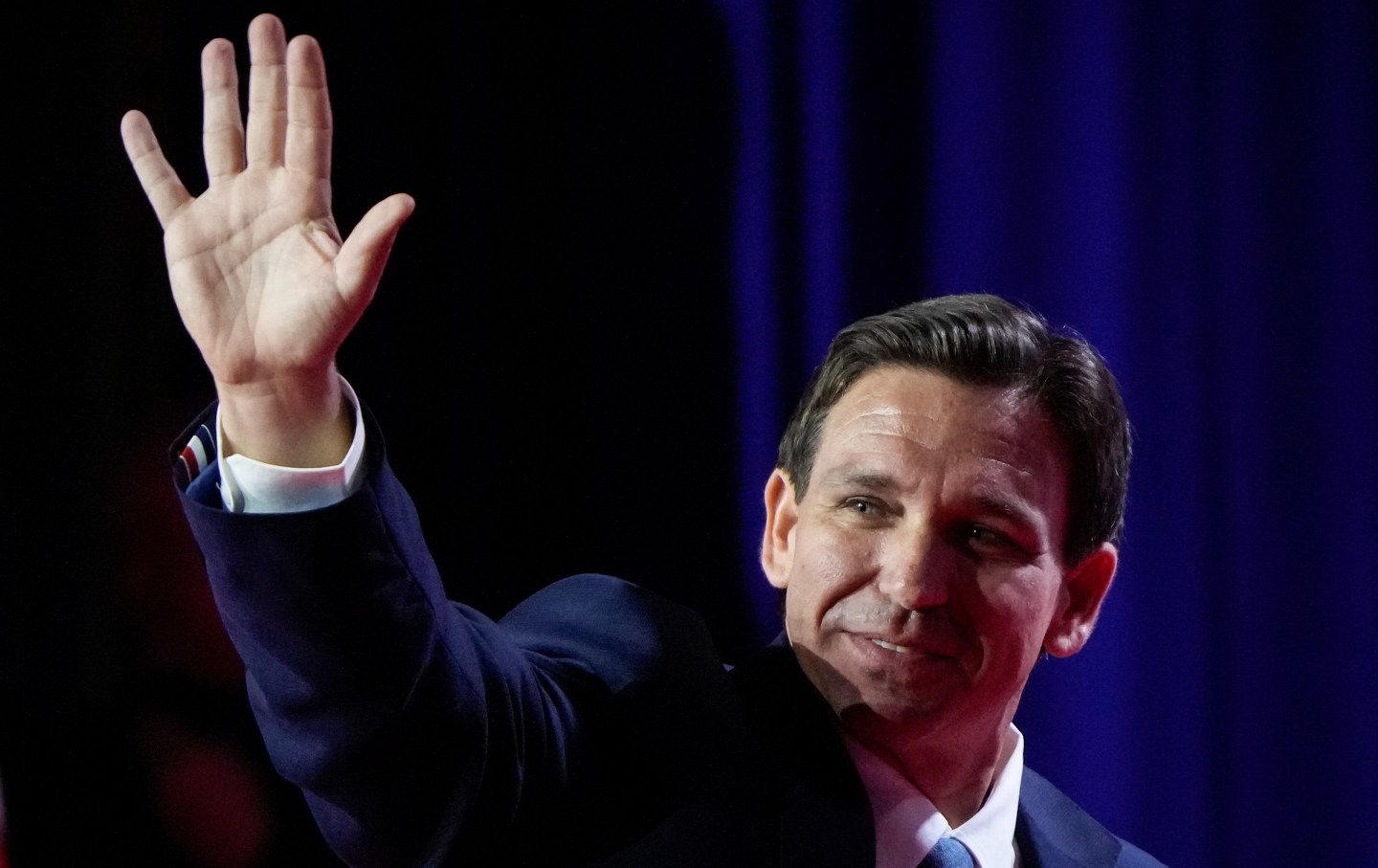
In the brutal game of politics, autopsies are often conducted while the patient is still alive. Florida Governor Ron DeSantis only ended his presidential bid on Sunday, but the stench of decay and mortality followed his campaign for many months, as he faltered in the polls and was mercilessly mocked by front-runner Donald Trump. Well before DeSantis threw in the towel, journalists at NBC and The Washington Post had run lengthy postmortems of the infighting and incompetence that allegedly hamstrung the candidate from the start. My Nation colleague Joan Walsh waited for DeSantis’s announcement suspending his campaign before delivering her own efficient and slashing rebuke. By all these accounts, DeSantis was doomed even before he announced his candidacy by a mixture of indecisiveness, poor strategic planning, and lack of a coherent message.
To the extent that DeSantis’s failure smooths the path for Trump’s inevitable coronation, it’s to be regretted. But DeSantis was never a Trump alternative in any meaningful sense. The whole logic of his candidacy was that he was Trump without the baggage—someone who could carry out Trump’s agenda in a more competent and forceful way than the former president. To that end, DeSantis styled for himself a political persona of cold, calculated bigotry that was singularly loathsome. DeSantis allied himself with the homophobes and transphobes of Moms for Liberty to sign many wide-ranging anti-LGBTQ+ laws designed to make life miserable for sexual minorities in Florida. He targeted black voters for disenfranchisement in a reversion to the dark history of Jim Crow. He placed the state’s colleges and universities—particularly the New College of Florida—in the hands of far-right ideological fanatics intent on destroying intellectual freedom and efforts to promote racial diversity. In a particularly vile stunt, he turned migrants into political props by having them transported from Florida to Martha’s Vineyard.
As Philadelphia Inquirer columnist Will Bunch concluded, “It’s so tempting to pile on the Ron DeSantis jokes but I keep thinking about the Black voters he had arrested, the kids who had to leave New College, the migrants he tricked onto that plane—all for the sake of the worst campaign in American history.” There’s no reason to mourn DeSantis’s epic failure.
DeSantis’s early defeat is remarkable given the lavish amount of money and media support he received from GOP plutocrats. By last September big donors had given his campaign more than $23 million—far more than to any other Republican candidate. Because moneyed DeSantis donors quickly ran into the limits of campaign finance law, his campaign relied heavily on the Never Back Down super PAC, funded to the tune of more than $130 million by last fall.
NBC’s dissection on DeSantis’s collapse emphasizes the logistical problems caused by the campaign’s lopsided dependency on funding from billionaires. Under campaign laws, campaigns aren’t allowed to coordinate with outside groups such as Never Back Down. The DeSantis campaign allegedly played fast and loose with these rules, because the super PAC was where the money was. Aside from the coordination problem, the big donors who made up the backbone of DeSantis’s support soured on the candidate’s heavy emphasis on red-meat culture-war politics. They preferred a more old-style Republican emphasis on austerity and foreign policy hawkishness. South Carolina Senator Tim Scott initially benefited from this re-funneling of money, although the donor class eventually settled on Nikki Haley, who goes forward as the last viable alternative to Trump.
The NBC account documents many more strategic failures: the fecklessness of Scott Wagner, the CEO of Never Back Down, who spent time in the crucial days before the Iowa caucus assembling a jigsaw puzzle; the reluctance to launch DeSantis’s campaign quickly after his 2022 reelection as Florida governor; a social media strategy that involved elevating and catering to cranks (including a staffer who promoted a video using Nazi imagery); an ill-advised decision to launch the campaign on a glitchy Twitter platform; overspending in the early weeks of the campaign that quickly depleted resources and led to staffing layoffs; an ill-conceived focus on door-to-door canvassing of rural voters, rather than the suburban Republicans who were more receptive to a Trump-skeptical message.
The Washington Post offers a parallel litany of maladministration. According to the newspaper, “From the beginning, the effort was hobbled by major miscalculations, competing advisers, wooden interactions with voters and a series of indictments against the former president that DeSantis could not control.”
The point about “a series of indictments” hints at the true problem, which cuts closer to the core rationale of DeSantis’s run and went well beyond the haphazard mistakes that bedevil all campaigns. Normally, having a rival who was under more than 90 indictments for serious crimes would be good for a candidate.
But the Republican electorate was so enamored of Donald Trump that the more often he was indicted the stronger he became in polling in the primaries. The reason is simple: Trump’s core political identity is as an anti-system politician—an outsider who upsets the applecart of the status quo. When he’s indicted, that’s just further proof that the system is out to get him.
DeSantis’s big problem was that the GOP electorate loves Trump as the great avatar of their hatred of the political status quo (which they see as beholden to powerful and devious liberal elites). Give this electorate, did it ever make sense to run as “Trump—but more politically adept and administratively competent”? It’s precisely Trump’s opposition to the norms of normal politics and administrative knowledge that makes him appealing. Running as “Trump—but competent” is like trying to create a rock star that is “Elvis—but chaste and subdued.” It reflects a misunderstanding of the product being sold.
One manifestation of Trump’s anti-system politics is that he doesn’t want to just defeat his rivals; he wants to humiliate them so they stand exposed as craven and weak. Consider the nicknames he gives them: Little Marco (Rubio); Lyin’ Ted (Cruz), Liddle Mike Pence, and Ron DeSanctimonious. These childish gibes are especially harmful to Republicans, because they eventually have to eat their pride and endorse Trump if they want any role in the party’s future. In the case of Cruz, the fact that Trump accused Cruz’s father of being involved in the John F. Kennedy assassination (and called Cruz’s wife ugly) hasn’t stopped Cruz from become a particularly servile lapdog of Trumpism.
Last Sunday, DeSantis commented on Trump’s bullying by telling an Iowa crowd, “You can be the most worthless Republican in America. But if you kiss the ring, he’ll say you’re wonderful.” The governor then added, “You can be the strongest, most dynamic, successful Republican and conservative in America ― but if you don’t kiss that ring, then he’ll try to trash you.”
Exactly one week after these damning words, DeSantis endorsed Trump. In a rare gesture of magnanimity, Trump announced that the nickname Ron DeSanctimonious has been “officially retired.” Since DeSantis was already groveling, there was no need to rub it in.
More from
Jeet Heer 
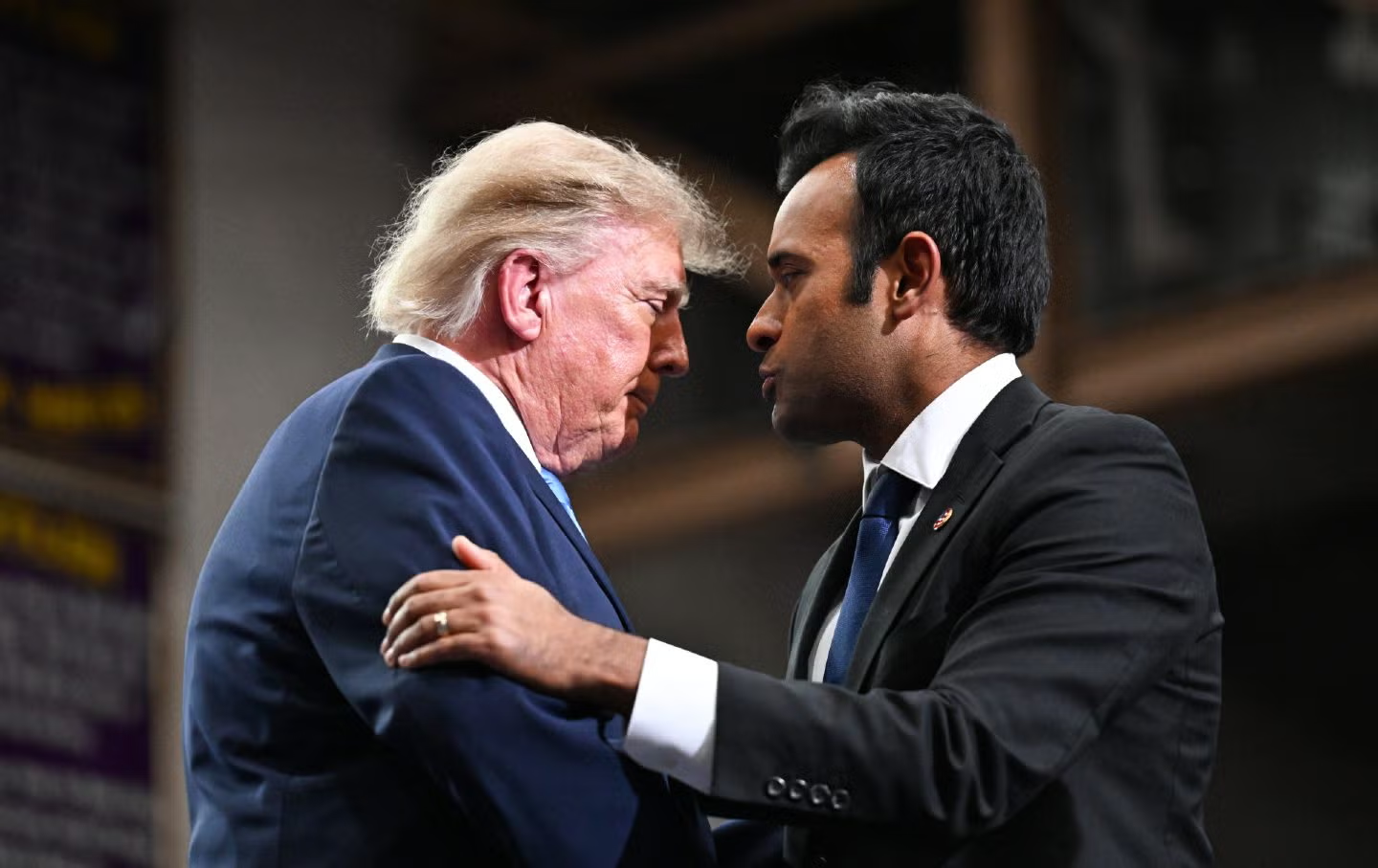
Why Trump Is Embracing Vivek Ramaswamy’s Vile Ad Why Trump Is Embracing Vivek Ramaswamy’s Vile Ad
The president is leaning into the politics of toxic parenting.
Even Republicans Are Waking Up to Trump’s Corruption Even Republicans Are Waking Up to Trump’s Corruption
And, somewhat shockingly, so are Democratic elites.
Where Is the Outrage Over Trump’s Racist Targeting of Ilhan Omar? Where Is the Outrage Over Trump’s Racist Targeting of Ilhan Omar?
The establishment press and some Democrats are strangely mute over the president’s flagrant abuse of the legal system.

The Real AI Threat Is Already Here The Real AI Threat Is Already Here
Never mind some future apocalypse—AI is being used right now to cause enormous suffering.
Elon Musk’s James Talarico Smear Blew Up In His Face Elon Musk’s James Talarico Smear Blew Up In His Face
But that doesn’t mean the danger from Musk’s lies is over.
Does America First Really Mean Israel First? Does America First Really Mean Israel First?
Mike Huckabee’s aide shows how an extremist agenda dominates Trump’s Middle East policy.

