Chuck Schumer Should Resign
Democrats never learned the lessons of Trump’s successes on tariffs and trade. Now the party’s leaders must take responsibility for their failure to embrace economic populism.
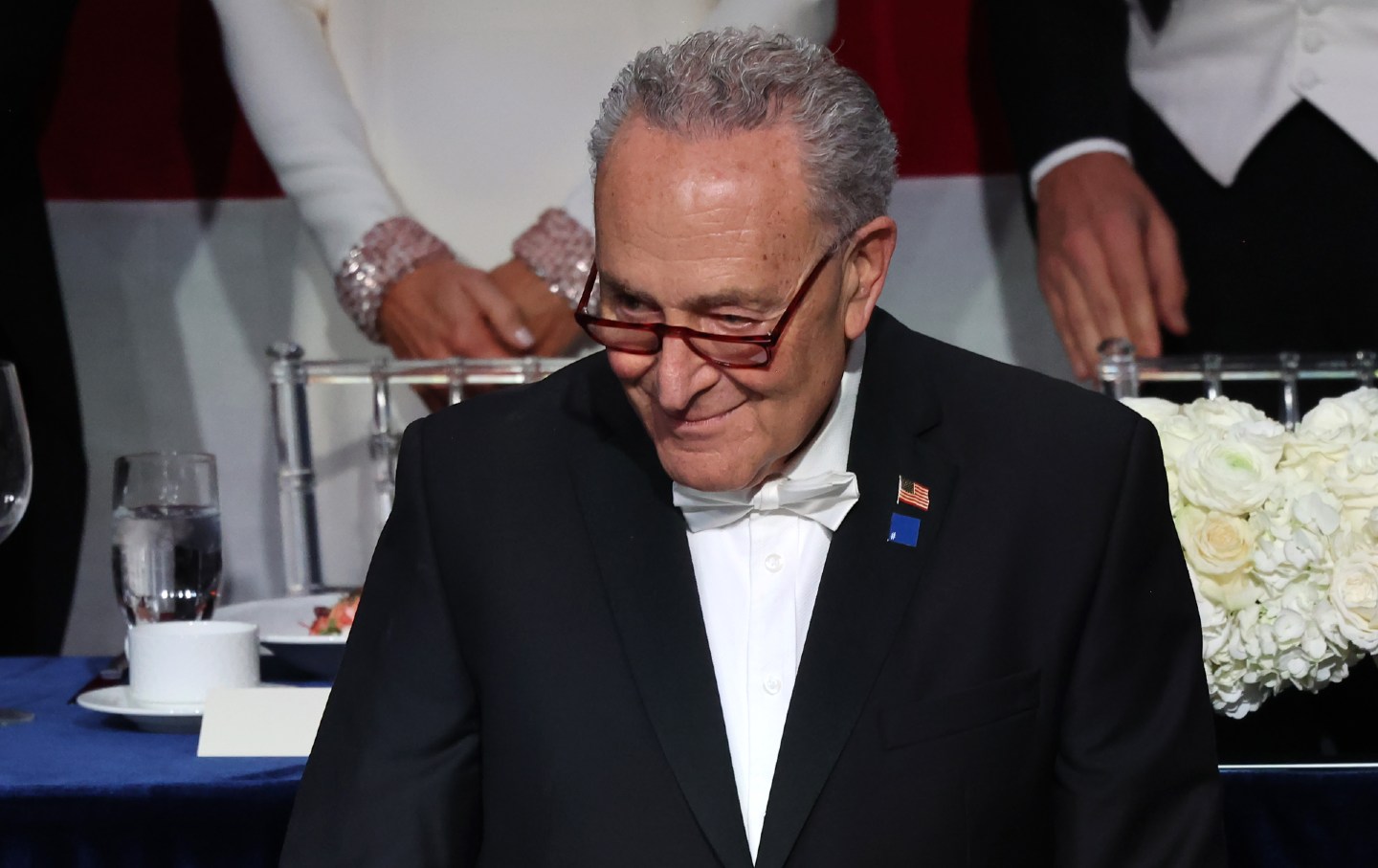
Senate Majority Leader Chuck Schumer attends the annual Alfred E. Smith Foundation Dinner at the New York Hilton Midtown on October 17, 2024 in New York City.
(Michael M. Santiago / Getty Images)
When a leader, whether of a party or a military campaign, sets out an explicit strategy that fails overwhelmingly, that leader, if he or she has a modicum of honor, should resign. In just the last few years, UK Prime Minister Liz Truss resigned after only 44 days in office; her successor, Rishi Sunak, resigned recently after leading his party to defeat. In August, Japanese Prime Minister Fumio Kishida resigned because of deep public dissatisfaction. Yesterday’s Democratic bloodbath requires no less of Chuck Schumer.
In 2016, Chuck Schumer confidently declared that Hillary Clinton would win, that Democrats would win the Senate, and that “for every blue-collar Democrat we lose in western Pennsylvania we will pick up two moderate Republicans in the suburbs in Philadelphia, and you can repeat that in Ohio and Illinois and Wisconsin.”
That did not happen. The obvious lesson, to many, was the party’s wholesale failure on economic populism, as a matter of both politics and policy. We Democrats didn’t just hold hands with Republicans on ultra-globalization; we had led the fight on opening everything up to China, and on NAFTA. Clinton led the way, but Obama followed, abandoning localism, economic patriotism, and anti-monopoly in favor of big companies and a promise of cheap goods. Deep dives into trade policy and polling found that Trump’s embrace of tariffs was key to his success.
But the party did not learn the lesson. Instead, it kept hunting for more and more suburban votes, and kept promising that demographic change would magically do the work that campaigning was not doing. Millennials, Gen Z, and Black and Latino voters were supposed to come in and save the party that was losing on its own terms. Big money and big super PACs were supposed to fill the void left by an increasingly hollowed-out local party infrastructure, and the goal of hunting for suburban votes fit nicely with the goal of wooing big donors like Mark Cuban and Reid Hoffman.
There were exceptions, in the late teens and this cycle. Representative Chris Deluzio from Pennsylvania won in Trump country with a strong track record of supporting tariffs against China and fighting against bad trade deals. Josh Riley in NY-19 won in a knife fight in the most expensive house race in the country with a focused agenda of fighting price gouging, calling campaign donations corrupt, supporting tariffs and local manufacturing. (To be sure, the indisputable populist Sherrod Brown was swallowed by the red wave; the Democratic Party’s overall perception matters more than individual races except in closely divided districts.)
Despite this, Biden, of all people, seemed to actually understand the problem; in domestic policy, at least, the president turned his back on Wall Street and elite donors, instead pursuing aggressive antitrust action and doubling down on the tariffs put in place by Donald Trump, supplementing them with crucial domestic spending to support local manufacturing. He elevated Lina Khan, Rohit Chopra, and Katherine Tai, and called on the Senate to act to break up Big Tech.
But Biden had to work with a Federal Reserve that was determined to keep interest rates at unbearable levels. He also bizarrely seemed to choose a press office that reflected the Clinton/Obama legacy, and instead of openly welcoming the hatred of the billionaires and monopolists and globalists his administration was confronting, most of his public statements—with few exceptions—sounded more like aw-shucks pragmatism, not reflecting the righteous public anger at elites who had been politely screwing over Americans for decades and calling it “efficiency.” But one of the key hurdles in the way of economic populism was a Senate led by Schumer that was notoriously uninterested in fighting corporate power. Schumer killed the Big Tech bills, and carried water for crypto.
How could an electorate whose top issues were the economy and democracy choose Trump? Because of the failures of Democrats to stand up for the little guy against crushing concentrated financial power. What Schumer has never understood—and many Democratic elites continue to fail to understand—is that economic populism is every bit as much about democracy as the big “democracy is on the ballot” discussion that dominated the legacy media airwaves. It’s about working class people having power, enough power that they can speak freely, change jobs, start a company, without being crushed by global trade or corporate monopolies. And trade policy is about economics, to be sure, but it is also about reaffirming democracy, too, the sovereign power to make decisions over our own lives. Perhaps big money and the dreams of super PAC dollars backing him up clouded his view.
This is not all Schumer’s fault, sure, but that doesn’t mean he shouldn’t resign. There are decades’ worth of leaders who share in the blame. Other heads at the DCCC and DNC should step down as well. But a high-profile resignation by Schumer would, perversely, give Democrats reason to hope. One of the core responsibilities of leadership is taking responsibility for success and failure equally, without overclaiming one and evading responsibility for the other.
Support independent journalism that does not fall in line
Even before February 28, the reasons for Donald Trump’s imploding approval rating were abundantly clear: untrammeled corruption and personal enrichment to the tune of billions of dollars during an affordability crisis, a foreign policy guided only by his own derelict sense of morality, and the deployment of a murderous campaign of occupation, detention, and deportation on American streets.
Now an undeclared, unauthorized, unpopular, and unconstitutional war of aggression against Iran has spread like wildfire through the region and into Europe. A new “forever war”—with an ever-increasing likelihood of American troops on the ground—may very well be upon us.
As we’ve seen over and over, this administration uses lies, misdirection, and attempts to flood the zone to justify its abuses of power at home and abroad. Just as Trump, Marco Rubio, and Pete Hegseth offer erratic and contradictory rationales for the attacks on Iran, the administration is also spreading the lie that the upcoming midterm elections are under threat from noncitizens on voter rolls. When these lies go unchecked, they become the basis for further authoritarian encroachment and war.
In these dark times, independent journalism is uniquely able to uncover the falsehoods that threaten our republic—and civilians around the world—and shine a bright light on the truth.
The Nation’s experienced team of writers, editors, and fact-checkers understands the scale of what we’re up against and the urgency with which we have to act. That’s why we’re publishing critical reporting and analysis of the war on Iran, ICE violence at home, new forms of voter suppression emerging in the courts, and much more.
But this journalism is possible only with your support.
This March, The Nation needs to raise $50,000 to ensure that we have the resources for reporting and analysis that sets the record straight and empowers people of conscience to organize. Will you donate today?