Democrats Should Listen to What Chuck Rocha’s Saying About Their Party
The strategist who helped Bernie Sanders win the Latino vote took himself out of the race for DNC chair—but he’s still got lots of ideas.
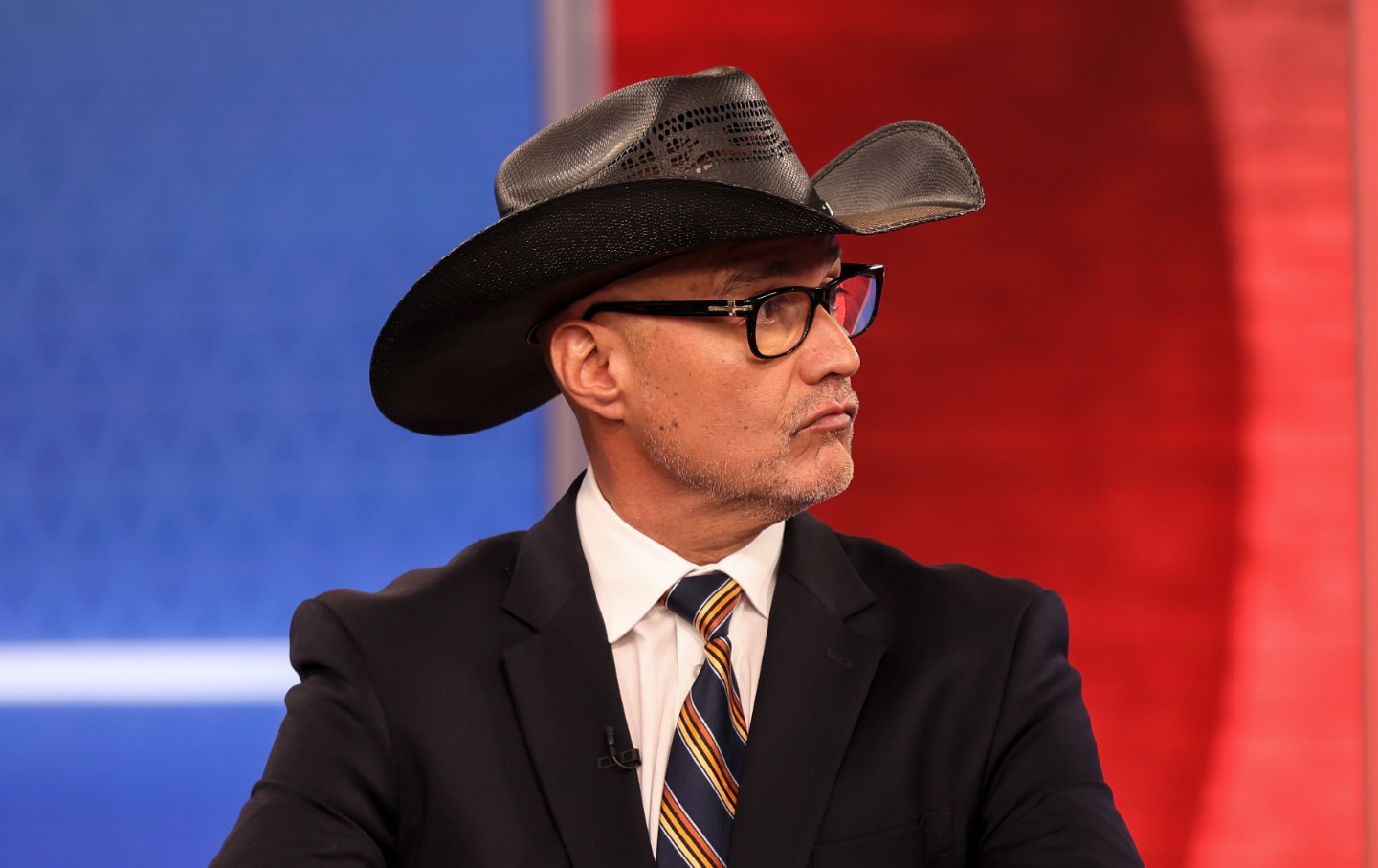
Chuck Rocha appears on CBS News on November 5, 2024.
(Michele Crowe / CBS via Getty Images)Chuck Rocha, the outspoken political strategist who helped Bernie Sanders win strong support from Latino voters for Sanders’s 2020 presidential bid, and who more recently has emerged as an important voice in debates about how Democrats should address the 2024 election debacle, won’t be joining the crowded race for chair of the Democratic National Committee. Blunt as always, Rocha announced this week, “I’m not running for DNC chairman because, after meeting with former chairmen (to discuss what the primary focus of the committee’s work). I have no interest in being a full-time fundraiser for the party. I’m still committed to fixing and rebuild our party, but I’ll do it without being the chairman.”
That was a pointed, and entirely appropriate observation regarding the DNC, which many critics have argued spends inordinate amounts of time chasing after big money and far too little time building a party that appeals to working-class voters. That criticism has been amplified following the November 5 election, as Democrats across the country have wrestled with the question of how to renew a party that lost the presidency and the control of the US Senate, failed to retake the US House, and made no gains in races for governorships.
Concerns about the DNC have been expressed even by its own members, including former Communications Workers of America president Larry Cohen, a longtime critic of the DNC’s approach who has argued since the election, “The number one reform is to get rid of the dirty money. We need to say that the Democratic Party is going to use its money—$100 million a year—not for TV, or operatives or consultants, but for organizing.”
A number of candidates have entered the race to replace outgoing DNC chair Jamie Harrison, and for other top DNC posts. Among them are progressives such as Wisconsin Democratic Party chair Ben Wikler and Minnesota Democratic-Farmer-Labor Party chair Ken Martin. Former Maryland governor Martin O’Malley, an unsuccessful 2016 presidential contender, is also running, along with New York state Senator James Skoufis and former Maryland Senate candidate Robert Houton. Many other names have been suggested, including those of former Chicago mayor and current ambassador to Japan Rahm Emanuel, an insider favorite, gun control advocate David Hogg, and Michigan state Senator Mallory McMorrow, who earned a national following with a 2022 floor speech on the “hollow hateful scheme” of Republicans who attack public educators for teaching about systemic racism and supporting LGBTQ+ youth.
Rocha, a self-described “red neck farm boy from East Texas” who started as a union activist and became a highly regarded political strategist for Sanders and others, had been in the mix in the weeks after the election. His extensive background in organizing and turning out Latino voters drew interest from Democrats who are struggling to address a steep and politically troublesome decline in Latino support for the party in many parts of the country.
But just because Rocha isn’t running for chair doesn’t mean he’s going to sit on the sidelines. On Wednesday, he declared on CNN, “I hope somebody runs who really wants to reform the party.” Then, he published an important op-ed in The Boston Globe, where he observed, “If you listen to how Republicans describe Democrats, you might never imagine I could be one.”
“I didn’t go to college, worked in a tire factory, and eventually became a union man. I have a criminal record, and I have been a single father for 35 years,” Rocha recalled in his Globe article.
But I joined the Democratic Party because it actually represents the principles President-elect Donald Trump claims he stands for but that he clearly does not. I wanted to fight against exporting US jobs overseas, to drain the Washington, D.C., swamp of rich, powerful people who think they are better than the rest of us, and to stop spending taxes on foreign wars when there are plenty of problems at home. And I have remained a Democrat to protect my mother, who relies on Social Security, and my son, a union steamfitter and single father who needs child-care assistance for his twin boys. I want to ensure my grandchildren inherit a planet without war, or one burning up from climate change.
The party cannot do those things without winning elections, and to do that, Rocha explained, it must “return to the working-class values that made me join it in the first place.” To that end, he suggested, it should take lessons from the winning campaign of Arizona US Senate candidate Ruben Gallego, for whom Rocha was a senior adviser. It mattered, Rocha wrote, that Gallego “met voters where they were: a Canelo Alvarez prize fight watch party at a boxing gym, town halls in Spanish, and community events featuring carne asada and beers. That’s not politics as usual—but believe me, it worked.”
Rocha offered a lot of other advice—about the need for “a true 50-state campaign plan that doesn’t ignore ‘flyover’ states,” the importance of devoting extra resources to rural and Latino regions of the country “starting in the southwest so we can win back Nevada and Arizona.” He wants to see more permanent organizers hired, and more work with consulting firms led by Black and Latino strategists. “If party resources keep going to the same professional consultant class who fail up, even when we lose, the Democratic Party will continue to sputter,” warned Rocha, who added, “The DNC should also create a new messaging commission to help rebrand itself leading up to the 2028 elections. I’m not talking about hiring an agency in New York City to come up with a snazzy new logo but a full-on reinvention of how Democrats should communicate their message.”
Some Democrats may bristle at the argument for a major makeover, but Rocha wrote, “If we don’t do that work, Democrats should be prepared to watch where JD Vance or Marco Rubio take the country after Trump slinks back to Mar-a-Lago.”
Support independent journalism that does not fall in line
Even before February 28, the reasons for Donald Trump’s imploding approval rating were abundantly clear: untrammeled corruption and personal enrichment to the tune of billions of dollars during an affordability crisis, a foreign policy guided only by his own derelict sense of morality, and the deployment of a murderous campaign of occupation, detention, and deportation on American streets.
Now an undeclared, unauthorized, unpopular, and unconstitutional war of aggression against Iran has spread like wildfire through the region and into Europe. A new “forever war”—with an ever-increasing likelihood of American troops on the ground—may very well be upon us.
As we’ve seen over and over, this administration uses lies, misdirection, and attempts to flood the zone to justify its abuses of power at home and abroad. Just as Trump, Marco Rubio, and Pete Hegseth offer erratic and contradictory rationales for the attacks on Iran, the administration is also spreading the lie that the upcoming midterm elections are under threat from noncitizens on voter rolls. When these lies go unchecked, they become the basis for further authoritarian encroachment and war.
In these dark times, independent journalism is uniquely able to uncover the falsehoods that threaten our republic—and civilians around the world—and shine a bright light on the truth.
The Nation’s experienced team of writers, editors, and fact-checkers understands the scale of what we’re up against and the urgency with which we have to act. That’s why we’re publishing critical reporting and analysis of the war on Iran, ICE violence at home, new forms of voter suppression emerging in the courts, and much more.
But this journalism is possible only with your support.
This March, The Nation needs to raise $50,000 to ensure that we have the resources for reporting and analysis that sets the record straight and empowers people of conscience to organize. Will you donate today?