
Affordable Housing Is at Stake in the NYC Election, but Advocates Can’t Agree on How
While half of the proposals on this year’s ballot deal with housing, elected officials and organizers in New York City are divided on their effectiveness.
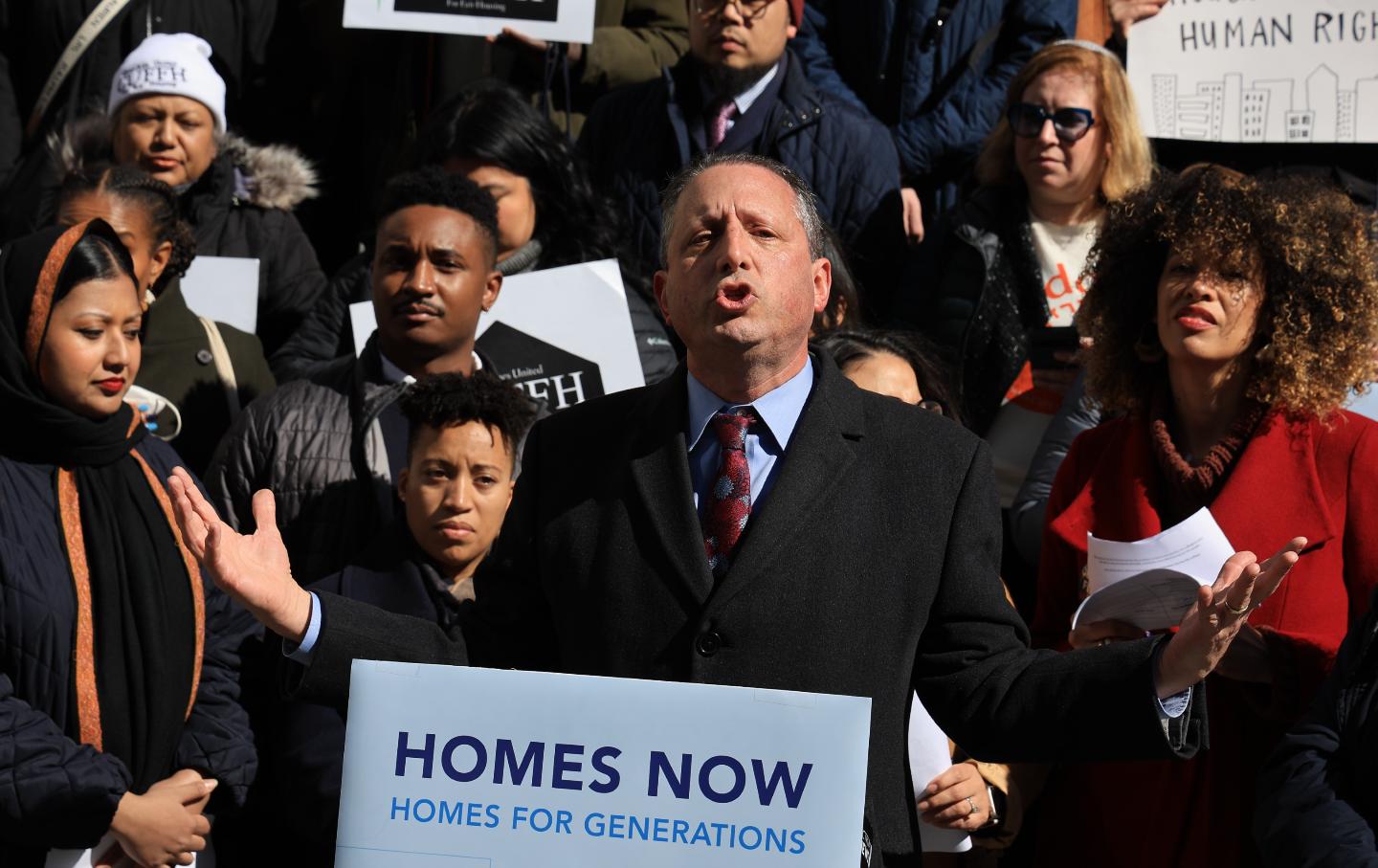
New York City Comptroller Brad Lander is pictured during press conference and launching of the Affordable Housing Budget Campaign with NYC Council Progressive Caucus in March 2024.
(Luiz C. Ribeiro / Getty)
When Astoria resident Kasey McNaughton broke her leg last summer, her immediate worry was the medical bills. “This is an emergency that I didn’t plan for,” said McNaughton. Because of the additional costs, she wasn’t sure if she would be able to pay her rent for the month. “My rent is going up. My neighbor’s rent is going up, and even modest increases or minimal increases are hurting people really bad,” said McNaughton, a tenant organizer for the Youth Alliance for Housing, which fights for “a world where housing is decommodified, houselessness does not exist, and everyone is guaranteed a safe, quality, and permanently affordable home.”
In New York City, rents are higher than ever, even as vacancy rates plummet. While housing insecurity extends citywide, students and youth are often at the forefront, as a record high of 154,000 students in New York City have experienced homelessness within the past school year. Almost 10 percent of all rental housing is considered overcrowded, and existing developments like NYCHA have suffered catastrophic damage from continued disrepair.
This November, the future of affordable housing is at stake in New York City—and not just in the mayoral race. (Zohran Mamdani, the Democratic nominee with a double-digit lead, has made affordability and a rent freeze for stabilized tenants the focus of his campaign.) Of the six proposals on the ballot, half of them tackle affordable housing. If passed, Proposals 2, 3, and 4 would amend the state Constitution and city charter to fast-track applications for affordable housing developments, simplify review of housing projects, and establish an affordable housing appeals board.
But affordable housing advocates and elected officials across the city are divided on the effectiveness of the proposed amendments.
Manhattan Borough President Mark Levine, Brooklyn Borough President Antonio Reynoso, and Comptroller Brad Lander, for example, have all endorsed the measures, while the City Council attempted to keep the proposals off the ballot, saying they “deceive voters” and would “give the public’s power to developers.” Mamdani has not yet publicly expressed a stance on the ballot measures, though Cea Weaver, who has advised Mamdani’s campaign on housing policy, said she supports the proposals. Independent candidate Andrew Cuomo has also backed all three, while Republican Curtis Sliwa opposes them.
Though the tenant-rights organization New York State Tenant Bloc does not officially endorse ballot measures, Weaver, the organization’s director, personally believes they will be “really strong complements” to some of their work, echoing sentiments from local community organizers like Asad Dandia. “I’m a born-and-raised New Yorker,” Dandia wrote on X, “and I support voting YES on affordable housing proposals 2, 3, 4, and 5 this November. The more of it we build, the more freedom we have to choose where in the city we can live.”
Weaver says that the passage of Proposal 2, which speeds up the review time of applications for affordable housing developments, would make it easier for city financed housing to be affordable, and give the public sector a “leg up.” An analysis done by the City Council over the summer shows that up to 12 districts in Manhattan, Queens, Brooklyn, and Staten Island would qualify for the expedited review.
But skeptics, including some progressive members of the City Council, have expressed concern that by fast-tracking the process, legislators’ role in selecting the developments would be undermined, shifting their power to mayoral appointees.
“If we fast-track these processes, I’m very curious about what kind of developments will get pushed through,” said McNaughton. “When we talk about zoning, we need community control of housing; we need input from tenants; we need input from representatives who are supposed to serve our interest.”
Proposal 3 would establish the Expedited Land Use Review Procedure, implemented for land-use projects that are of smaller scale (of no more than 45 feet), and increase housing capacity up to 30 percent. While the City Council would still get final approval for dispositions of city property, it would diminish the authority of council members, and by extension the constituents they represent, to approve or reject qualifying projects. “Ballot measure 3 allows for faster acquisition for the purpose of affordability,” Weaver said. “As we’re thinking about ways the Zohran administration can take over affordable housing, it will help him tremendously.”
Proposal 4 would create a three-member Affordable Housing Appeals Board—consisting of the council speaker, local borough president, and the mayor—to approve or deny land use applications for affordable housing. In the event that they wish to reverse a City Council decision, this board would replace the mayor’s veto power.
“There is no actual guarantee in any of these proposals that there will be truly affordable housing,” said Mira Gupta, a member of the Youth Alliance for Housing. “My recommendation is to the tenants, and that is to get organized,” McNaughton said. “Unionize your building. [Otherwise] young people aren’t going to be able to grow old in this city.”
More from The Nation
Why Can’t Top Democrats Just Say “No War With Iran”? Why Can’t Top Democrats Just Say “No War With Iran”?
The response to what could be the biggest geopolitical disaster of the 21st century is foot-dragging, silence, and sleepy, feigned opposition long after the deed is done.
This Is an Unnecessary, Unauthorized, and Unconstitutional War This Is an Unnecessary, Unauthorized, and Unconstitutional War
Congress has a duty to take up War Powers resolutions and assert its primacy over matters of war and peace.

Will There Be Justice for Survivors? Will There Be Justice for Survivors?
The Epstein files have renewed scrutiny of alleged misconduct by powerful figures, including Donald Trump and Prince Andrew, raising ongoing questions about accountability and just...
New York City Hospitals Fold to Trump. Will Zohran Mamdani Defend Trans Care? New York City Hospitals Fold to Trump. Will Zohran Mamdani Defend Trans Care?
As a candidate, Zohran Mamdani made promises to New York City’s trans community. With two hospital systems ending trans youth care, he’s now facing his first test.

This Minnesota Winter Is the New Prague Spring This Minnesota Winter Is the New Prague Spring
I’ve studied Czechoslovakia in 1968. I live in Minneapolis. The similarities between the historic invasion and the current ICE “surge” are scary.
Jesse Jackson Reshaped the Democratic Party Jesse Jackson Reshaped the Democratic Party
The candidate may have started as a long-shot contender, but The Nation always took him—and his impact on political history—seriously.

