Saving the Scarlet Macaw in Narco Country
In eastern Honduras, Indigenous guardians are risking their lives to protect the famous red parrot.
La Moskitia, Honduras—The DHC-6 Twin Otter from Tegucigalpa touched down on a 12,000-foot strip of dirt. There was no signage confirming that this was the Puerto Lempira airport in eastern Honduras. Most passengers carried suitcases and boxes brimming with food, clothing, medicine, and other materials. But I had traveled light, ready to cross more than a hundred miles of rough road to reach inland communities where I hoped to better understand the allure of one of the most beautiful—and most highly coveted—birds in the world: the scarlet macaw, known to the Afro-Indigenous Miskito majority as the apu pauni.
Puerto Lempira—the capital of Honduras’s easternmost state, Gracias a Dios—sits on the edge of La Moskitia, a 14,000-square-mile rainforest often called “the second Amazon” and “the lungs of Central America.” In English, it’s known by the exoticized misnomer The Mosquito Coast. (Oral tradition says La Moskitia is named for Miskut, a legendary Indigenous leader—not the blood-sucking insect.) Until 1957, Gracias a Dios—literally “Thank God”— remained largely unmapped and had no formal government presence. Its remoteness—pipantes (motorized canoes) and small planes are the main mode of transportation—has helped protect its scarlet macaw population, but it has also made it a haven for groups looking to avoid the law and whose activities now threaten the iridescent bird.
My mission in La Moskitia was a simple one: to see if and how it’s still possible for scarlet macaws to live in harmony with humans in a shared community. I had already visited several macaw conservation projects run by universities, nongovernmental organizations, and wealthy individuals across Central America and the Caribbean. But as important as these efforts are, few of these incorporate Indigenous people whose ways of living have sustained both the birds and the forests they’ve lived in for millennia.
In La Moskitia, the fates of the Miskito and the scarlet macaws are inseparable. By dispersing seeds, the scarlet macaws regenerate the forests that feed the Indigenous communities, who in turn safeguard the bird. Now both the macaw and the people are under threat: Poachers raid nests for eggs bound for international buyers; settlers burn down forests for cattle and agriculture; and narco-linked groups exploit the region’s lawlessness to traffic along La Ruta, the mass of jungle and forest they use to move billions of dollars worth of drugs north.
Thankfully, I wouldn’t be undertaking the six-hour drive to La Moskitia’s villages alone. Outside the airport’s rusty gate, Santiago Lacuth, a leader in the Miskito village of Mavita, greeted me with a hearty smile, and beside the lanky Lacuth was Lorakim Joyner, a five-foot-tall Atlanta-born wildlife veterinarian and Unitarian Universalist minister who leads One Earth Conservation, a US nonprofit that works with parrot preservation efforts. They stood in front of a faded white 2005 Toyota pick-up truck. Packed with barrels of water, boxes of foodstuffs, electrical equipment, and other materials for Mavita, the Toyota had the look and feel of a reliable but tired workhorse, a Rocinante with cracked windows.
The sides of the Toyota were emblazoned with a luminescent yellow, blue, and red parrot soaring against a blue sky. Above the image were the Spanish and Miskito words: Proyecto Apu Pauni, or the Apu Pauni Project. After stalling momentarily, the Toyota awakened, and our journey to Mavita began.
Anticipating a long, bumpy ride, I asked Lacuth and his son Jarri, who sat next to me in the back wearing a baseball cap to teach me how to say things in Miskito. Their native tongue bears the marks of regional history, migration, and conquest. Miskito is a mix of local Indigenous Sumu and other regional languages, South American Chibcha, Nahuat (the language of the Aztecs and other Mesoamerican peoples), West and Central African languages, Spanish, and Caribbean languages, especially Jamaican English. Jarri began the Miskito lesson with words he thinks might be easiest for me to understand.
“We’re riding in a ‘truk,’” he told me in Spanish. “And this is the dur, he added while hitting the car door. Rice and beans mixed together—called casamiento (marriage) in my parent’s homeland of El Salvador and moros y cristianos (moors and Christians) in Cuba—is called riceanbeans in Miskito.
After I explained that I’m writing a book about scarlet macaws, he said (in Miskito-inflected Spanish), “We would say you’re writing a buk about the apu pauni.”
The English loan words in Miskito traveled to this part of the Central American Caribbean through different subjects of the British empire: formerly enslaved people who escaped plantations in Jamaica, bureaucrats, and English explorers who set foot here from the 16th to 18th centuries. Also influencing the Miskito language were pirates like Blackbeard (Edward Teach), Henry Morgan, and John Coxen—some of whom had pet scarlet macaws rumored to speak fragments of pirate English.
The pine forests and grass lawns surrounding the road give this part of La Moskitia the look and feel of one long tropical golf course, a hundred-mile mirage to someone like me coming from the drought-ravaged, soon-to-be-grassless desert of Las Vegas.
A few minutes into our trip, it became obvious that the Miskito’s Apu Pauni Project has made their marks on the land: Its signs in Miskito and Spanish dotted the road to Mavita. One of the first billboards we encountered had a picture of a large macaw flying and declared, “SAY NO TO ANIMAL TRAFFICKING!—In La Moskitia We Protect Parrots and Guaras.” (Guara is the Indigenous-derived Spanish word for the scarlet macaw in Central America.) This and other signs bear the logo of Miskitu Asla Takanka or MASTA, the organization of Miskito unity that fought for decades to secure the collective tenure over 1.6 million acres (about 7 percent of Honduras’s landmass) to the Miskito and other Indigenous groups who inhabit the region.
Further down the road, another sign declared, “These Titled Lands Belong to the Indigenous Miskito People.” Below those words, in all caps, the phrase “NO SE VENDE, NI SE COMPRA,” signaling that the land is not for sale and can’t be bought. Other signs had similar messages: “Miskito territory is not for sale” and “Whoever buys titled land buys nothing!”
“There is no such thing as private property here,” Lacuth explained. “Our Miskito statutes are very clear about this. People are invading our land and using it for cattle ranching, burning forests, and other illegal activities. The guaraand the forest are threatened by the terceros.”
The terceros—“the third ones” or “third parties”—are non-Miskito settlers from outside La Moskitia, who, for decades, have invaded the territory and cleared forests for migratory agriculture, monoculture, oil exploration, and other uses. Many of the terceros conduct their activities under the protection of Los Poderosos (literally “the powerful ones”), the cartel leaders and big ranchers making profits on this pit stop on the cocaine superhighway.
About an hour into the drive, Lacuth pulled over. To the right of us stood a cross bearing the name of Osvaldo Jacobo, one of the early Miskito environmental leaders who founded MASTA in 1976. “This is where they killed Osvaldo,” Lacuth said, describing the incident that took place in 2000. “They ran trucks over him, killed him because he fought for our rights.” Lawlessness here did not die with the pirates.
An hour later, Lacuth pulled over to a spot that resembled every other spot on the long road. He pointed to a shallow hole in the ground and said that hit men hired by poachers “followed me on motorcycles until they thought it was safe to kill me at this spot. They fired several shots into the truck and cracked the windshield there.” He gestured to the truck’s still-splintered windshield. The projectile’s path included my seat.
Seeing Jacobo’s cross and hearing about the assassination attempt on Lacuth amid the tropical air gave me vertigo and an eerily familiar feeling. My mind went back to the 1980s, when I drove on Honduran, Nicaraguan, and Salvadoran roads and saw crosses, heard similar stories, and had my life threatened by anonymous men—Salvadoran death squads—for doing what we called “Solidaridad.”
Being here also stirred memories of reports about how La Moskitia was used as a landing base of operations for a more silent actor in the story of the region: the CIA, which illegally transported arms and drugs though Honduras as a part of the Reagan administration’s logistical and political support for the contras, violent extremists who were trying to overthrow the Sandinista government just across the Coco River in Nicaragua.
It reminded me that drugs continue to loom large in the story of La Moskitia, including that of the scarlet macaw. Lacuth told me large swaths of La Moskitia are dotted with narco airstrips used to fly cocaine from Colombia to the United States: “The terceros don’t act alone. They respond in coordination with the narcos. Both would benefit from eliminating me.”
Lacuth and his people are risking their lives to save the scarlet macaw. “We do this for love,” he said. “One of our words for ‘love’ is latwan kaikaia. Miskito is funny. Latwan kaikaia means ‘love,’ but it can also mean ‘pain.’”
To tell someone you love them in Miskito literally translated means “it hurts me to see you” or “to see pain.”
“The guaras touch our hearts when they’re happy and when they’re sad,” Santiago told me. “We used to take them for granted—but now we don’t. Our survival depends on them, and we need to protect them.”
For the remainder of our journey, I returned to learning Miskito. Lacuth adjusted his rearview mirror, and I asked him what it’s called.
“Lookingglasska.”
I’m besotted by the idea that this archaic term—“looking glass”—has been in use here since explorers and pirates used collapsible telescopes to survey the Caribbean coast of modern-day Honduras in the 16th century.
And our arrival in Mavita felt like stepping through a looking glass into a different world: one where people defend both the scarlet macaws and the forests that sustain both birds and humans.
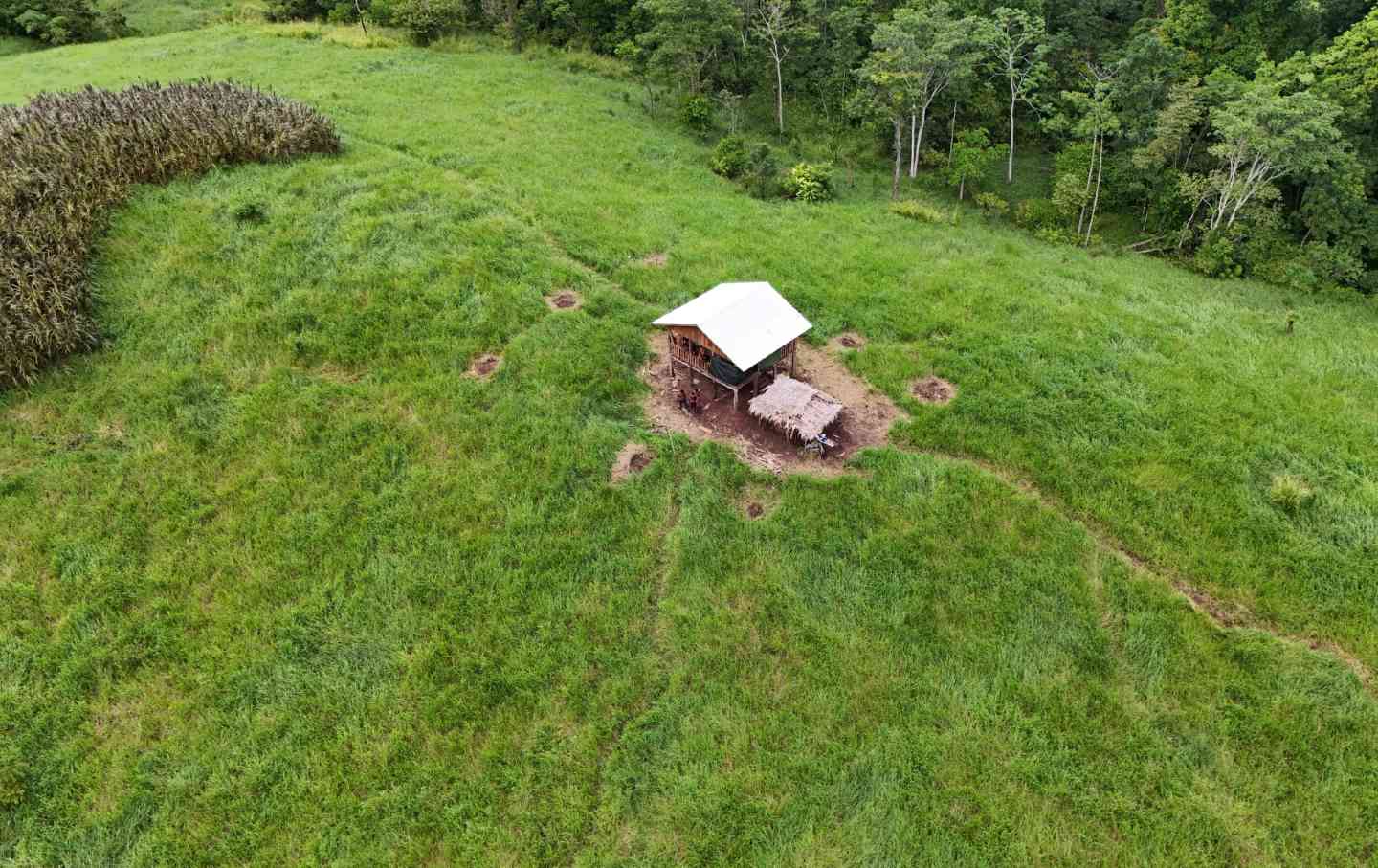
Thoughts of assassinations, narco planes, and corruption melted before the sight of the morning mist hovering over the hills above the tropical savanna grass, coconut palms, and pine trees surrounding Mavita’s wood huts.
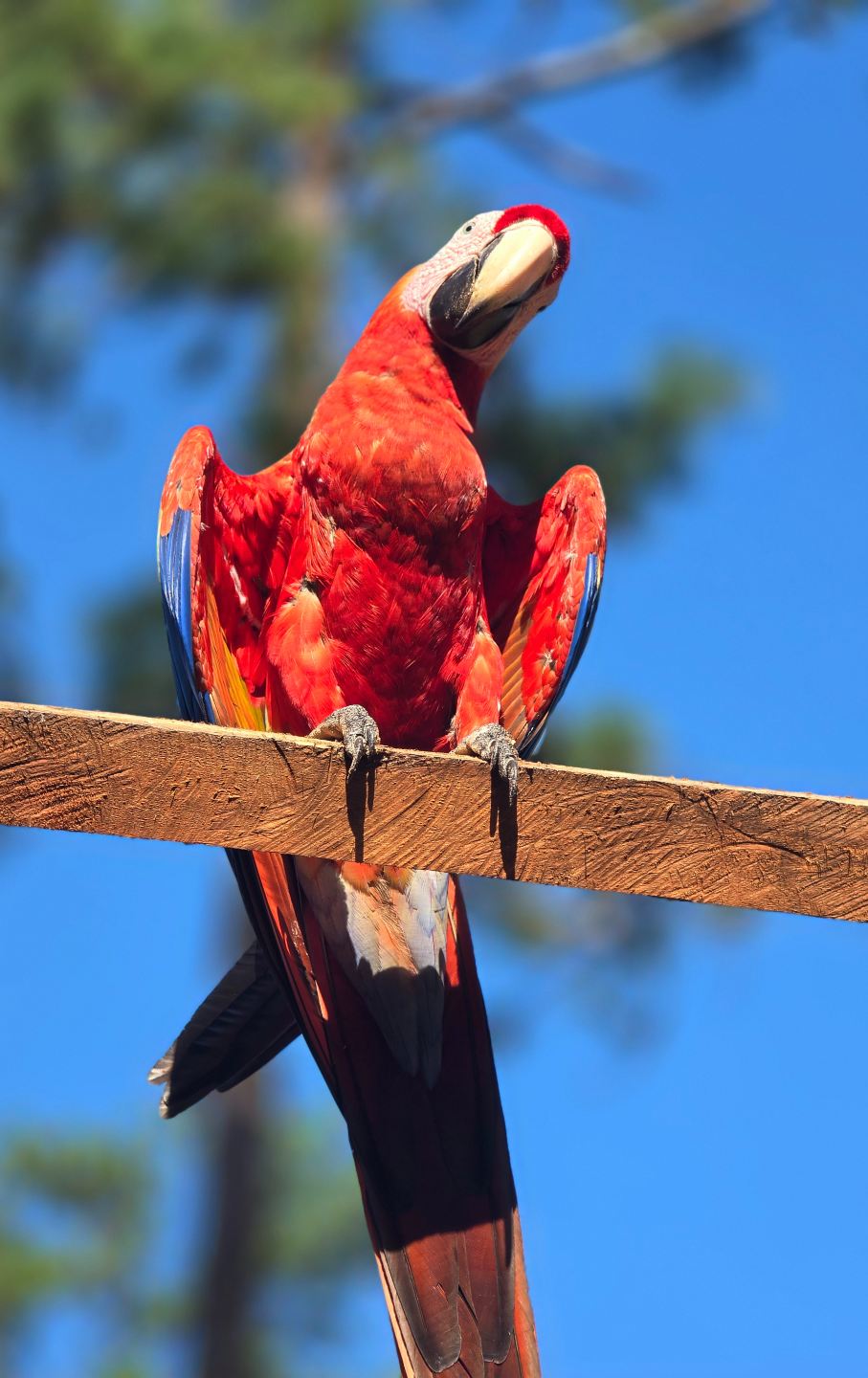
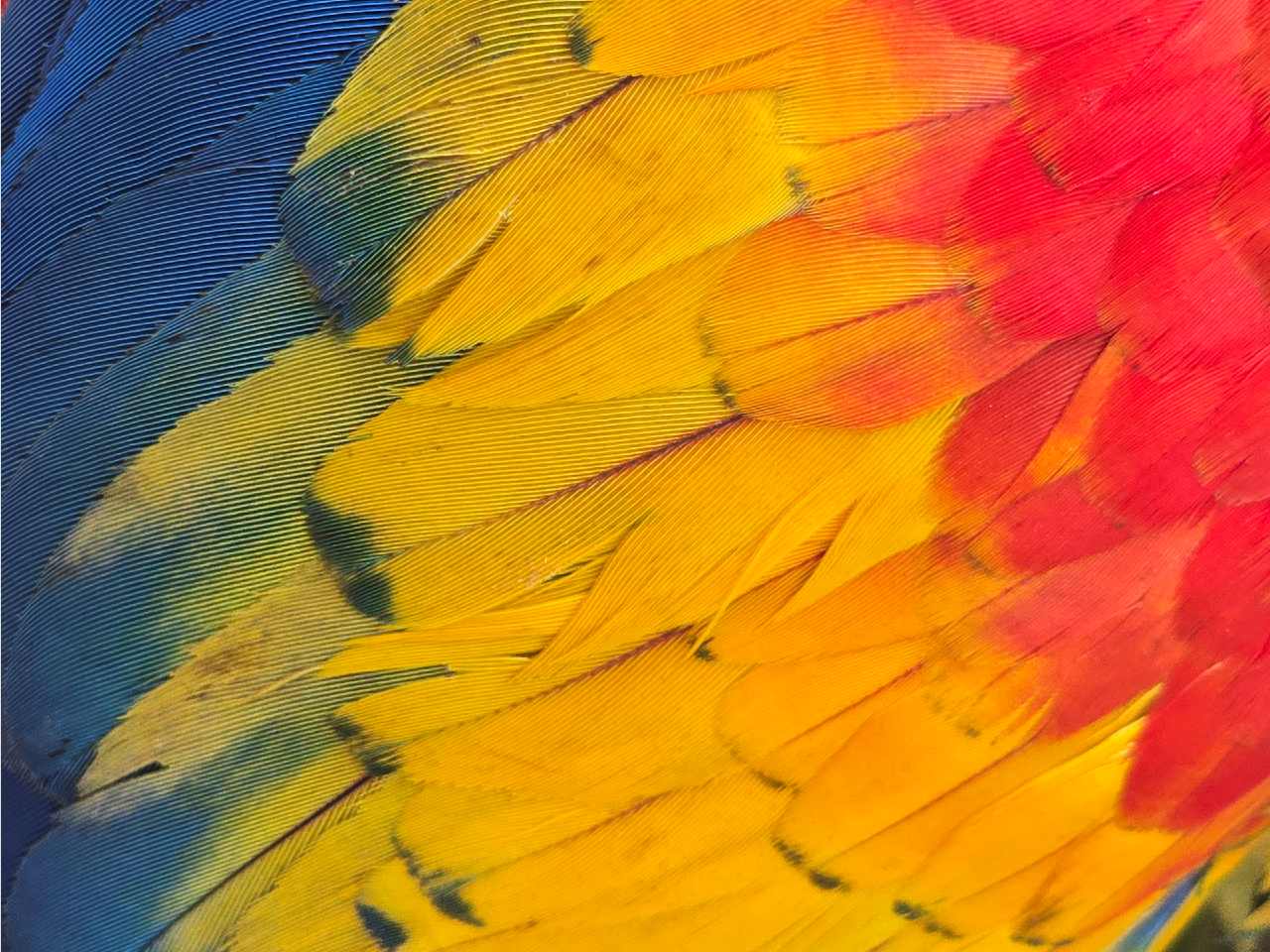
It was 5 am. The sun was rising. So was the bird whose bright red head, neck, chest, and wings have inspired native peoples across the continent for millennia to associate it with the sun and light.
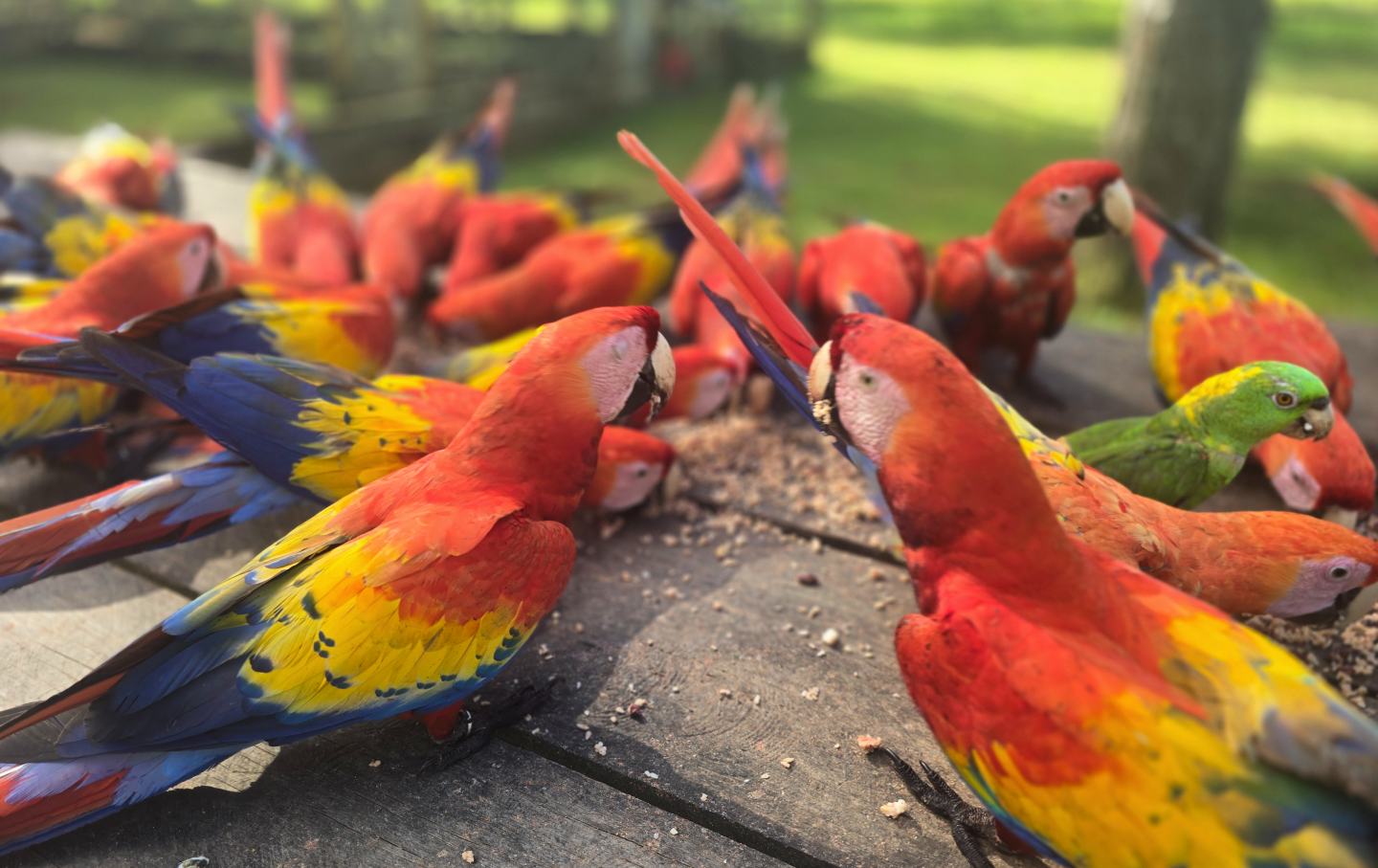
Synchronized with the dawn, scarlet macaws began to fly around the village. Dozens of red, yellow, and blue streaks descended from the pine trees into the grassy spaces between Mavita’s wooden huts, offering a glimpse of what human-macaw coexistence has likely looked like for much of history. Soon the birds erupted into the squawks that for centuries would have marked the start of day—its loudest moment—across Indigenous settlements throughout the tropical Americas.
Recorded at over 102 decibels from 15 feet, these squawks are louder than a Harley Davidson without a muffler, and they signal that it’s time for Anayda Pantin and her assistants to begin their daily ritual of feeding the scarlet macaws.
“Bal patampis bal. ¡Bal patampis bal!” Pantin, Santiago’s wife, said, calling the macaws to feast on the cart full of rice mixed with beans, yucca, and plantain she feeds the birds with twice a day.
“We sometimes run out of money and can’t buy them their food,” she said as she shoveled out breakfast for the 30–40 macaws that descend on the cages where another dozen or so macaws are healing in the Rescue and Liberation Center of La Moskitia, which Pantin founded and codirects with Lacuth. “Even when there’s no money,” she added, “we always find something to give them.”
As years passed and she married, she and Lacuth started noticing that the skies were less luminescent. Fewer and fewer birds flew in and around Mavita. “We started counting them and noticed that the number of scarlet macaws was decreasing. So we started feeding and caring for them at home.”
Their efforts drew the attention of police and military personnel who began to bring them confiscated birds, many of whom were abused and injured by poachers or their former owners. As the number of macaws grew, Pantin and Lacuth sought the help of Miskito authorities and NGOs, formalizing their work with the help of Honduran conservationist Hector Portillo Reyes, who had spent years in the region.
Soon after, Reyes introduced them to Joyner. Her organization, One Earth Conservation, raised funds, conducted classes on parrot conservation, and set up labs and veterinary clinics. The work of monitoring nests and patrolling forests eventually got a boost from drones, motorbikes, cameras, and other technical assistance.
Joyner also helped them draw more international attention to Mavita, one of the few places in the world where scarlet macaw preservation is led by Indigenous people. Forced by hunger and poverty, locals—Miskitos and non-Miskitos—had poached so many birds that, between 2005 and 2010, the scarlet macaw population in the area had dwindled from 500 to 100 birds.
Joyner and One Earth Conservation responded quickly, providing more funds. The Apu Pauni Project made an enormous difference, safeguarding over 1,000 nests, reducing scarlet macaw poaching by 80 percent thanks to Miskito-led patrols of over 500,000 acres of territory. Dr. Donald Brightsmith, a leading ornithologist and parrot expert based at Texas A&M, told me that Miskito efforts to preserve the scarlet macaws are “incredibly important” because they are “not just fighting and risking their lives for a species, but for an entire ecosystem.” The Apu Pauni Project also provides education, employment, and other benefits to the community.
Pantin departed for a while and returned to a large cage carrying a white cloth bag that’s moving from within. “This little one was injured,” she said while looking at the bird struggling to get out of the bag. “Are you ready? Are you ready?”
The bird broke free, hobbled around the table, and grabbed a nearby tree branch set up in the “liberation center”—a place for birds to practice flying before being set free.
“It was injured, and I had to pick out its feathers one by one to allow it to grow new ones,” she explained as the bird started to flap its newly feathered wings. “It’s trying to get used to them.”
“Being free takes a lot of work,” she said. And at that moment, the bird began its first flight in the large cage. Pantin’s eyes welled up: “It causes me great emotion to see them fly again—or fly for the first time.”
After several minutes, she left the bird to its newfound flight and stepped outside. The wooden table that had been covered with rice, beans, and plantain was suddenly overrun with iridescent blues, yellows, and reds, as the macaws feasted. When finished eating, some of the macaws played; others stared while hanging upside down on a wood plank set up nearby; still others pecked playfully at the feathers of their mates—the only ones these monogamous birds will have for decades (they can live up to 70 or 80 years).
“These birds are very smart,” she said. “They understand a lot of Miskito words.”
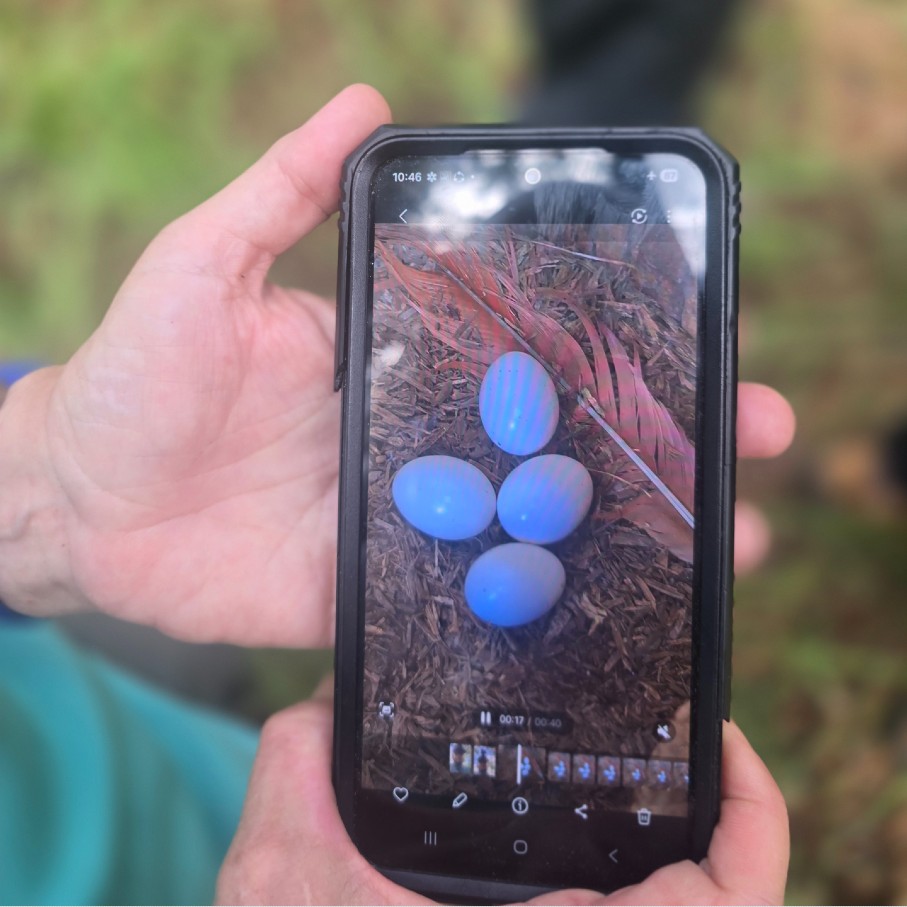
The bonds between the birds and Miskitos like Pantin are palpable. I watched Pantin’s son, Wesley, climb a 100-foot-tall Caribbean pine. After a few minutes, he reached the hole in the tree where some macaws nest, turned on the head-mounted camera on his yellow helmet, and started transmitting images to a laptop below. I found the images of tiny, featherless newborn macaw chicks crawling to warm each other in the nest moving, the embodiment of forest vulnerability.
Equally striking was the response to the video from Joyner, Lacuth, and the volunteers down below who came on the monitoring excursion: They repeated and cried out, “¡Es un milagro, es un milagro!”—it is a miracle—at the sight of four eggs in a nest, along with three newborn. The average scarlet macaw nest has about three eggs.
I suspect that scarlet macaws are so moving to people because they are sensitive to human feelings. “They feel what we feel,” Pantin said. “I think they know when I’m sad. Sometimes, they don’t want to eat and just stay sad.”
The emotional reciprocity she described echoes the findings of researchers who told me that because scarlet macaws depend on the flock for survival, they have evolved a preternatural ability to connect and feel. And this ability extends not just to other parrots but to the humans they encounter. It’s perhaps why in the United States, Veterans Affairs psychologists use macaws and other parrots to treat PTSD in war vets.
Scientists and Mavita locals have also told me that the birds may also experience trauma from natural disasters, predators, and the greatest threat they face here: poachers.
“I used to climb the trees, find the nests, take the guara eggs, and sell them,” Tomas Manzanares, a Miskito man from the nearby village of Rus Rus, told me.
In the 1990s, he explained, poachers sold eggs and birds locally to buyers from other parts of Honduras, who then resold them as pets or to hotels and tourist destinations.
Popular
“swipe left below to view more authors”Swipe →“I grew up when the guaras were everywhere you looked,” he said. “But I had a family and needed to feed them. There was no work here. It hurt my soul, but necessity obligated me to sell them.” Manzanares’s statements made sense; according to the World Bank, 72 percent of Indigenous households in La Moskitia cannot afford a basic food basket.
Today, that trade has become more international, as Jarri Lacuth, my Miskito-language teacher, made clear. From his family’s thatched-roof wooden hut, Jarri Lacuth told me that he went to in Nicaragua to find out who was purchasing the eggs, and to do so, he had to go undercover.
“I spoke with the main buyer in Esperanza, Nicaragua, where we have Miskito family,” he said. “He’s from Taiwan but spoke good Spanish with a Chinese accent. Somebody told him I work with scarlet macaws.”
“One day,” Jarri continued, “he showed up asking for me. We met at an office in Esperanza, and he showed me pictures of all the eggs and parrots he had. He sells them to zoos, individuals, and other buyers. He asked me how many nests we have near Mavita. He offered about 10,000 cordobas ($272) per guara and up to 200,000 cordobas ($5,445) for 120 eggs. He showed me photos of people in a laboratory feeding 300 to 400 chicks with a syringe in special cages they buy. He offered me work and to be allied with him. People have seen him and others in boats on the rivers, going from town to town offering people money for guara. What he wanted most were eggs. Lots of poachers in Nicaragua and La Moskitia work with him. Authorities are after him, but he’s avoided capture for a long time.”
The Taiwanese buyer is only part of the confluence of criminal interests that threaten the ecosystem: There’s also the terceros, who destroy thousands of acres of pine forest and rainforest for illegal cattle ranching and logging; corrupt government officials and politicians who find creative ways to avoid Miskito and Honduran laws protecting the land, macaws, and people; poachers who steal eggs and birds to sell to illicit national and international markets—all of whom are protected by criminal organizations that operate in La Moskitia.
Coastal and other Miskitos tell stories of roads and sea routes that regional criminal groups like the Cachiros and the Atlantic Cartel control. And everywhere you go, you hear tales of macaws owned and raised by the mysterious narcos who built and lived in now-abandoned mansions inland and along the coast.
The narco bird lovers in La Moskitia and across Honduras reflect how the country’s official bird also symbolizes the noxious effects of the corruption that threatens the bird and its tropical habitats. “The narcos share an interest in continuing the poaching, land grabs, and other activity of the terceros,” Santiago Lacuth told me. “None of them wants any attention to what’s happening here. That allows them to keep doing their drug business while getting cover from the terceros who steal, buy, and sell land that no one can touch or even visit because it’s protected by the narcos.”
The drug ecology here in Gracias a Dios and other parts of Honduras has made cartel and gang members in Honduras rich and powerful. “The narcos and terceros are taking over and destroying thousands of hectares of land,” Lacuth continued. “Because we’re so poor here, even some Miskitos are violating our laws prohibiting private property and selling it for the terceros and narcos.”
Enabling their influence are politicians in Honduras, where for decades, “corruption is the operating system” of the government, according to a report by the Carnegie Endowment for International Peace. The contradictions and absurdity of the corruption were on display earlier this year, as Juan Orlando Hernandez—the Honduran president whose administration put the macaw on the $200 lempira bill and supported anti-deforestation and macaw reintroduction programs—was granted a “full and complete pardon” by Donald Trump, after serving just three years of a 45-year sentence for drug trafficking and firearms. Many in Mavita believe that this corruption swallowed government funds committed to protect the scarlet macaw and its habitats. President Nasry Asfura’s Secretariat of Natural Resources and Environment did not respond to multiple requests to comment on where the 1 million lempiras ($37,500) approved to protect the scarlet macaw went. The Apu Pauni Project has not seen any of it.
In recent months, the poaching has reached crisis levels. Outsiders have raided 19 of the 106 active scarlet macaw nests identified by the Apu Pauni Project, according to Joyner.
“This is the worst year for trafficking,” Joyner said. “People are selling the eggs for what are incredible amounts of money here.” She said that one group was intercepted at an international airport with nearly 300 eggs.
In response to the crisis, the Miskitos, Joyner, and the people of Mavita have launched the Unconditional Solidarity campaign, which is aimed at telling the world about the poaching surge and pressuring Honduran authorities to intervene more forcefully.
“We’re signaling ‘emergency,’ because we can’t stop poaching without greater involvement,” she said. “We can’t just have the local Miskito community and a couple of nonprofits taking on the gigantic narco system. If we fail, all the nests will be poached.”
So far, the campaign appears to be having an impact, Joyner said. “Everybody in Puerto Lempira is watching the campaign on social media. Security forces are doing regular checkpoints, and the government has committed some military personnel to increase the patrolling for poachers. We’ve raised some money and raised the level of awareness. People who see us on the road stop and say, ‘You’re the people we see talking on TikTok about the guaras.’”
These efforts have reinforced the shift already underway among some former poachers. Manzanares told me he stopped poaching in 1998 and began educating others about why it was wrong to rob chicks and eggs from their mother. His transformation came at considerable cost: He showed me scars from gunshot wounds.
“I was swimming in a river next to the main road one day, enjoying the sun and beauty,” he told me from the office of the NGO he works at in Puerto Lempira. “And then I felt the burning sensation here [he pointed to his right forearm], here [then to his upper right arm]. There are nine screws here [left arm]. This one [pointing to his chest] came this close to my heart and punctured my lung. The bullet is still in my back.”
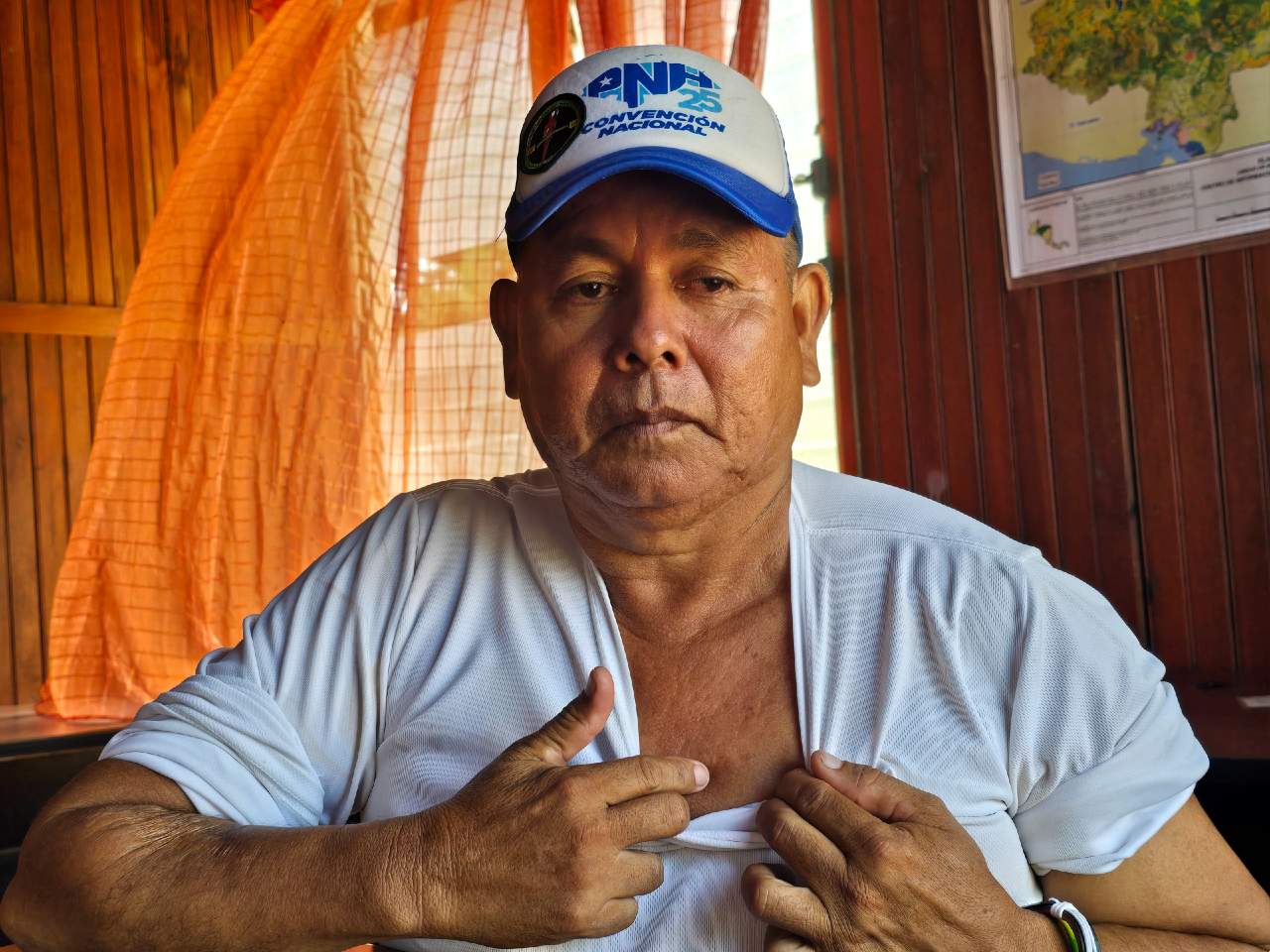
He told me this having just returned from patrolling and putting out fires set by terceros and that he was afraid that inhaling the fumes were making him sick.
Why continue?
“Because the guara shows me the saddest and most beautiful things,” he said without hesitation.
He described watching macaws circle above burning pine forests as they searched for “their chicks who were burning to death on the ground.”
“It makes me extremely sad and hits me here,” he said, pointing again to his chest. “But watching them hatch, grow feathers, and fly makes my heart open.… They feel happy when we’re protecting them. That’s why I do my part.”
Become a Sustaining Donor This September
Between the reemergence of right-wing red-baiting and Donald Trump’s use of the chilling National Security Presidential Memorandum–7 to criminalize left political organizing, we’re seeing McCarthyism reborn before our eyes.
This assault on democracy cannot be ignored or wished away. Resisting it requires bravery in the face of threats and repression, a steadfast commitment to the truth, and the unwavering belief that we can—and will—overcome this darkness.
We must have an independent media that sets the record straight, unearths corruption and abuses of power, and advances a politics of justice and dignity for all if we’re to win this fight.
That’s why I’m writing to you today. This September, The Nation needs to add 100 monthly donors to sustain our progressive journalism. Your contribution makes the next investigative report, the next truth-speaking column, and the next pathbreaking essay all possible.
I hope you’ll support our work with a recurring donation today. If you donate $10 or more a month, we’ll send you a brand new “Hands Off the Free Press!” sticker to recognise your commitment to our cause. Please, donate today.
Onward,
Katrina vanden Heuvel
Editor and Publisher, The Nation