Binance’s MAGA-Branding Strategy
The world’s largest crypto exchange often operates beyond the reach of the law. Now it’s helping to enrich the Trump family
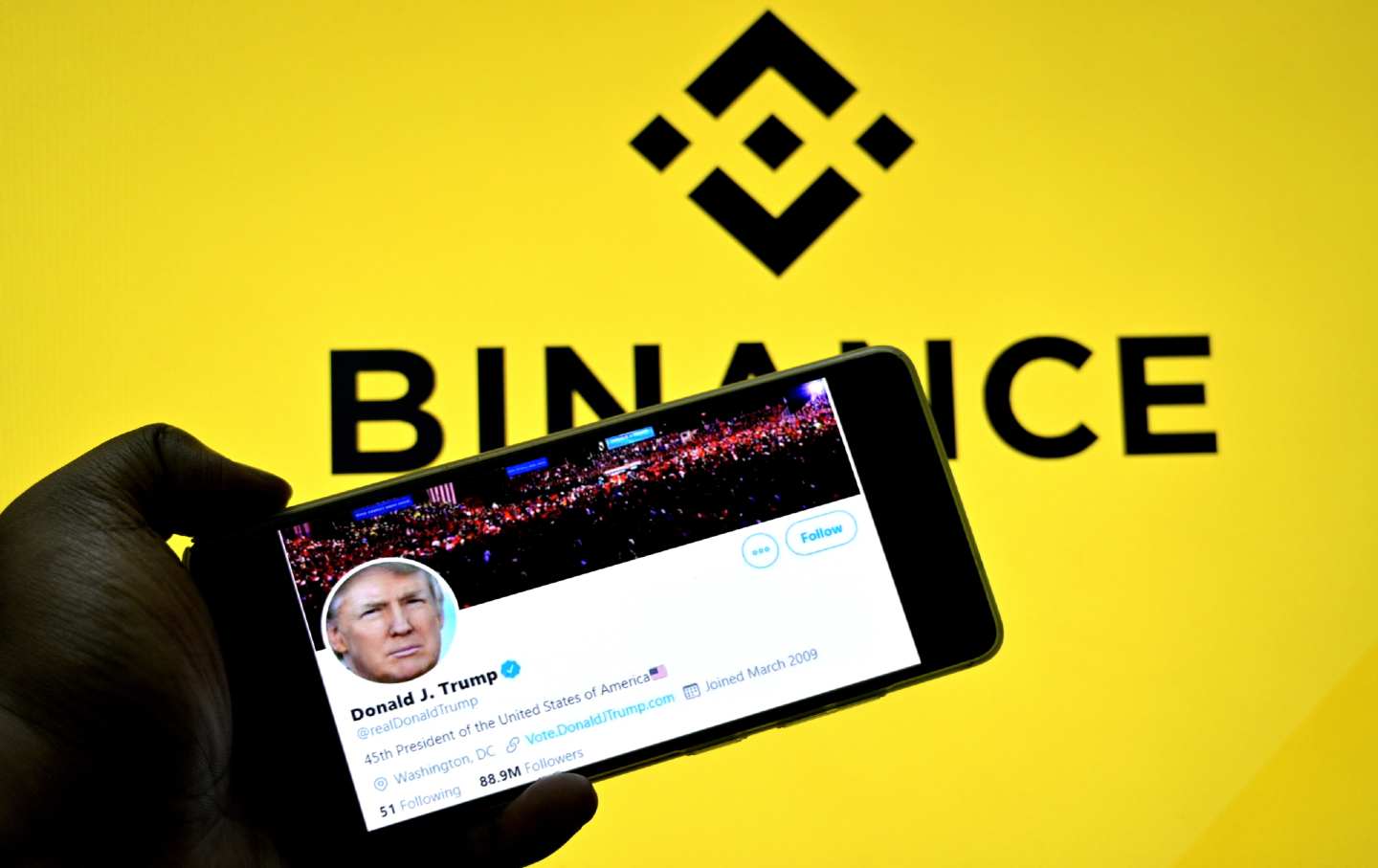
Donald Trump and Binance, partners in power
(Avishek Das/SOPA Images/LightRocket via Getty Images)
While in office, President Donald Trump has enriched himself far more than any American politician before him. He hasn’t done it alone. Perhaps no company has provided more financial and logistical support to Trump’s cryptocurrency empire—the engine of his newly acquired wealth—than Binance, the world’s largest crypto exchange. Binance has become the principal market for World Liberty Financial, the Trump family’s primary crypto venture, which has sold billions of dollars worth of its tokens. Binance employees even wrote the code for USD1, Trump’s dollar-pegged stablecoin.
On its way to becoming the world’s dominant crypto exchange, Binance also became notorious as a financial conduit for cyber criminals, sanctions evaders, and militant groups. During President Joe Biden’s administration, former Binance CEO Changpeng Zhao, (widely known as CZ) spent four months in federal prison after pleading guilty to violating anti-money laundering laws. The company agreed to pay a $4.3 billion fine—one of the biggest in corporate history—and to largely stay out of the U.S. market. Biden’s SEC also filed a civil lawsuit against Binance, which accused the crypto exchange of a range of violations, including market manipulation, illegally serving U.S. customers, and mishandling customer funds. (SEC legal filings alleged that billions of dollars in company revenue flowed through overseas companies controlled by CZ and a never-seen Chinese co-founder named Guangying Chen.)
Under President Trump, that has all changed. Last May, the SEC dropped its lawsuit. In October, Trump pardoned CZ. According to the Wall Street Journal, Binance also worked, with Trump’s support, to relax government oversight of the exchange. Earlier this month, CZ attended a World Liberty Financial-hosted crypto summit at Mar-a-Lago, where guests included Eric Trump, Donald Trump Jr., the chairman of the Commodities Futures Trading Commission, and top crypto industry and Wall Street executives.
Its legal and regulatory shackles loosened, Binance now stands accused of behavior that, as the Journal delicately put it, “echoed some of the same concerns that drew U.S. scrutiny in 2023.” According to multiple reports, last November, Binance dismantled an internal team of investigators that had uncovered 1,500 Binance accounts in Iran, where the exchange was operating in violation of economic sanctions. Just two of these accounts had moved $1.7 billion worth of crypto to accounts possibly controlled by the Iranian Revolutionary Guard Corps. One belonged to an entity that also acted as a vendor for Binance, which indicated that it was more than an average crypto trader. The investigators had also discovered that Russian officials were using Binance to pay crew members from its “shadow fleet” of oil tankers that dodged international sanctions stemming from Russia’s war in Ukraine. After Binance’s investigators reported their findings up the company’s org chart, several were fired, and others were reassigned.
With no official headquarters, Binance is an unusual global organization. After starting in China before moving to Japan and then Malta, Binance now calls itself a “decentralized” operation, although much of the business seems to be run out of crypto-friendly regions like the United Arab Emirates and the Cayman Islands. Binance has also maintained a presence in France, where CZ once took a selfie at a dinner with President Emmanuel Macron. Last year, French authorities announced an investigation into Binance for money laundering and tax fraud.
Facing investigations all over the world, Binance has shown itself to be adaptable and resilient, surviving the imprisonment of its CEO, a bizarre standoff with the Nigerian government over alleged currency manipulation, and its constant search for more welcoming jurisdictions from which to operate. Presenting itself as a tool of financial liberation and offering free educational courses about crypto finance , Binance has made deep inroads in the global south, especially in parts of Africa, Pakistan, and southeast Asia. While the Journal reported that Binance has become less cooperative with government requests for data and legal assistance, the company depicts itself as a partner to law enforcement, posting on social media about the training sessions in blockchain forensics it offers to investigatory agencies around the world. Binance claims to be training local cops to fight the very kind of crime that has flourished on its platform.
Having been replaced by a lieutenant as CEO when he went to federal prison, CZ no longer officially runs Binance, but he is still widely associated with the company, and the culture and practices he put in place seem to persist. In 2020, a report in Forbes—whose claims were later backed up by SEC legal filings—described a “Tai Chi document” proposing a new Binance company strategy. This memo proposed that Binance serve up its small U.S. branch as compliant with U.S. regulations while the main, jurisdiction-less Binance entity would continue to illegally serve American customers. More recently, a number of compliance personnel have left Binance, often posting paeans to their peers on LinkedIn while resolutely ignoring all of the alleged financial lawbreaking that took place under their collective watch for years.
For a U.S. president whose sons and business partners are deeply engaged in crypto finance networks ranging from El Salvador to Abu Dhabi to Singapore, there could hardly be a better partner than the world’s most influential crypto company. The benefits flow both ways, as exemplified by a $2 billion deal in which the UAE government-owned firm MGX bought a stake in Binance using World Liberty Financial’s USD1 stablecoin. Instead of wiring Binance 2 billion actual U.S. dollars in that deal, MGX sent the money to World Liberty Financial in return for two billion USD1 stablecoins, which Binance happily accepted as payment. MGX got its Binance stake; Binance got a new shareholder while becoming the top market for a hot new, politically connected token; and the Trump family crypto empire got $2 billion to invest in U.S. Treasuries. Later, in an apparent continuation of the quid pro quo, the Trump administration allowed UAE firms to acquire highly coveted Nvidia chips whose export was usually subject to strict quotas.
After the recent reports about possible Iranian government entities using Binance to move billions of dollars, Democratic Sen. Richard Blumenthal of Connecticut wrote to Binance Co-CEO Richard Teng demanding “records and information related to Binance’s role in Iranian money laundering and its repeated failure to prevent illicit use by sanctioned entities, terrorist organizations, and other criminal actors.” Binance “has long been aware” of how its platform is being used, Blumenthal charged, but instead of addressing the issue, it attempted to cover such abuses up by firing its own investigators.
There could hardly be a more explicit allegation of wrongdoing leveled against a company that once agreed to pay the biggest fine in U.S. corporate history. But under Trump’s kleptocratic administration, Binance’s alleged sins matter far less than its cozy relationship with this country’s leading crypto entrepreneur. After he pardoned CZ, Trump claimed not to know who the Binance founder was. But the president then went on to say that he had heard that CZ—who lived abroad but came to the U.S. in order to agree to a plea deal—was a victim of lawfare, just like he had been. By any reasonable outside assessment, that’s not true. But when billions of dollars are being channeled into Trump family coffers, the truth ends up being a worthless asset.