Trump Will Not Make Architecture Great Again
Last term, his ill-informed embrace of “traditional” aesthetics fanned the flames of the culture wars. This time, he’s poised to do even more damage.
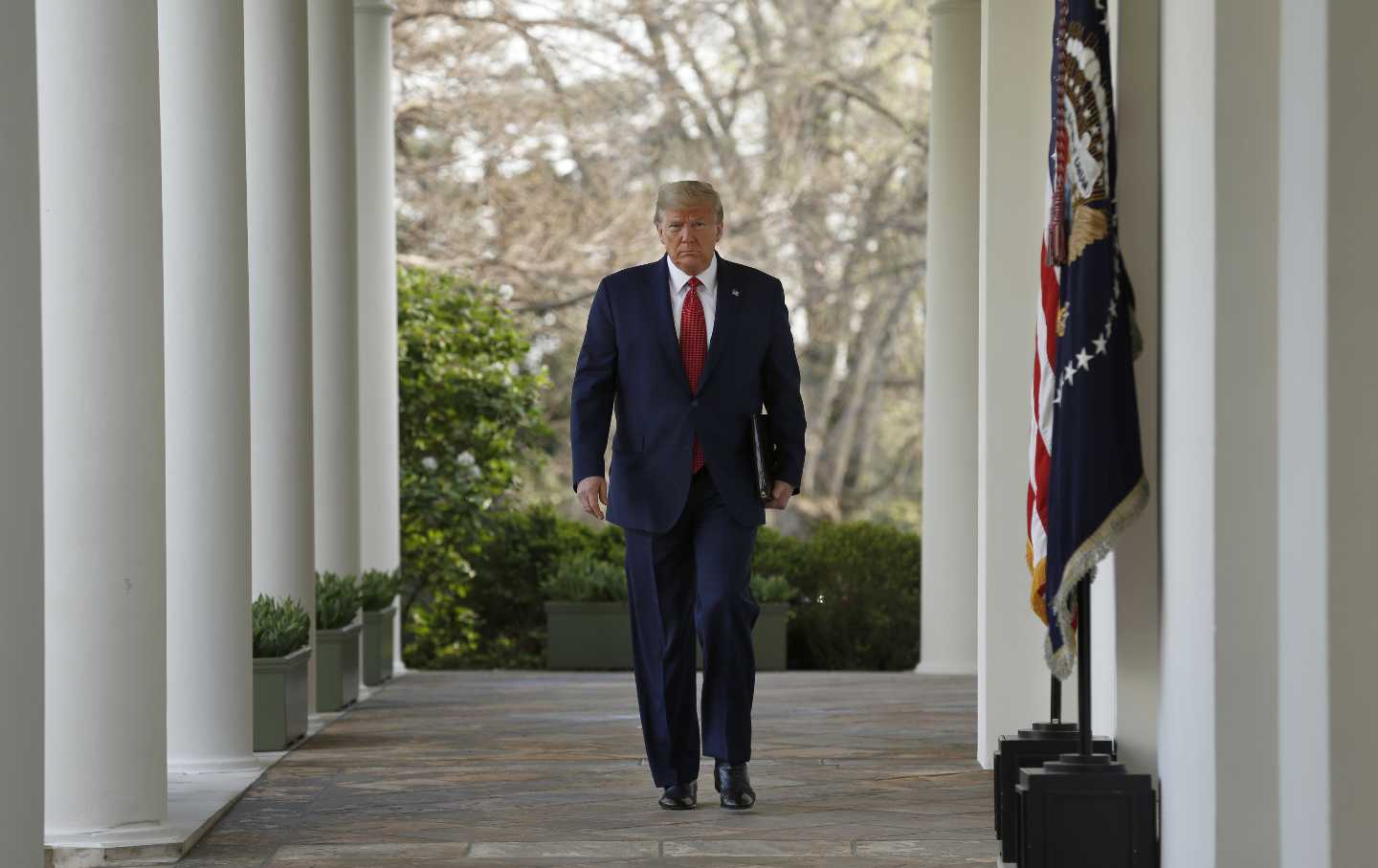
Donald Trump enjoys a good faux-Hellenic column.
(Stefani Reynolds / Getty)
What will become of architecture under a second Trump presidency? It’s a question on the mind of both industry insiders and critics. I began my career as an architecture critic in the shadow of the first Trump administration. It became apparent early on that Trump, being a developer, was keen to get involved in architectural matters. One expected this to go the route of, say, that building Eric Adams built for the Turkish government, i.e., blatant graft. Instead, he took a different turn.
One of Trump’s biggest successes was in stoking the flames of the culture war, and architecture was no exception. He and his party accomplished this in a few different ways. For one thing, he appointed archconservatives to important advisory boards in the federal government. To take just one example, he invited Justin Shubow, a long-time proponent of “traditional aesthetics”—which essentially means neoclassical architecture rendered in contemporary building materials—to the US Commission for Fine Arts, which oversees all construction in Washington, DC. Ultimately, though, this had little effect. Trump’s executive order purporting to “Make Federal Buildings Beautiful Again,” another attempt to mandate faux-Hellenic aesthetics for government buildings, died in the water, probably because he had bigger fish to fry. While he didn’t wind up getting all the marble columns he wanted, Trump won in other ways on the architecture front.
Around the mid-2010s, right-wing organs such as Fox News began roping the field of architecture into the culture wars, best exemplified in Tucker Carlson’s hand-wringing screeds against “postmodernism”—at the time a catch-all term for anything coded as academic and liberal, whether one was talking about gender theory or literary poststructuralism. It didn’t matter that there was an architectural movement called postmodernism, which, in its most revanchist forms, wasn’t so politically unaligned with the goals of Tucker et al. Indeed, postmodern neoclassicism—à la Léon Krier, with his screeds against modernism, or Prince Charles’s experimental planned town Poundbury, with its oversize pediments and goofy lintels—already seemed to settle this score some 40 years ago, after which everyone got bored. It also didn’t matter that Carlson used the word to lump together all contemporary and modern architecture regardless of period, a category that also includes most of Trump’s developments. Postmodernism, to the new right wing, simply meant: not neoclassical and therefore liberal and degenerate (woof!) and, of course, robbing the world of beauty.
At the time, most critics, including myself, spent a lot of energy trying to call right-wing “trad guys” out on their hypocrisy, lack of knowledge, and the sheer material impossibility of their demands. (We can’t bring back all those exhausted stone quarries of the 19th century.) In this battle, we lost. We lost in part because architecture was merely a front for what was at heart a more overarching ultra-right advocacy for “traditional values.” The real goal was to make historical architecture on the whole inextricable from Eurocentric white supremacy. The same ancient Rome that inspired Mussolini was still doing its job for Carlson and marble bust avatars on Twitter. The problem was, when we called a spade a spade, we’d already lost by dint of simply being “woke.” Of course “loving beauty” wasn’t white supremacist, are you insane?
Right-wingers were able to capitalize on this rhetoric because underlying it was an inconvenient truth: A lot of new buildings are ugly. They are ugly not for any culture-war reasons but because they are built cheaply in order to best satisfy the profit motive undergirding real estate development as we know it. Whatever traditionalism’s value as a rhetorical cudgel, the real reason few attempt to build “traditionally” today is the immense cost. Hence, when architects do erect buildings in the neoclassical style, they tend to have a certain McMansion je ne sais quoi; see, for example, the ridiculously pompous Schermerhorn Center for the Performing Arts in Nashville. For the culture-war pundits, it didn’t matter that things couldn’t be made “beautiful” for the same reason they were made ugly—there had to be an ideological conspiracy theory behind the whole thing.
For all intents and purposes, the right wing has won the architectural culture war in that traditional or historical architecture has become politicized in a way that runs contrary to why it was built or how it continues to relate to everyday life. We did not figure out how to fix this problem under four years of a Democratic president; it merely died down a little because no one was blowing on the coals. Another thing that dimmed during Biden was the socialist movement, which brought architecture some of its most important developments of the mid-2010s. For example, the Architecture Lobby, an organization that advocates for the labor rights of architects, surged with momentum in the first Trump years. Efforts to unionize architecture firms that began during the early Trump years are finally coming to fruition in offices like Bernheimer Associates. Another advocacy group, Who Builds Your Architecture?, which aimed to shed light on the abuses in the construction industry, also got its start at that time, though it unfortunately seems to have gone dormant.
In academic circles, there was a huge surge in understudied topics in architectural theory, such as labor, maintenance, and logistics. Architecture criticism, too, flourished, with the development of publications like the New York Review of Architecture. Environmental organizations like Sunrise Movement and the Democratic Socialists of America’s Green New Deal working group set off a flurry of activity in both political and academic groups where people from many different walks of life organized for things like a just transition or sought new ways of thinking about urban ecologies, transportation, resiliency, and energy. A Democratic presidency, coupled with the pandemic, sapped away a lot of that energy. As the Biden administration failed to deliver on promise after promise, the momentum waned. Now, we are left with a body politic that is demoralized, exhausted, and disappointed. This is the biggest obstacle facing not only architectural advocacy but the left writ large.
We are smarter and better politically prepared than we were eight years ago. There are a lot of strategies that we don’t have to waste our time trying again. The Women’s March may not have amounted to much, but the resurgence in the labor movement did. There was a lot of bullshit distraction—“covfefe,” etc.—and we needn’t waste our time on it this round. Trump’s plans are going to be disastrous for many fields, including architecture. His tariffs will absolutely destroy the construction industry and render it incredibly expensive to build anything. Right now, he and Elon Musk are planning to gut the federal government for profit and with it any form of public infrastructure. Architecture as a job is in the mud, with new construction already down since last year. It’s only going to get worse, as the industry is particularly vulnerable to financial shocks and fluctuations in the real estate market. With no end in sight for the “vibecession,” and with Trump already reneging on plans to cut inflation because it would eat into corporate profits, things are only going to get worse from here, in (if you’ll pardon the pun) a structural way.
One thing that is clear is that we can’t just stand by and watch. It’s easy to throw our hands up and say well, we tried. The fact is, we didn’t—I didn’t—try hard enough. That fire that Trump stoked in the politics of the built environment was a hugely generative creative and ideological force. Maybe the coals will be cold by the time he takes office, and maybe we’ll have to do some of that stoking ourselves. But the fire kept us warm before. It should do so again.
Support independent journalism that does not fall in line
Even before February 28, the reasons for Donald Trump’s imploding approval rating were abundantly clear: untrammeled corruption and personal enrichment to the tune of billions of dollars during an affordability crisis, a foreign policy guided only by his own derelict sense of morality, and the deployment of a murderous campaign of occupation, detention, and deportation on American streets.
Now an undeclared, unauthorized, unpopular, and unconstitutional war of aggression against Iran has spread like wildfire through the region and into Europe. A new “forever war”—with an ever-increasing likelihood of American troops on the ground—may very well be upon us.
As we’ve seen over and over, this administration uses lies, misdirection, and attempts to flood the zone to justify its abuses of power at home and abroad. Just as Trump, Marco Rubio, and Pete Hegseth offer erratic and contradictory rationales for the attacks on Iran, the administration is also spreading the lie that the upcoming midterm elections are under threat from noncitizens on voter rolls. When these lies go unchecked, they become the basis for further authoritarian encroachment and war.
In these dark times, independent journalism is uniquely able to uncover the falsehoods that threaten our republic—and civilians around the world—and shine a bright light on the truth.
The Nation’s experienced team of writers, editors, and fact-checkers understands the scale of what we’re up against and the urgency with which we have to act. That’s why we’re publishing critical reporting and analysis of the war on Iran, ICE violence at home, new forms of voter suppression emerging in the courts, and much more.
But this journalism is possible only with your support.
This March, The Nation needs to raise $50,000 to ensure that we have the resources for reporting and analysis that sets the record straight and empowers people of conscience to organize. Will you donate today?