
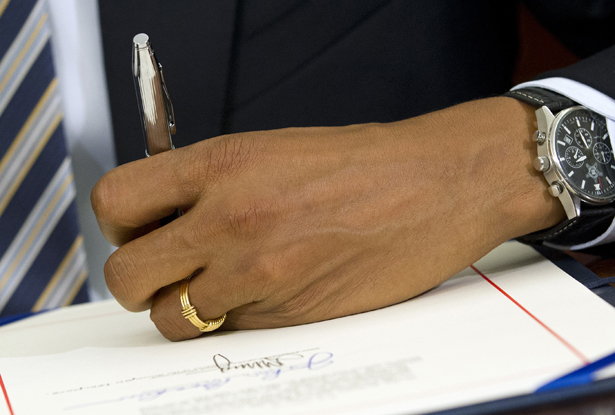
President Barack Obama signs the Honoring America's Veterans and Caring for Camp Lejeune Families Act of 2012, Monday, Aug. 6, 2012, in the Oval Office at the White House in Washington. (AP Photo/Haraz N. Ghanbari)
Say what you like about Wally Hudson—and people do—he knows his audience. For months, the chairman of Virginia’s Mecklenburg County Republican Committee displayed pictures of Barack Obama as a drug dealer, witch doctor and caveman on his party’s Facebook page, resisting calls from higher-ups to remove them. “We know our regular readers, who are good conservatives,” Hudson told The Washington Post. “They’re gonna get a kick out of it.”
The presence of a black president has posed a real challenge in self-control for many Republicans, who were raised on a diet of welfare queens and Willie Horton. And when their opponent is a black man with a surname that rhymes with “Osama,” the temptation is just too great. During Mitt Romney’s ill-fated trip to the United Kingdom in July, his adviser claimed that Romney appreciates the “special relationship” more than Obama because he is “part of an Anglo-Saxon heritage.” Newt Gingrich insists that Obama’s “not a real president.” Donald Trump wants to see another birth certificate.
These statements violate the most important tenet of Richard Nixon’s Southern strategy: plausible deniability. In his diary, Nixon’s chief of staff, Bob Haldeman, described the operational blueprint for a new electoral landscape built on bigotry. “You have to face the fact that the whole problem is really the blacks,” Nixon told him. “The key is to devise a system that recognizes that while not appearing to.”
For some time now, there has been precious little to be gained by attacking a candidate’s race in elections on a national level, and plenty to lose. And that’s truer today than ever. Polls indicate people are far less likely to vote a Mormon into the White House than an African-American. Indeed, Americans feel more comfortable with a black man as commander in chief than a black man having a relationship with a white woman. National campaigns that go negative on race are assumed to be negative on many other things, from gender to modernity. Moreover, Obama is no easy target: on every metric concerning how easy it is for voters to relate to candidates, he has always scored better than his white opponents.
This has led some to argue that race is not a factor in this election. The Bradley effect is dead; long live the first black president. “Racists, real racists, are so insignificant now as to not matter,” claimed New York Daily News columnist Derek Hunter. “The days of them mattering died sometime after Democrats lost the South.” Too bad Trayvon Martin’s parents didn’t get that memo.
There are two problems with this. First, just because the election doesn’t center on Obama’s race doesn’t mean race is not a factor. Whether it’s Bill Clinton attacking Sister Souljah or George W. Bush speaking at Bob Jones University, race has always been a central part of American politics, whether black people were running for office or not.
Popular
"swipe left below to view more authors"Swipe →
And for good reason: race is about power, and it is through power that resources are distributed. Race will disappear as an issue when racism disappears as a material force. In the meantime, it will also be a tool to leverage resentment. For example, GOP ads pitting Medicare (which Republican vice presidential nominee Paul Ryan wants to cut anyway) against healthcare reform claim that the hard-earned benefits of working people will be frittered away on “a massive new government program that is not for you.” Such is the nature of demographics and poverty in this country that more than three-quarters of Medicare recipients are white, while more than half of those without health insurance are not. Thus the specter of racialized redistribution is invoked without being explicitly articulated.
This mind-set was illustrated brilliantly at a Tea Party rally in Arkansas in June, where a speaker told the following joke as an icebreaker: “A black kid asks his mom, ‘Mama, what’s a democracy?’
“‘Well, son, that be when white folks work every day so us po’ folks can get all our benefits.’
“‘But mama, don’t the white folk get mad about that?’
“‘They sho’ do, son. They sho’ do. And that’s called racism.’”
The crowd loved it. The speaker was forced to resign only after a recording was released.
Second, it is precisely because of racism’s material consequences that different racial groups have particular electoral allegiances on the basis of their real or perceived economic and social interests. The trouble for the GOP is that Nixon’s Southern strategy is based on courting an electorate far whiter than today’s. Since 1980, the proportion of white voters has declined in every consecutive election bar one. The racial base on which the GOP has relied for two generations is sinking.
Meanwhile, the combination of a black Democratic presidential candidate and the racist and nativist Republican rhetoric has reduced the GOP’s appeal to blacks and Latinos to critical levels just as those two groups have grown in influence. An NBC News/Wall Street Journal poll in August put African-American support for the GOP at rock bottom: 0 percent. The party’s support among Latinos hovers around 27 percent—far lower than what it needs or has enjoyed in the past. At the time of this writing, eighty-two Electoral College votes appear to be up for grabs. Of those, seventy-two are in states where white people comprise less than 70 percent of the population. To win, Romney needs 61 percent of the white vote nationally from a white turnout of 74 percent. In 2008, John McCain got 55 percent from the same turnout. The GOP’s only response to this so far has been to try to stop nonwhite people from voting altogether with punitive voter ID laws.
Far from playing less of a role in this election, race is as great a factor as it’s ever been.

