
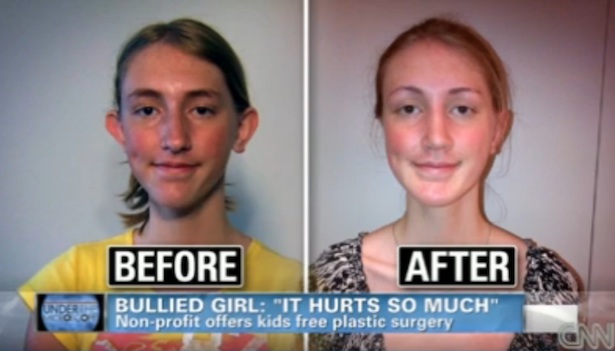
Nadia Ilse, a bullied 14-year-old, recently received $40,000 in free cosmetic surgery from the Little Baby Face Foundation, an organization that helps children with facial deformities. It sounds like a quite a nice story until you hear what Ilse’s “deformity” was: Her ears stuck out a bit.
The Georgia teen’s supposedly corrective surgery included having her ears pinned back, a nose job and a chin reshaping. This is our culture now: teen girls thinking that the slightest perceived imperfection—any deviation from what they see in magazines—is tantamount to deformity and in need of surgical correction.
There are plenty of culprits to point to—misogyny, pop culture and the plastic surgery industry, for starters. But there’s also a more insidious problem: the notion of self-esteem as a cure-all for girls.
I’m sure Ilse’s mother—who sought out the charity that subsidized her daughter’s surgery—meant well. Her kid was being taunted and she wanted her to feel good about herself. And indeed, Ilse’s reaction after the surgery seemed to indicate that it helped. “I look beautiful, this is exactly what I wanted, I love it,” she said.
Of course Ilse feels better about herself—the world is cruel and conforming to traditional beauty standards can ease teenage suffering, if just for a bit. But this is the problem with teaching young women that the key to happiness and success is self-esteem.
If our end goal for girls is simply to have them feel “confident”—especially about their looks—then we create a trap where anything that makes a girl feel better about her appearance, no matter how harmful, is a reasonable solution. (How many times has plastic surgery been preceded by a “I’m doing it for me!” explanation?)
There may be a bit of head-shaking over young girls going to drastic measures to feel beautiful, but we never seem to question the idea that feeling beautiful is a worthy goal in the first place. We should tell girls the truth: “Beautiful” is bullshit, a standard created to make women into good consumers, too busy wallowing in self-loathing to notice that we’re second class citizens.
Girls don’t need more self-esteem or feel-good mantras about loving themselves—what they need is a serious dose of righteous anger. But instead of teaching young women to recognize and utilize their very justifiable rage, we tell them to smile and love themselves.
Popular
"swipe left below to view more authors"Swipe →
When I was younger I begged my parents to let me get a nose job. Like Ilse, I was taunted at school and hated my nose so thoroughly I was sure my face was an affront to the people around me. My parents, to their credit, never considered letting me have surgery. They simply assured me I was beautiful the way I was. But here’s the thing: I knew that wasn’t true. I was a smart kid, and I realized that compared to what was considered beautiful, I was absolutely awkward-looking.
As my friend writer Jaclyn Friedman once said to me, the problem isn’t that girls don’t know their worth—it’s that they absolutely do know their value in society. Young women know exactly how ugly the culture believes them to be. So when we teach girls to simply “love themselves”, we’re implicitly telling them to accept the world as it is. We’re saying that being beautiful is something worth having when we should be telling them a culture that demands as much is toxic.
In a lot of ways I’m glad I was considered unattractive as a kid—there is an upside to ugly. I developed a sharp sense of humor, a defense against the taunts. I thought more deeply about how good and bad people can be. I started writing. I found feminism.
There’s nothing wrong with embracing ugly. It’s okay to feel inferior—we don’t feel ugly or less than because of some deficit in our confidence, we feel that way because we’re systematically trained to believe it. Because society depends on it. Self esteem won’t change that—shifting the culture will.
As an adult, I can look back and know that like a lot of kids, it just took me a while to grow into my face. I look how I’m supposed to look. But more importantly, I know that anger and action can be more fulfilling than being beautiful.
People who promote self-esteem in girls have their best interest at heart. And self-love and self-care are certainly worthy goals—but not on their own. Because what makes us feel better about ourselves is not always what’s best for us or others in the long run. Life shouldn’t be a feel-good campaign.
This is a fucked-up country to grow up in, especially as a girl. And we all want to give young women the tools necessary to succeed. So let’s teach girls to survive a misogynist culture with a fist, not a smile.

