Biden’s Best Move Is to Declare Class War. Why Is He Holding Back?
With Donald Trump making promises to oil barons, the President has avoided making his Republican opponent’s connections to corporate America a feature of his reelection campaign.
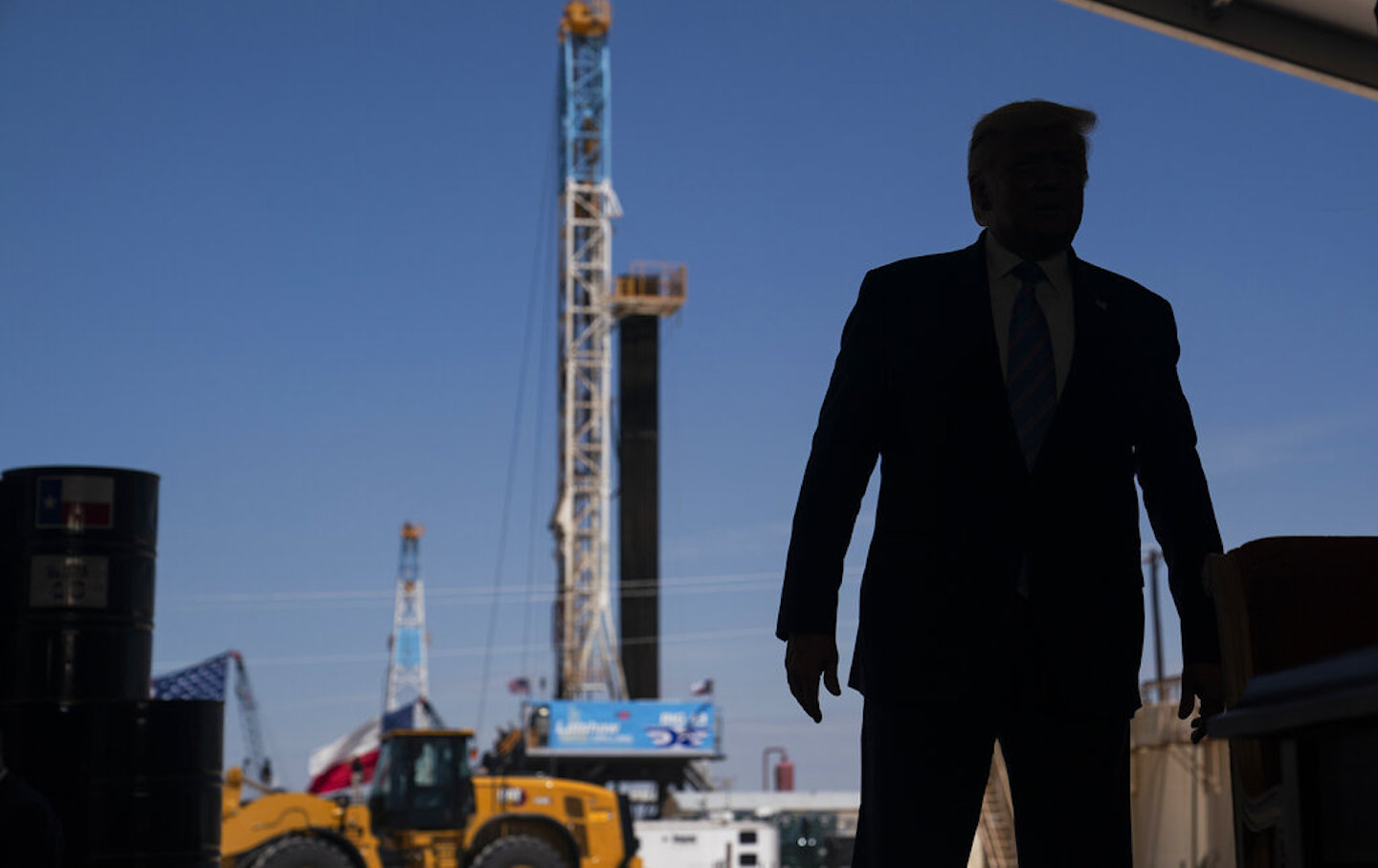
President Donald Trump arrives to deliver remarks about American energy production during a visit to the Double Eagle Energy Oil Rig, Wednesday, July 29, 2020, in Midland, Texas.
(Evan Vucci / AP Photo)An air of puzzled frustration clings to the Biden reelection effort. As the many deficiencies of Donald Trump go on garish display in courtrooms, spur extended bouts of campaign rally aphasia, and generally assail the mediasphere, the consensus view in Bidenland is, “How can we be losing to this guy?” Of course, that’s when the lead Biden strategists aren’t insisting that all the adverse polling numbers that pile up in their inboxes with such worrying frequency are just plain wrong.
There’s a set of presuppositions fueling the Biden team’s bewilderment. It’s long been axiomatic, at least among political science savants, that core metrics of economic performance, like overall growth, wage growth, and low unemployment, should all but guarantee an incumbent president’s reelection. Since the economy on Biden’s watch has hit those key benchmarks—historically so in the case of employment—the November presidential balloting should be a coronation. Yes, inflation remains a stubborn obstacle—particularly in the big-ticket housing sector—but it hasn’t gone above the level reached during Ronald Reagan’s commanding “Morning in America” economic pitch in 1984. So where’s the hitch?
Politics, that’s where. Fueled in no small part by the core ineptitude of mainstream media economic coverage, an electorate contending with unpredictable upward lurches in consumer pricing reverts to a false but beguiling narrative: Tax-slashing and trade-baiting Donald Trump had presided over a balmy pre-pandemic economy, while regulation-minded and free-spending Joe Biden has botched his handling of it. In reality, of course, economic shifts don’t neatly match up with presidential tenures, and Trump was every bit the deficit monger that Biden is held to be in right-wing folklore—and then some.
However misguided this retrospective account of economic switchbacks and reversals may be, it does little political good to grouse about its unfairness. Instead, it has to be met head-on with a more persuasive narrative, detailing how the Biden White House has husbanded broadly distributed prosperity—and more important still, its active role in countering the grasping villainy of a callous and overindulged economic oligarchy. As Henry Adams long ago noted, politics is the organization of hatreds, and Team Biden’s economic messengers need to round up some targets of economic populist rancor pronto.
Fortunately, it’s a target-rich environment. Indeed, the Trump campaign has graciously crafted a perfect opening for such a message. As The Washington Post reported late last week, Trump hosted a premium donor confab for oil industry executives, and made them a baldly transactional pitch: Fork over a billion dollars (yes, that’s billion with a “b”) for my reelection, and I will rescind a wide range of Biden environmental regulations, thwarting the widespread rollout of electric vehicles and unleashing a reckless and destructive wave of industry profiteering. Even by the debauched standards of post–Citizens United campaign finance law, Trump’s overture was stunning—though of course, still technically legal, in all likelihood. Not since the ill-starred presidency of Warren Harding has an aspiring chief executive auctioned off energy policy to the highest bidders—and here Trump was doing it as a de facto cattle call to Big Oil’s lead proprietors, over Mar-a-Lago platters of chopped steak.
What’s more, the same energy profiteers Trump was romancing en masse are conveniently some of the biggest engineers behind the supply-chain inflation that continues to upend the consumer economy. Studies of the wave of corporate “greedflation” artificially driving prices further upward in the wake of the pandemic lockdowns have identified energy concerns as the lead offenders—who, as a direct result, realized some of the greatest profits from those inflationary surges. And that rash of price gouging was further abetted by the forces of paper speculation—hedge funds, principally—that have long sent energy prices skyward.
Trump’s open-air policy auction was so egregious that Democrats on the House Oversight Committee, led by ranking member Jamie Raskin (D-Md.), have opened up a probe into its details—though, since they are not in the House majority, they won’t be able to compel industry cooperation with subpoena powers. Still, Raskin’s efforts had previously unearthed $7.8 million in illicit payments to Trump family businesses from foreign nationals—a blatant violation of the Emoluments Clause, and ample cause for a third Trump impeachment, had other congressional Democratic leaders been able to sustain any sort of focus on the systematic corruption of the country’s political economy. And Sheldon Whitehouse (D-R,I,), chair of the Senate Budget Committee, has given preliminary indications that he might turn his panel’s attention to Trump’s quid pro quo proposal to the oil barons.
Welcome as these congressional inquiries are, they shouldn’t be what’s driving public attention to the moneyed corruption of the MAGA grift: That has to be the prime directive of the Biden campaign. As Celinda Lake, a pollster for the Democratic National Committee who worked on Biden’s 2020 campaign, told Guardian columnist Stephen Greenhouse, the Biden campaign needs to reverse the logic of its economic pitch: “They tend to start the message with their accomplishments. They need to start the message with the overall narrative and then go to their accomplishments.”
The key ingredient of that narrative, she said, is the very sort of bad economic actors whom Trump is courting. “We need to have a dramatic framing that we’re going to take on villains to make the economy work for you and your family,” said Lake. “The villains can be a lot of things—corporations that don’t pay any taxes or drug companies that make record profits while they gouge you on prices.”
Or oil companies who’ve been responsible for driving up the cost of living throughout the economy—and are now apparently in cahoots with Trump to fatten their bottom lines further at the expense of the environment and the urgent demands of climate-change mitigation. When Biden has taken up the cry of greedflation, as he did during his State of the Union address, he tends to focus on nudge-style efforts at piecemeal reform, such as curbing the shrinkage of volume in snack packaging or rescinding junk airline and hotel fees—just the sort of gnat-straining wonkery that Lake and other Democratic pollsters caution against. Biden needs to make oil industry CEOs the face of the corporate brigandry that Trump would sanction in a second term—and then drive the point home by underlining the pain that feckless Trump policies such as his proposed across-the-board 10 percent tariff would create for working families.
When Franklin Roosevelt—the Democratic President Biden would like most to be compared to—mounted his own reelection campaign in 1936, he thundered from the convention podium that he had won the hatred of the Depression economy’s predatory financial class, and that he gleefully “welcome[d] their hatred.” How far is Biden from that sort of appeal? When the Post reporters Josh Dawsey and Maxine Joselow were working on their scoop on the oil barons’ Mar-a-Lago orgy, they solicited a comment from Biden’s campaign—who turned them down, only to deliver a pro forma statement once the story blew up online. You can rest assured that FDR is looking down from economic populist heaven through his pince-nez—and wincing.
Support independent journalism that does not fall in line
Even before February 28, the reasons for Donald Trump’s imploding approval rating were abundantly clear: untrammeled corruption and personal enrichment to the tune of billions of dollars during an affordability crisis, a foreign policy guided only by his own derelict sense of morality, and the deployment of a murderous campaign of occupation, detention, and deportation on American streets.
Now an undeclared, unauthorized, unpopular, and unconstitutional war of aggression against Iran has spread like wildfire through the region and into Europe. A new “forever war”—with an ever-increasing likelihood of American troops on the ground—may very well be upon us.
As we’ve seen over and over, this administration uses lies, misdirection, and attempts to flood the zone to justify its abuses of power at home and abroad. Just as Trump, Marco Rubio, and Pete Hegseth offer erratic and contradictory rationales for the attacks on Iran, the administration is also spreading the lie that the upcoming midterm elections are under threat from noncitizens on voter rolls. When these lies go unchecked, they become the basis for further authoritarian encroachment and war.
In these dark times, independent journalism is uniquely able to uncover the falsehoods that threaten our republic—and civilians around the world—and shine a bright light on the truth.
The Nation’s experienced team of writers, editors, and fact-checkers understands the scale of what we’re up against and the urgency with which we have to act. That’s why we’re publishing critical reporting and analysis of the war on Iran, ICE violence at home, new forms of voter suppression emerging in the courts, and much more.
But this journalism is possible only with your support.
This March, The Nation needs to raise $50,000 to ensure that we have the resources for reporting and analysis that sets the record straight and empowers people of conscience to organize. Will you donate today?