
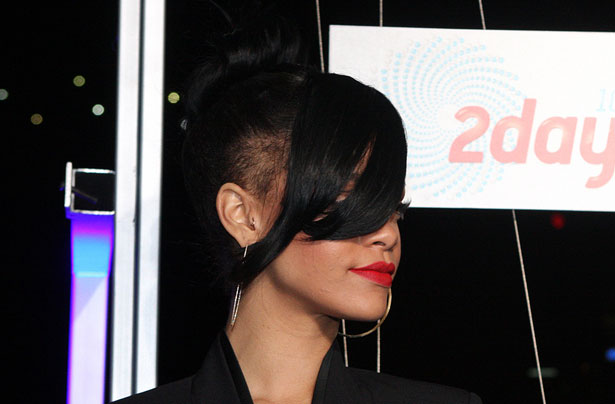
Rihanna. (Flickr/Eva Rinaldi)
Thank God for Rihanna and Chris Brown. It’s the one violence-against-a-women-of-color story that money media can’t get enough of.
To recap, the Grammy Awards took place; Rihanna performed live from the stage. That was news in itself. Four years ago, a much-publicized attack on the musician by her boyfriend, fellow recording artist Chris Brown, left her too beaten and bruised to perform. The two skipped the Grammys that year and Brown was charged with a felony in connection with the attack and sentenced to five years probation and 6 months community service.
Fast forward to 2013. Just days before the Grammies, Brown was back in court on charges he’d failed to complete his community service. Rihanna was seen blowing him kisses from the gallery, and days later, there they were, a cuddly couple at the Awards, Rihanna with a big sparkling rock on her ring finger, unironically performing her ballad “Stay.”
What’s going on? Rihanna told Oprah Winfrey she still loves Brown. In a cover story on Rolling Stone she’s quoted as saying that dating Brown makes her happy and "If it's a mistake, it's my mistake…After being tormented for so many years, being angry and dark, I'd rather just live my truth and take the backlash. I can handle it."
Leaving aside the culturally unfortunate pairing of “angry” and “dark,” when it comes to backlash, Rihanna knows whereof she speaks. Backlash is us. Everyone, it seems, has an opinion on the young woman’s decision to snuggle up to her batterer, from the MSNBC show host Melissa Harris-Perry to the creator of the HBO series Girls.
Watching Rihanna go back to Brown “breaks my heart in half,” Girls’ Lena Dunham told Alec Baldwin, because of all the young girls who look up to and admire the artist. "[Being a role model] is a platform that you have to take seriously.”
Others swamped Twitter with calls for pundits to lay off: It’s nobody’s business if Rihanna goes back to Brown. As she says, it’s her mistake, her personal choice. And so it goes on.
Two things are striking about this story. First, the conversation is all about Rihanna. Secondly, the more people talk about it, the more obvious it becomes that they have absolutely no faith that our current criminal justice responses to domestic violence work. The assumption is that Brown will beat again, even after arrest, conviction, probation and at least some service. The statistics bear the skeptics out. This is what should break our hearts.
Popular
"swipe left below to view more authors"Swipe →
According to studies compiled by the American Bar Association, between 40 and 60 percent of domestic violence offenders were re-arrested for assault within two years of their first arrest. Treatments differ, but most studies show that probation and parole without treatment have no detectable effects on the likelihood that an offender will offend again. Where addiction and drug abuse is involved, let’s just say, parole without drug treatment parole is virtually useless.
Those facts are relevant to the other big news story of this week: the reauthorization of the 1994 Violence Against Women Act. Nineteen years ago, VAWA was a landmark piece of legislation that sought to improve responses to domestic violence, dating violence, sexual assault and stalking. The 2013 version, passed by the Senate this week, authorizes $659 million over five years for criminal and community programs including hotlines shelters and training. It also expands VAWA to include new protections for LGBT and Native American victims of domestic violence, to give more attention to sexual assault prevention and to help reduce a backlog in processing rape kits. It notably doesn’t expand protections for vulnerable undocumented immigrants.
VAWA now goes to the Republican-controlled house where, in all likelihood, there will be debate and yet more debate over the same old ground: do women lie? Don’t women beat? And heck, if we can’t cut cash for policing, can we take it from those “community” programs? (After all, community groups don’t have the power of the police and prison unions.)
The frustrating thing about all this – one of the things, at any rate – is that this old debate isn't the discussion we need to be having. Nearly two decades on, we need to talk about next steps. VAWA has been critical in breaking the silence around violence against women. It has provided services to survivors. It has developed treatment programs and trained generations of police, but it hasn’t made the violence stop. Mandatory arrest hasn’t done it, and neither has parole. The explosion in the number of prisons—and people in them—hasn’t done much either. There’s been a spike in prisons, but very little decline in gender violence. Indeed, the expansion of mandatory minimum sentencing and incarceration has swept up more and more women into the criminal justice system—and once people get involved in the criminal justice system, violence only gets worse. The Bureau of Justice reports that almost half of all women in jails and prisons had been physically or sexually abused before their imprisonment—a much higher rate than reported for the overall population.
Nineteen years after the first passage of the Violence Against Women Act, there are more prisons, and more men—and women—in them. But the violence hasn’t stopped. One in four women still reports having been abused by a partner. According to the Justice Department, three women are still murdered every day. The very community programs now under the budget cutters knife may be just the programs we need the most, including drug and alcohol treatment, quality housing, accessible childcare and healthcare—in fact, communities that care.
Nineteen years after the passage of the Violence Against Women Act, we need to reauthorize. We also need to do more. Hotlines and shelters are great, but what will make the violence stop? Judging Rihanna won’t do it. Leaving it to the cops won’t do it. We need to do it, now.
Read Laura Flanders's print feature on feminist activism around the world.

