
The ICJ’s Ruling Was the First Crack in Israel’s Armor of Impunity
Even as the Israeli government dismisses the ruling, the international community has sent a message that Israel no longer enjoys the immunity that’s protected it since 1948.
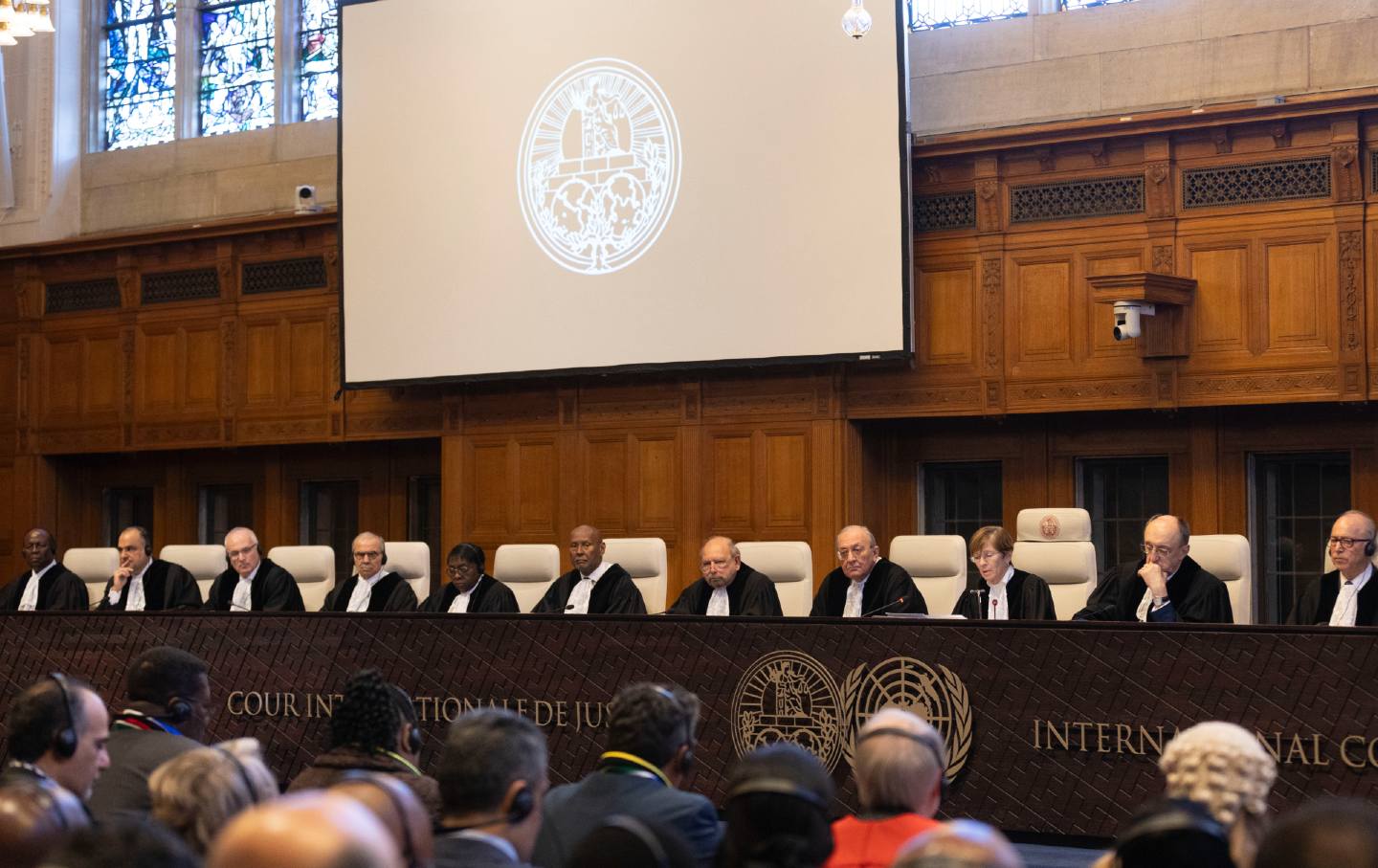
The International Court of Justice delivers an order on South Africa’s genocide case against Israel on January 26, 2024, in The Hague, the Netherlands.
(Michel Porro / Getty Images)On March 29, 1955, David Ben-Gurion, who was then serving as Israel’s defense minister in between stints as prime minister, brought a proposal to the government: to capture the Gaza Strip from Egyptian hands. A few days earlier, several Palestinians from Gaza had crossed the border and killed an Israeli woman in the village of Patish, in the region now known as the “Gaza Envelope.” Ben-Gurion considered conquering the Strip to be the proper Zionist response.
Prime Minister Moshe Sharett opposed the plan, believing that occupying Gaza would bring about complex entanglements with the United Nations. He reminded Ben-Gurion that it was only thanks to the UN and its November 1947 resolution that Israel had even been founded seven years prior.
In his journal, Sharett wrote that Ben-Gurion grew upset: “‘No and no,’ Ben-Gurion yelled. ‘Only the audacity of the Jews founded the state, not a decision by the UN shmoo-en’”—or “oom shmoom,” in Hebrew.
A year and a half later, after returning to the premiership, Ben-Gurion acted on his proposal: backed by the military might of Britain and France, Israel took advantage of the Suez Crisis to occupy the Gaza Strip and half of the Sinai Peninsula. Instead of establishing the “Third Israelite Kingdom,” as he promised in the immediate aftermath of the war, however, Ben-Gurion was forced to withdraw after a decision by the UN—the very body he had disparaged—and strong US pressure.
But the phrase he coined, “Oom Shmoom,” became a foundation stone of Israeli self-conception: Israel is not accountable to anyone for its actions, not to the UN and not to international law.
Nearly 70 years on, the phrase “Oom Shmoom” now has a companion. In response to last month’s decision by the International Court of Justice (ICJ) that there is a plausible risk that Israel is committing genocide in Gaza, Israeli National Security Minister Itamar Ben-Gvir tweeted: “Hague Shmague.”
The world’s top court—after hearing South Africa’s case for invoking the Genocide Convention and Israel’s defense in turn—had stopped short of ordering an immediate cease-fire, but issued several interim rulings: that Israel must take all possible measures to prevent genocidal acts, prevent and punish incitement to genocide, and ensure the provision of aid to civilians, among others. “The decision of the antisemitic court in The Hague proves what was already known: this court does not seek justice, but rather the persecution of Jewish people,” Ben-Gvir railed.
In other words, Ben-Gurion and Ben-Gvir do not only share similar initials; they also share a dismissiveness of the international community, its institutions, and its laws. “Our future is not dependent on what the gentiles will say, but rather on what the Jews will do,” Ben-Gurion said in a 1955 speech—a sentence that became a guiding principle for Israeli policy, and chimes strongly with Ben-Gvir’s modern retelling.
Much remains uncertain about the ICJ case. We don’t yet know how the Hague will ultimately rule on the question of whether Israel is committing genocide in Gaza, and settling the issue may take years. We also don’t know what Israel will write in the report that it is ordered to deliver to the court in two weeks, which is supposed to show what it has done to prevent genocide in Gaza; nor do we know whether the court will be satisfied with the report or issue new, more stringent orders to protect the Palestinians in Gaza.
We also don’t know if the UN Security Council will be asked to force Israel to comply with such orders, and if the United States would rush to Israel’s side in such a scenario, as it has for decades. Still, we can say for certain: What happened at The Hague made a sizable crack in the armor of non-accountability that Israel has used to justify its actions since 1948—even if that hasn’t yet registered with much of Israel’s far-right government.
In order to understand the political significance of the ICJ’s ruling, we have to go back a bit. For years, Israel sneered at international law, certain that the United States would always be ready to clean up its mess in any international forum. So when South Africa approached the court with a request to open proceedings against Israel under the Genocide Convention, Israel initially treated the accusation with its usual blasé dismissiveness.
“South Africa’s claim lacks both a factual and a legal basis, and constitutes despicable and contemptuous exploitation of the Court,” Israel’s Foreign Ministry said in a statement. But The Hague thought otherwise.
Popular
“swipe left below to view more authors”Swipe →Its chief judge, the American Joan Donoghue, stated at the beginning of her remarks that, contrary to Israel’s claims, the court had the authority to rule in the case. Donoghue accepted South Africa’s presentation of the facts on the danger of genocide in Gaza almost in their entirety—from the number of civilian deaths and the extent of the destruction to the danger of hunger, the threat of diseases, and even worries about the fate of pregnant women in Gaza, a claim that was especially ridiculed in Israel. Israel’s claims that it makes a clear distinction between civilians and militants, and that Hamas uses civilians as “human shields,” were not mentioned in the decision.
“This is a dream come true for everyone who works in the field of human rights,” said Basel Sourani, a researcher at the Palestinian Center for Human Rights and a resident of Gaza who managed to leave for Cairo after 50 days of Israeli bombardment. “It’s the first time that Israel is being held accountable. We dreamed of this kind of accountability. It gives us hope.”
Sourani says that Palestinians have been pushing countries around the world to turn to the ICJ for years, all in the hopes of stopping Israel’s brutal treatment of Palestinians—but “we needed the technical breakthrough” offered by South Africa, since only signatories to the international treaties over which the court has jurisdiction can bring forward such a petition.
Sourani, who is active in the Palestinian human rights community, is painfully familiar with the frustration of writing and submitting reports that no one reads about Israel’s human rights abuses. But this time, he believes, is different. “When we approach Western countries with a report, they say, ‘OK,’ and that’s it. It’s something completely different when you present an ICJ opinion to a European diplomat. This is no joke.”
Sourani also believes that the ICJ’s provisional ruling will have an inevitable impact on the International Criminal Court, which is located just across the street, and on its prosecutor, Karim Khan. Until now, Sourani says, Khan has been dragging his feet in every case brought against Israel. “It’s a nightmare for him,” he explained.
And now, “instead of giving lectures on the importance of upholding international law, he’ll be forced to move from theory to practice. It will have enormous consequences,” Sourani concluded.
Like Sourani, Talia Sasson, an Israeli lawyer who worked for 25 years in the State Attorney’s Office and is now chair of the New Israel Fund’s international council, says Israel’s situation has changed. “This time, Israel was not dragged first to the Security Council, but to the ICJ in The Hague,” she explained.
While Sasson acknowledged in a recent article in Haaretz that there is a “large gap” between the PR part of the ICJ’s decision, which adopted the South African point of view, and the orders themselves, which were quite moderate, she cautioned that this gap should not be misleading. The ICJ gave Israel an opportunity to “mend its ways” and announce within a month what it had done to prevent genocide, but if Israel’s answer is not convincing, it is likely that much more significant orders will be issued against Israel.
In Sasson’s eyes, as in Sourani’s, the question is not only legal. “Israel found itself almost beyond the pale in terms of international public discourse,” she said. And the very fact that the ICJ agreed to seriously consider the claim that it is committing genocide puts Israel in a very difficult situation. “If the ICJ changes its decision vis-à-vis Israel, and if Israel does not strictly comply with the orders, it may find itself in a new situation, unfamiliar and worse than any of its predecessors,” Sasson warned.
In such a scenario, she continued, “it is doubtful whether an American veto will be imposed at the Security Council when there is an almost wall-to-wall consensus among the judges at the ICJ. It won’t be automatic.”
Sasson adds that because the Israeli media generally does not report on the extent of human suffering in Gaza, the Israeli public is in “kind of a bubble.” As a result, “if Israel finds itself in a Security Council debate about this, mainly due to the extreme statements by politicians being perceived as incitement to genocide, this could give the Israeli public an almighty shock. They will not be prepared for it.”
In the short term, it is difficult to predict what impact the ICJ ruling will have on Israel’s actions in Gaza. Sourani mentions the agreement to bring in UN representatives to examine the situation in northern Gaza as the first sign that Israel is taking the orders seriously; likewise, the decision to prevent demonstrators from blocking aid trucks entering Gaza from Israel is likely related to the ICJ’s order to ensure that enough humanitarian aid enters the Strip.
Moreover, although no Israeli politician would dare admit this, it is likely that an acceleration in negotiations for a lengthy cease-fire in exchange for the release of some of the Israeli hostages is also related to the decision at The Hague. In the event of a cease-fire, it will be much easier for Israel to show the judges that the danger of genocide in Gaza has lessened or dissipated.
There is, of course, a possibility that Israel will not respect the orders issued by the ICJ. If Israel’s war cabinet embraces Ben-Gvir’s “Hague Shmague” approach, the Israeli defense team at the ICJ will find it very difficult to convince the judges that Israel has not embarked on the path to genocide—certainly if the expulsion and resettlement plans touted at a recent major conference starring Ben-Gvir become official or even semiofficial government policy.
Sourani believes that if this is the case, the course that began in The Hague may well lead to sanctions like those imposed on apartheid South Africa. “The fanatics who lead the Israeli government don’t understand the dynamics around the world,” he said. “They think that no matter what, they will escape punishment.”
Until now, the line of fortifications shielding Israel from international sanctions—stretching from Ben-Gurion to Ben-Gvir—has held strong. The question is whether South Africa’s surprise attack will succeed in breaking this armor of immunity once and for all.
Become a Sustaining Donor This September
Between the reemergence of right-wing red-baiting and Donald Trump’s use of the chilling National Security Presidential Memorandum–7 to criminalize left political organizing, we’re seeing McCarthyism reborn before our eyes.
This assault on democracy cannot be ignored or wished away. Resisting it requires bravery in the face of threats and repression, a steadfast commitment to the truth, and the unwavering belief that we can—and will—overcome this darkness.
We must have an independent media that sets the record straight, unearths corruption and abuses of power, and advances a politics of justice and dignity for all if we’re to win this fight.
That’s why I’m writing to you today. This September, The Nation needs to add 100 monthly donors to sustain our progressive journalism. Your contribution makes the next investigative report, the next truth-speaking column, and the next pathbreaking essay all possible.
I hope you’ll support our work with a recurring donation today. If you donate $10 or more a month, we’ll send you a brand new “Hands Off the Free Press!” sticker to recognise your commitment to our cause. Please, donate today.
Onward,
Katrina vanden Heuvel
Editor and Publisher, The Nation
More from The Nation
CEOs Are Losing Control of AI CEOs Are Losing Control of AI
With no slowdown from Trump’s administration.
How to Arrest Benjamin Netanyahu How to Arrest Benjamin Netanyahu
Make no mistake: The United States can seize Netanyahu for crimes under US law and prosecute him in US courts when he is in New York City this week.
The GOP’s Incredible Shrinking Senate Map The GOP’s Incredible Shrinking Senate Map
Trump has so badly damaged the Republican Party’s brand that strategists are contemplating bitter fights—and losses—in races they’d been banking on as sure things.
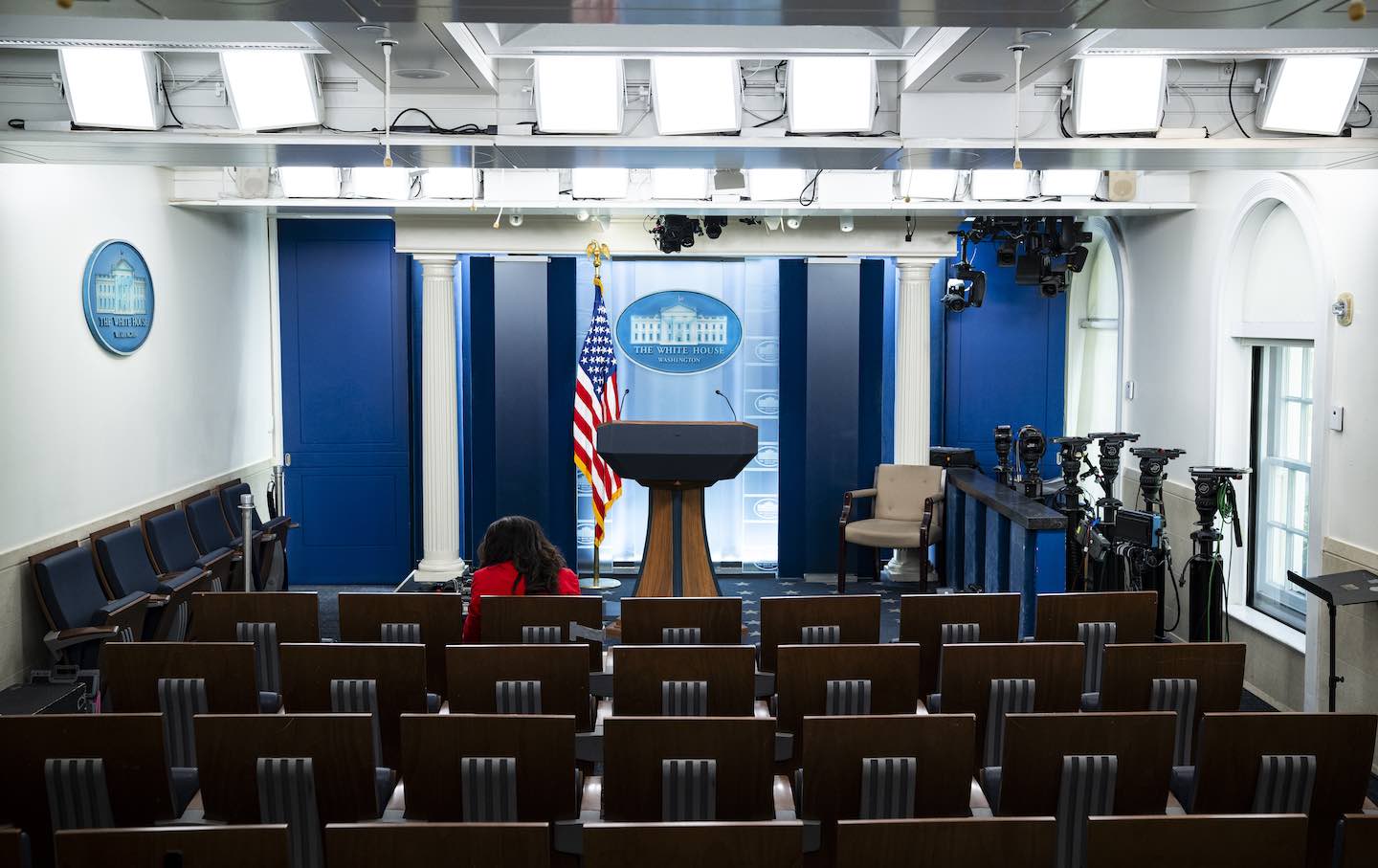
Trump Wants to Keep Journalists Out of the White House. He Should Get His Wish. Trump Wants to Keep Journalists Out of the White House. He Should Get His Wish.
The president has banned MS NOW, CNN, and Politico from attending press briefings. The rest of the media should respond with a boycott.
Gina Hinojosa: “We Flip Texas, and It’s Over” Gina Hinojosa: “We Flip Texas, and It’s Over”
Talking to Texas gubernatorial candidate Gina Hinojosa about what redistricting could mean and how a new generation of Democrats is speaking more directly to voters.
Pinochet: The Verdict of History in the Letelier-Moffitt Case Pinochet: The Verdict of History in the Letelier-Moffitt Case
An act of international terrorism on the streets of Washington, DC, still reverberates 50 years later.

