Ralph Nader’s Newspaper Is a Salvo Against D.C. Media
Capitol Hill Citizen is a welcome throwback to a more adversarial model of legislative coverage.
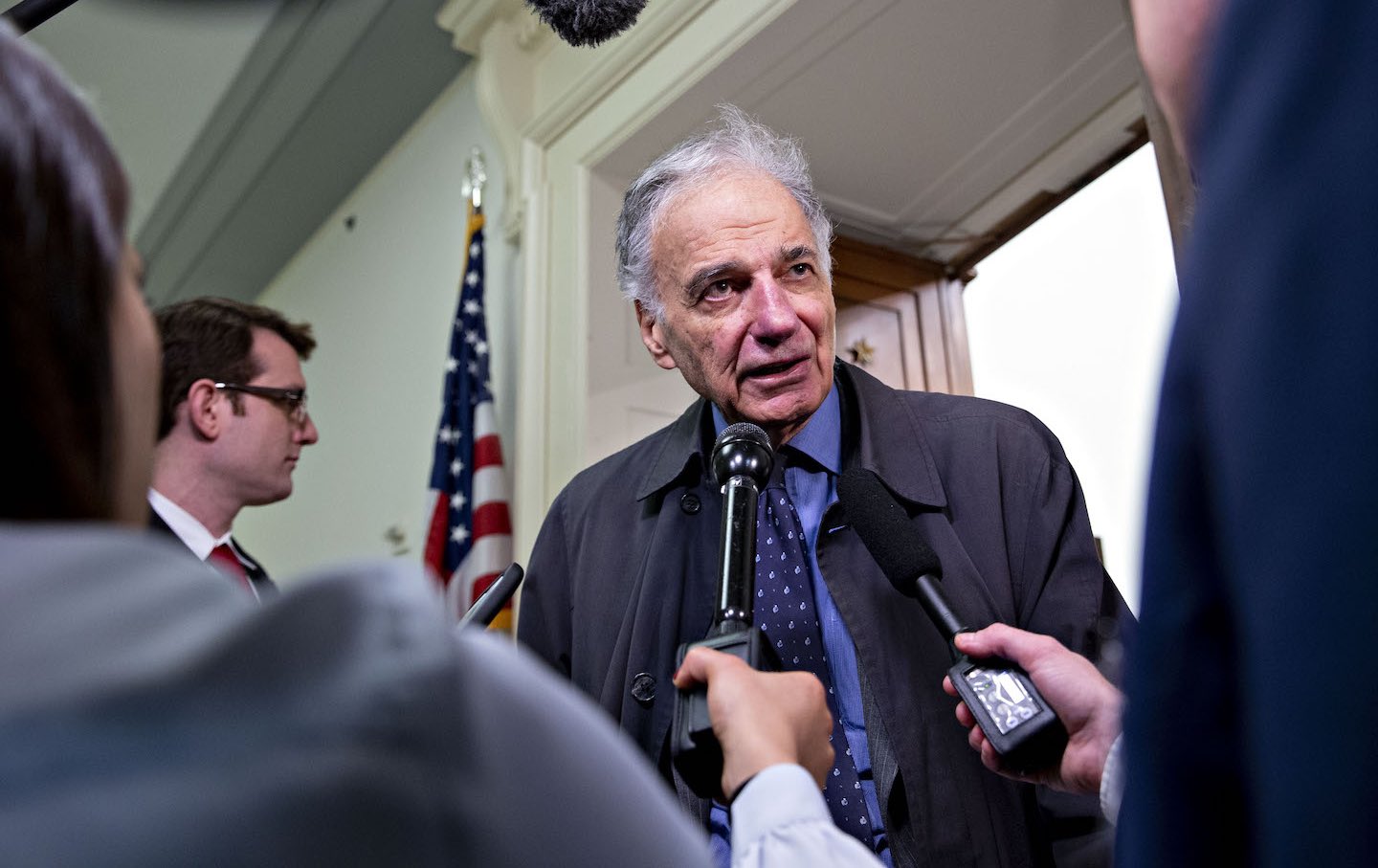
Ralph Nader speaks to the press during a break of the House Transportation and Infrastructure Committee in Washington, D.C., in 2019.
(Andrew Harrer / Bloomberg)One of the perks of a career on Capitol Hill is a surrounding environment that’s largely devoted to chronicling the importance of that career. Ever since Politico planted its flag back in 2007, there’s been a boom in trade journalism devoted to credulous coverage of the legislative process and the leaders who drive it. Take Axios, the bullet-pointed tip sheet for readers who find Politico’s breathless Hill coverage too Jamesian in scope. The Messenger, in turn, is defying the odds by pioneering an even more superficial model of politics coverage, as exemplified by “The Scale,” its click-friendly, event-ranking panel of “political seismologists.” This frenetic traffic in glorified Hill gossip stands alongside the more arm’s-length yet still studiously deferential coverage of Capitol Hill politics-as-usual, purveyed by CQ-Roll Call, National Journal, and The Hill (though it bears stipulating that The Hill’s opinion section is a stunning mosaic of right-wing clout-chasing).
So the Capitol Hill Citizen, a semi-monthly publication backed by longtime consumer advocate Ralph Nader, is a welcome throwback to a more adversarial model of legislative coverage. The mission is right there in the title, “citizens” otherwise serving as a quaint and near-obsolete afterthought to a legislative process dominated by corporate lobbying, influence-brokering, and favor-trading on both sides of the partisan aisle. (The paper’s masthead motto is also a spirited swipe at the self-serious one adopted during the Trump administration by The Washington Post: “Democracy dies in broad daylight.”)
In pursuit of its citizens-first mission, the paper’s Hill coverage reflects a markedly different set of priorities than you see in any other outlet. As House GOP leaders tee up stemwinding Hunter Biden probes and plans to impeach Joe Biden for being Joe Biden, the July/August edition of Capitol Hill Citizen leads with a dispatch from editor Russell Mokhiber announcing that inquiries into corporate crime have hit a new low on Biden’s watch—and that Biden’s dogged would-be prosecutors in Congress are likewise asleep at the switch when it comes to scheduling hearings on the issue. Citing research from Nader’s Public Citizen group, Mokhiber notes that corporate crime prosecutions by Biden’s Justice Department numbered just 90 in 2021, “less than half of the average annual number of corporate crime prosecutions brought in the previous 25 years.” The picture is just as grim on the broader front of white-collar crime, he observes, in a review of data from the Transactional Records Access Clearing House: “During the last fiscal year, which ended [in] September 2022, only 4,180 white-collar defendants were prosecuted. White-collar prosecutions were lower than in any year during Trump’s administration—even lower than during 2020, when due to the pandemic and the federal partial shutdowns, federal criminal enforcement activities of all kinds were sharply curtailed.”
The issue’s other features reflect an unapologetically sharp-elbowed approach to the Hill beat. A seven-page feature commemorating the 20th anniversary of the George W. Bush White House’s invasion of Iraq features transcripts of Nader’s radio interviews with anti-war activist Cindy Sheehan, former Marine officer and State Department official Matthew Hoh, who resigned his State post over the botched US invasion and occupation of Afghanistan, and foreign correspondent Dahr Jamaial. A Nader-penned editorial calls for federal lawmakers to hold town halls on the abuse of corporate power over an August recess usually devoted to securing big-donor backsheesh.
The paper is a throwback in another sense as well: It is a print-only publication in an age of digital click-harvesting. This choice is another rebuke to the callow quest of traffic for traffic’s sake that most conventional political news trades in. “Online is a gulag of clutter, diversion, ads, intrusions, and excess abundance,” Nader declares.
Still, in order to fulfill its uphill quest to practice real and consequential journalism in an age of vacuous clout-chasing, Capitol Hill Citizen will have to make some other, more difficult decisions. For starters, roughly half of a given issue’s articles appear beneath a byline that reads “Citizen Staff”—generally a practice adopted by publications relying too heavily on one or two main contributors. In the Citizen’s case, the quasi-anonymous attribution is an additional liability, given its devotion to bringing greater transparency to the doings of Congress: Detractors of the publication can readily charge that it’s not abiding by its principles—while also contending, with some justification, that they’re deprived of the opportunity of engaging the paper’s critics by name in a public forum.
Nevertheless, the advent of Capitol Citizen provides welcome adversarial fresh air in an otherwise languid and complacent media complex centered in and around Capitol Hill. Just don’t look for it to turn up on The Messenger’s Scale anytime soon.
Support independent journalism that does not fall in line
Even before February 28, the reasons for Donald Trump’s imploding approval rating were abundantly clear: untrammeled corruption and personal enrichment to the tune of billions of dollars during an affordability crisis, a foreign policy guided only by his own derelict sense of morality, and the deployment of a murderous campaign of occupation, detention, and deportation on American streets.
Now an undeclared, unauthorized, unpopular, and unconstitutional war of aggression against Iran has spread like wildfire through the region and into Europe. A new “forever war”—with an ever-increasing likelihood of American troops on the ground—may very well be upon us.
As we’ve seen over and over, this administration uses lies, misdirection, and attempts to flood the zone to justify its abuses of power at home and abroad. Just as Trump, Marco Rubio, and Pete Hegseth offer erratic and contradictory rationales for the attacks on Iran, the administration is also spreading the lie that the upcoming midterm elections are under threat from noncitizens on voter rolls. When these lies go unchecked, they become the basis for further authoritarian encroachment and war.
In these dark times, independent journalism is uniquely able to uncover the falsehoods that threaten our republic—and civilians around the world—and shine a bright light on the truth.
The Nation’s experienced team of writers, editors, and fact-checkers understands the scale of what we’re up against and the urgency with which we have to act. That’s why we’re publishing critical reporting and analysis of the war on Iran, ICE violence at home, new forms of voter suppression emerging in the courts, and much more.
But this journalism is possible only with your support.
This March, The Nation needs to raise $50,000 to ensure that we have the resources for reporting and analysis that sets the record straight and empowers people of conscience to organize. Will you donate today?