
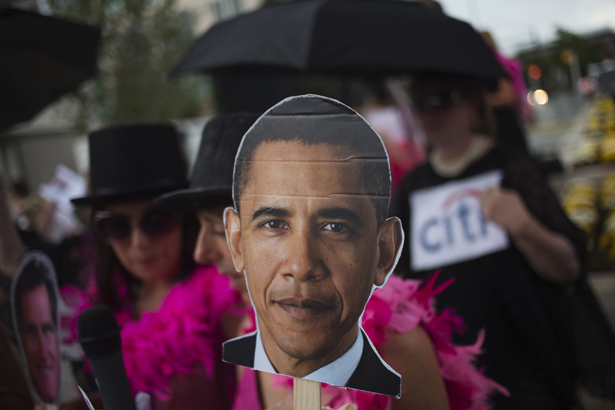
A protest against "Money and politics" near the venue for the Democratic National Convention in Charlotte, North Carolina September 2, 2012. Reuters/Adrees Latif
The familiar question of whether we work on electoral politics or on movement politics is fraught with emotion and argument about whether movement or electoral politics is more effective for the left. We think it is the wrong question. Both are needed, and without both, neither is effective.
In historical fact, movement politics and electoral politics are continuously intertwined. The fundamental dynamic is triggered when politicians have to deal with voter blocs composed of the same people to whom movements direct their appeals. We can see this dynamic on both the right and the left. The Tea Party picked up steam when Republicans eager for re-election began to repeat its slogans. So did the labor movement of the 1930s gain momentum from Franklin Roosevelt’s rhetorical appeals to the “common man,” just as the civil rights movement was energized by Lyndon Johnson’s echo of the movement refrain “We shall overcome.” When politicians echo a movement’s demands, they signal a degree of vulnerability to its constituency, and the movement gains traction.
It’s also worth remembering that when politicians are dependent on electoral blocs that are also movement constituencies, they will often hesitate to use the full arsenal of the state’s repressive capacities against movement actions and may even make uncertain efforts to protect movements—as when Robert Kennedy, as attorney general, grudgingly tried to protect the Freedom Riders.
Moreover, movements make gains when an electoral regime is forced to offer concessions to heal the widening rifts that the movement is causing in its electoral base. The demonstrations and marches against the beginning of the war in Iraq are often cited as a measure of the impotence of movement politics. We think rather that the problem was that the antiwar movement did not speak to an antiwar voter bloc that Bush and the Republicans depended on, so they could simply ignore the protests. By contrast, a smaller immigrant rights movement has pressured Barack Obama, who depends on Latino votes, to use presidential authority to void the deportation of undocumented youth. Similarly, looking to LGBT voters, Obama responded to the gay rights movement’s demands, ordering the end of “don’t ask, don’t tell” and reversing his position on gay marriage. And in one of the environmental movement’s most important recent victories, Obama denied a permit to build the Keystone XL pipeline after activists staged months of mass nonviolent civil disobedience in front of the White House.
This is why the diverse protests we call Occupy need a Democratic victory in 2012: not because Democrats on their own will magically implement the movement’s agenda, but because Democrats depend on some of the same constituencies that the movement represents and to whom it directs its appeals. The overlap creates space for movements to grow and thrive. They win policy reform to the degree that they are able to leverage these electoral opportunities. Progressive hopes for a bolder second Obama term thus depend on the vigor of the Occupy movement and the degree to which it sparks activism and defiance among the other great movements for social justice that have always been important in American politics.
Popular
"swipe left below to view more authors"Swipe →
To be clear, we don’t think Occupy activists should drop their work on foreclosures or student debt or worker rights in favor of joining the election campaign by knocking on doors or staffing the phone banks or whatever. After all, not only is it unlikely that many Occupy activists, disgusted as they are by the hypocrisy and corruption of electoral politics, would do so, but their movement work is actually a contribution to the campaign. Think of the impact of Occupy on the national discussion, with its slogans about Wall Street and the 99 percent, along with its encampments and general assemblies and twinkling fingers! It has made extreme inequality an issue no one can ignore. Even the Republicans are campaigning as the party of jobs and economic recovery.
Other Replies to Deepak Bhargava’s “Why Obama?”
Dorian T. Warren: “Go for the Jugular”
Saket Soni: “We Need More than a New President”
Bill Fletcher Jr.: “Defeat the Reactionary White Elite”
Tom Hayden: “Obama’s Legacy is Our Leverage”
Ai-Jen Poo: “A Politics of Love”
Robert L. Borosage: “Re-elect Obama—But Reject His Austerity”
Ilyse Hogue: “Time to Rewire”
And this web-only article:
Michael Brune: “For the Climate, Obama Needs Another Four Years”

