Kyrsten Sinema Does Us All a Favor
The formerly Democratic Arizona senator announced on Super Tuesday that she wouldn’t be seeking reelection.
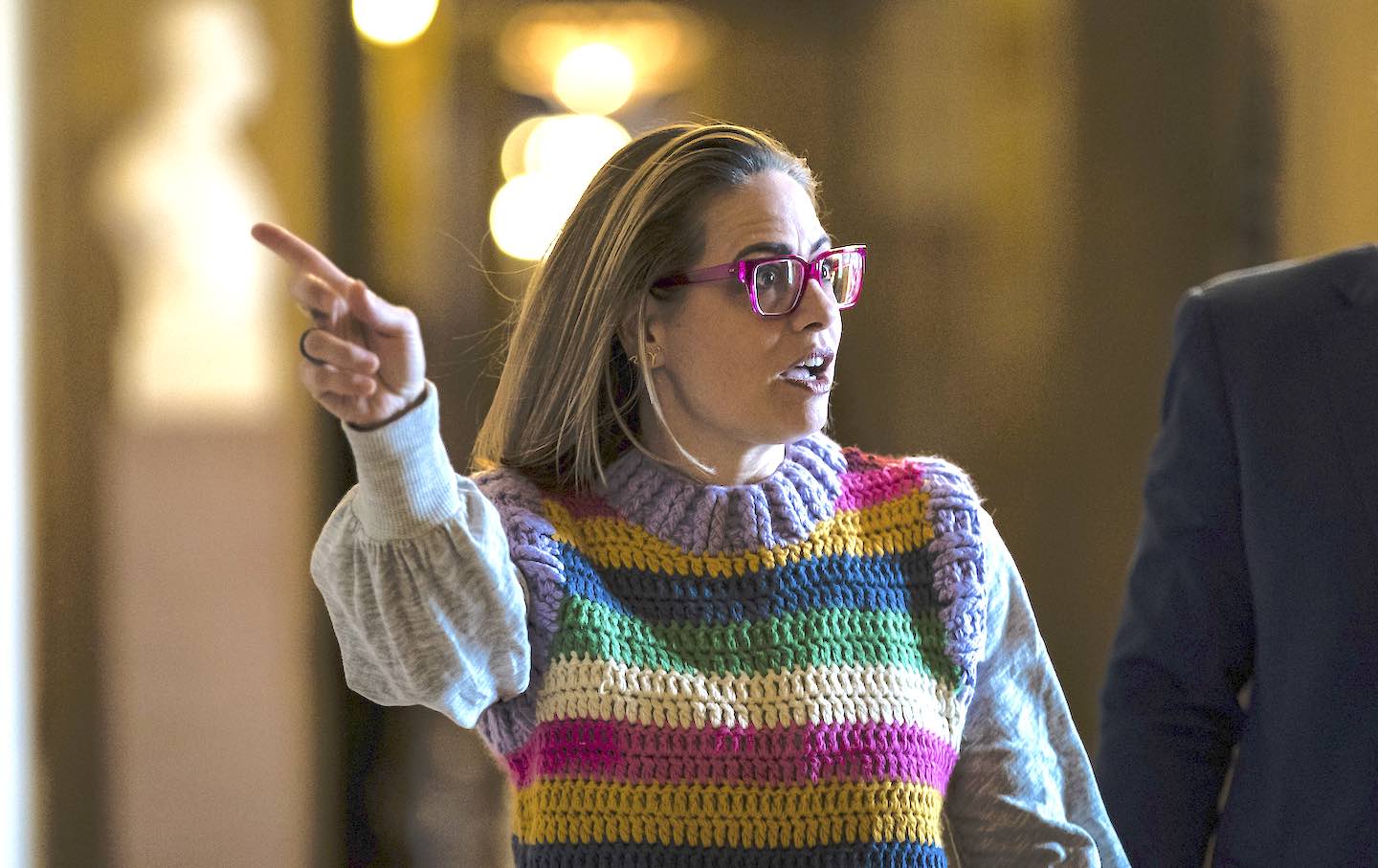
Senator Kyrsten Sinema walks to the Senate floor after a meeting in the offices of Senate minority leader Mitch McConnell on Capitol Hill in May 2023.
(Jabin Botsford / The Washington Post via Getty Images)The most encouraging return on Super Tuesday came early in the day, and didn’t involve any actual voting at all: Kyrsten Sinema, the formerly Democratic senator from Arizona, sent out a typically self-serving video announcing that she would not be seeking another term after initially planning to run as independent in the 2024 cycle. She delivered a fanciful account of her legislative record, claiming to have made heroic strides toward modernizing infrastructure, reducing water pollution, creating jobs, and brokering vital consensus on key issues dividing the country by choosing to “listen without judging and to focus on what unites us.” Yet, in a distressing departure from the well-worn catechism of the difference-trimming moderate, it turns out that the actual American public didn’t appreciate all this problem-solving tutelage: “Americans still choose to retreat farther into their partisan corners.”
“Compromise is a dirty word,” Sinema’s lamentation continued. “We’ve arrived at that crossroad, and we’ve chosen anger and division.” She then took up the standard passive-aggressive refrain of the “it’s not you, it’s me” breakup speech: “Because I chose civility, understanding, listening, working together to get stuff done, I will leave the Senate at the end of this year.”
Sinema’s official Senate farewell was, in other words, a classic Sinema performance: claiming the enlightened, above-the-fray rhetorical high ground while wallowing in the professional-class petulance reserved for an insufficiently grateful client base. Sinema’s announcement was good news for the sort of partisan political calculation she professes to deplore, since it leaves Democrats fielding a strong and accomplished House member, Ruben Gallego, against MAGA grievance merchant Kari Lake, a former TV newscaster who continues plying a paranoid election-denial narrative to dismiss the results of her failed 2022 run for governor.
But Sinema’s departure from the race signifies more than an improved Senate map for the Democrats narrow majority. The very trends she regards as so parlous for her future—and by natural extension, the fate of the American republic—represent a healthy and growing distrust for the inert cult of bipartisan Capitol Hill dealmaking as the only respectable path to resolving the country’s stubborn differences. This household god of conventional Beltway piety is the first-resort defense of cynical, bought-out lawmakers, from eternal no-labels hustler Joe Lieberman to New Jersey graft prince Robert Menendez to President Joe Biden, the erstwhile Senator From MNBA who now fetishizes bipartisan accords anywhere they appear to be on offer, be it the disastrous Senate border deal or the genocidal prosecution of the Gaza War.
Even in this dismal roll call of backward-reeling achievement, Sinema’s bipartisan blather stands out. She had notoriously served, along with Democratic Senator Joe Manchin, as a key “no” vote in the protracted effort to pass the Biden administration’s ambitious “Built Back Better” package of stimulus outlays and green public investments. She also helped block a critical bill to levy steeper taxes on hedge funds and private equity concerns—after bankrolling nearly a cool million in campaign funds from investment operations prior to the vote. And in perhaps her most morally incoherent citation of the holy mandate of bipartisanship, she withheld support for a desperately needed package of voting-rights reform on the grounds that it lacked across-the-aisle appeal.
The formalist myopia of this stance overlooks perhaps the most salient political truth of our age: that the Republican Party relentlessly restricts ballot access and gerrymanders congressional districts so it can continue to exercise maximal power as a governing minority. To insist on an advance bipartisan agreement to dismantle this prime fount of GOP political control is a tautological absurdity—a bit like demanding that extreme weather be completely dissociated from climate change. To top it all off, Sinema repeatedly, and disingenuously, broadcast her reverence for the late John Lewis—the person whom the voting rights legislation was named after—on her self-infatuated social media feeds. Lewis, needless to say, was never an apostle of elite-formalist bipartisan comity, having been jailed and beaten in his efforts to win justice for disfranchised African Americans during the civil rights era. It’s beyond grotesque that soulless establishment hacks like Sinema could invoke his memory while resorting to the racist parliamentary device of the filibuster to prevent the Senate from even debating the expansion of voting rights.
Yet characters like Sinema, Lieberman, and company almost never get called out for such first-order hypocrisies, because in the crabbed moral geography of the Capitol, they’ve staked out the position of omniscient piety. In this scheme of things, the appearance of procedural compromise is always and forever the highest achievement of dispassionate lawmaking, trumping the mere quest for political change through mass organizing and activism. Never mind that the record of bipartisan agreement in Congress has produced many of the worst and most regressive legislative initiatives in modern politics—from the deregulation of the financial sector and the TARP bailouts to No Child Left Behind, the authorization of the 2003 Iraq invasion, and the 1994 crime bill. The bipartisan fever dream remains catnip to the members of our governing class because it makes everything concerning the public weal ultimately about them and the elective affinities they share across party lines—their backroom codicils and after-hours cocktails, their lobbyist-drafted bills and donor-driven bailouts. So, to give the departing senator from Arizona due credit, she’s right about one thing: It’s not us, it’s you.
Become a Sustaining Donor This September
Between the reemergence of right-wing red-baiting and Donald Trump’s use of the chilling National Security Presidential Memorandum–7 to criminalize left political organizing, we’re seeing McCarthyism reborn before our eyes.
This assault on democracy cannot be ignored or wished away. Resisting it requires bravery in the face of threats and repression, a steadfast commitment to the truth, and the unwavering belief that we can—and will—overcome this darkness.
We must have an independent media that sets the record straight, unearths corruption and abuses of power, and advances a politics of justice and dignity for all if we’re to win this fight.
That’s why I’m writing to you today. This September, The Nation needs to add 100 monthly donors to sustain our progressive journalism. Your contribution makes the next investigative report, the next truth-speaking column, and the next pathbreaking essay all possible.
I hope you’ll support our work with a recurring donation today. If you donate $10 or more a month, we’ll send you a brand new “Hands Off the Free Press!” sticker to recognise your commitment to our cause. Please, donate today.
Onward,
Katrina vanden Heuvel
Editor and Publisher, The Nation