
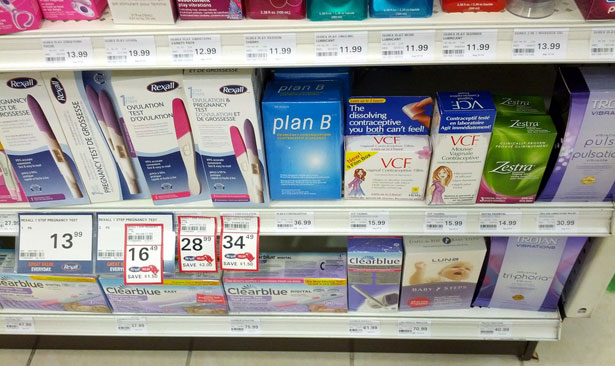
Contraceptives at a pharmacy in Toronto. (Flickr/Cory Doctorow)
Yesterday, the FDA announced that it will make Plan B—also known as emergency contraception (EC) or the morning after pill—available over the counter to women older than 15 years old who can prove their age. This decision comes less than a week before the end of a thirty-day deadline imposed by a federal judge mandating EC be available without a prescription to women of all ages. So despite the FDA’s announcement, the Obama administration still needs to appeal the judge’s decision or request a stay by Monday.
Some heralded the FDA’s decision as a victory—Planned Parenthood’s Cecile Richards called it “an important step forward.” But Nancy Northup, president of the Center for Reproductive Rights—whose lawsuit against the FDA sparked the federal ruling—called the restriction “arbitrary.”
“Lowering the age restriction to 15 for over-the-counter access to Plan B One-Step may reduce delays for some young women—but it does nothing to address the significant barriers that far too many women of all ages will still find if they arrive at the drugstore without identification or after the pharmacy gates have been closed for the night or weekend.”
Indeed, it’s hard to see how most 15-year-olds would be able to access the drug, given that they need to prove their age in the form of a driver’s license, passport or birth certificate. As Sarah Kliff at The Washington Post points out, most states won’t allow teens to apply for a driver’s license until they are 16 years old, and in 2010, only 28 percent of 16-year-olds even had licenses.
Popular
"swipe left below to view more authors"Swipe →
Teens who don’t have access to a government ID would not have any easier a time procuring a passport or birth certificate. If a girl had either of those documents, it’s most likely that her parents would have them filed away. And if a teenage girl wanted to obtain a passport or birth certificate herself, there is no way she could do so in the seventy-two hours needed to ensure that Plan B is effective. There’s also a socioeconomic factor to who has licenses and who doesn’t, making the proof-of-age restriction even more burdensome to marginalized communities, especially young women who are undocumented.
Even 15-year-olds with an acceptable form of identification are not out of the woods. A study published last year in the journal Pediatrics showed that many pharmacists don’t understand the law as it pertains to Plan B. The study found that because of pervasive misinformation, nearly 20 percent of 17-year-olds would be denied the drug. And now we’re not even talking about pharmacists—but cashiers, who are more likely to be younger and untrained in protocol surrounding Plan B.
The larger question, however, is why should there be an age restriction at all. The reason a judge ruled Plan B should be available to women and girls of all ages is because it’s safe for all ages. And seriously, if we believe a 14-year-old is too immature to know how to take a pill, do we really think she’s adult enough to handle an unwanted pregnancy?
The truth is that the age restriction is completely arbitrary, tied only to our puritanical comfort levels. And listen, I get it; I think it’s fair to say that most people are uncomfortable with the idea of a 14-year-old having sex. But here’s the thing—access to Plan B isn’t about keeping a 14-year-old from having sex—by the time she gets to the pharmacy, that ship has sailed—it’s about keeping a 14-year-old who has already had sex from getting pregnant. And despite what urban legend (or past embarrassing FDA memos) may tell you, making emergency contraception more available is not more likely to make young teens have sex—it will just make them less likely to end up pregnant.
We can’t let our discomfort with teen sex trump young people’s right to sexual and reproductive health and we can’t continue to let politics trump science. If we care about young women’s health and bodily autonomy and integrity, we’ll drop all age restrictions from emergency contraception. Anything less isn’t just illogical—it’s immoral.
 Take Action: Stand Up for Access To Emergency Contraception
