
Before the Internet changed everything, the Berkman Center was there. Founded as a different kind of research lab about ten years ago, Harvard Law School’s unusual project – blending think tank freedom with academic rigor – is celebrating its first big anniversary this week. The sold-out conference features celebrities in the world of Internet culture, like professors Yochai Benkler and Jonathan Zittrain, and actual celebrities catapulted by Internet culture, like Wikipedia Founder Jimmy Wales, named one of the world’s most influential people by Time magazine.
Jonathan Zittrain, nicknamed Jay-Z by techies in attendance, kicked things off by explaining his new book, "The Future of the Internet; And How to Stop It." As more web appliances restrict user choice, like iPhones, he warned that people will have less power to impact the web. That’s because these popular "tethered appliances" can only be modified by their parent companies. Zittrain argues that the web will foster less innovation under this system, freezing the current landscape and reducing the prospect for "generative" developments.
Networked politics was a hot topic in several sessions. Jesse Dylan, who directed "Yes We Can," the music video drawing lyrics from a speech by Barack Obama, spoke about how the creators were surprised by the viral success of the project. (I spoke on the same panel, about the youth vote in 2008.) Another presenter discussed a fascinating April study of the Iranian blogosphere, mapped by link patterns and topic areas:
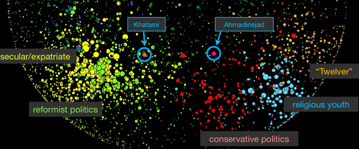
Iran’s political blogosphere has more elected participation than most countries; the circled dots are the blogs of Iran’s current and former president. The large size of the dots reflects their many incoming links. The discussion of wired international activism turned to Jeff Ooi, a popular Malaysian blogger elected to Parliament this March. And as more governments restrict political speech online, one participant said activists abroad need more flash drives and portable storage systems that can save and spread political dissent, even when governments scrub it from the open Internet.
Today Harvard also announced it will pluck Berkman from the law school and elevate it to a "university-wide, interfaculty initiative." That bureaucratic shift reaffirms the Center’s culture, which is more dynamic and interdisciplinary than any curriculum cabined in a single graduate program. You know, like the Internet.

