
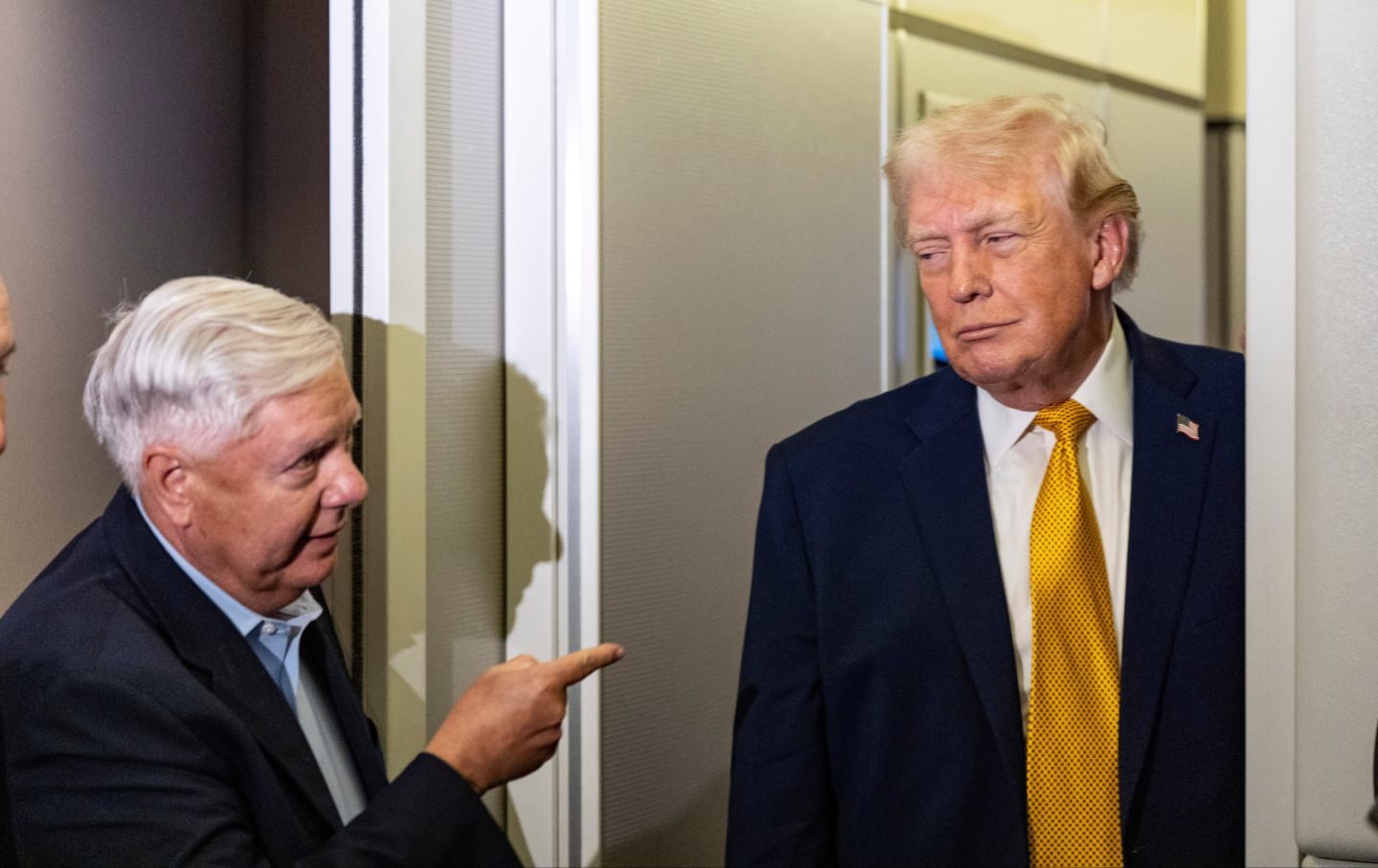
Lindsey Graham gestures as President Donald Trump speaks with reporters on Air Force One, on January 4, 2026.
(Alex Brandon / AP)Although Senator Lindsey Graham, who died unexpectedly on Saturday at 71, was one of the most odious figures in American public life, he does deserve a partial defense from a strangely pervasive calumny directed against him by liberal critics. In the last decade of his life, Graham underwent a dramatic political transformation. In 2015 and early 2016, Graham became a no-holds-barred foe of Donald Trump, whom he lambasted as “a race-baiting, xenophobic, religious bigot” who “represents the worst in America.” But Graham started to warm to Trump once the insurgent candidate won the Republican primary on May 4, 2016. This process accelerated after Trump was elected president in November, when Graham became, against stiff competition, the president’s most obsequious lackey.
Graham’s metamorphosis was all the more startling because his earlier disdain for Trump sprang logically from his political history. Prior to 2016, Graham was best known as the ultra-hawkish ally of fellow war-happy senators John McCain and Joe Lieberman (their noxious nickname for themselves was the “Three Amigos”), which made him a natural opponent of candidate Trump’s isolationist foreign policy. Further, Graham had a history of bipartisanship, working with Democrats on immigration reform and campaign finance and casting the sole Republican vote on the Senate Judiciary Committee in support of Sonia Sotomayor and Elena Kagan’s Supreme Court nominations. This gave Graham a profile, on domestic matters at least, more mainstream than Trump’s burn-it-down populism.
What explains Graham’s quick change of political identity? One theory popular among Resistance liberals and Never Trump conservatives was that the senator, who was widely rumored to be a closeted gay man, had been blackmailed by Trump, perhaps with kompromat provided by Vladimir Putin. In 2019, for instance MSNBC host Stephanie Ruhle dropped a heavy-breathing hint along this line by suggesting that Trump knows “something pretty extreme about Lindsey Graham.”
The blackmail theory was never grounded in evidence and suffered the further disadvantage of making Graham seem like a victim rather than someone making affirmative choices about his life. The actual story of Graham’s ideological conversion is much worse than any conspiracy theory, because he gave up his principles for the worst of reasons: to stay close to the center of power, stave off MAGA primary challenges, and bring Trump around to Graham’s deeply militarist worldview.
The best account of Graham’s late-life arc is found in a brisk book by William Saletan, a journalist for The Bulwark, titled The Corruption of Lindsey Graham (now available on Saletan’s Substack). With forensic care, Saletan traces the step-by-step shifts Graham made while becoming first Trump’s apologist and then a rabid MAGA partisan.
Graham succumbed to Trump because he knew the demagogue spoke for a substantial part of the GOP base, one that the party could not afford to alienate if it wanted to win elections. In a CNN interview in March 2016, Graham estimated that between 35 and 40 percent of Republicans believe “the world that they knew growing up is being lost. They feel like the Mexicans are taking their jobs…. There’s a market out there for ‘Send them all back.’” Trump was successful, he added, because he knew how to “prey on people’s fear.”
Graham was still a Trump critic at this point, but merely on pragmatic grounds: He feared that Trump would lose the election and damage the GOP brand. But once Trump won the Republican nomination, Graham immediately started sending signals that he wanted to get on the MAGA train. On May 6, 2016, Graham admitted to CNN that Trump could prove him wrong by winning the general election against Hillary Clinton. Five days later, Graham had a warm phone conversation with Trump.
As Saletan notes, Trump “chatted [Graham] up and asked for advice on national security. Graham loved it. This was what the Senator had hoped for. If he couldn’t be president, he wanted to shape the president’s foreign policy.”
Speaking to The New York Times Magazine in 2019, Graham admitted, “I went from, ‘OK, he’s president’ to ‘How can I get to be in his orbit?’” Graham then boasted that he eventually elbowed his way into an even more desirable spot in Trump’s “smaller orbit.” The following year, Graham crowed, “I’ve never had more access to a president than I have with Donald Trump.”
Viewed simply through these transactional terms, the Graham-Trump alliance benefited the senator. As Saletan notes, “Graham’s bargain—going easy on Trump’s domestic behavior while pressing him on foreign policy—paid off. From Syria to Iran to North Korea, Trump was doing what Graham wanted.” It turned out that Trump’s occasional rhetorical gestures toward a less interventionist foreign policy were merely campaign rhetoric. In practice, Trump could be as belligerent as George W. Bush, a fact that delighted Graham.
The South Carolina senator was happy as a pig in clover as the sidekick to a global bully. (He could also see that staying on Trump’s good side was essential if he wanted to avoid being ousted by a MAGA supporter in a Senate primary.) When Trump raised the specter of nuclear annihilation against North Korea, warning that he would unleash “fire and fury,” Graham was an eager echo chamber. He warned North Korean dictator Kim Jong Un that if he tried to “play” Trump, “it will be the end of you.”
As Trump’s faithful lapdog, Graham started to defend the president’s worst actions. Saletan notes that Graham, descended “to a polarized worldview that made it easier to rationalize devotion to” Trump. In 2019, Graham accused the Democrats of trying to “basically destroy America as we know it.”
That same year, Trump ranted that Representative Ilhan Omar, a US citizen, should go back to her native Somalia. Graham offered the disingenuous apologia that Trump was only mad at those who criticized him. According to Graham, “A Somali refugee embracing Trump would not have been asked to go back. If you’re a racist, you want everybody from Somalia to go back.”
Popular
“swipe left below to view more authors”Swipe →In 2020, Graham dived even deeper into the MAGA swamp. He started echoing Trump’s conspiratorial language about stolen elections. The senator told Fox News in November 2020, “We lose elections because they cheat us.” Graham became briefly critical of Trump after the president incited a mob to attack the Capitol on January 6, 2021. But as Saletan documents, this break with Trump was both short-lived and tactical: The motive of his criticism seemed geared toward saving Trump’s reputation for a future presidential run.
Graham might have felt he was justified on pragmatic grounds, but not all his fellow hawks agreed. Liz Cheney was every bit as militarist as Graham, but she, to her credit, realized that no policy victories could justify complicity with Trump’s attacks on the rule of law.
For those who oppose militarism, Graham’s compromises look even worse, since he used his persuasive perch in the Senate to advocate for some of the most horrific policies in recent history: the Iraq War under George W. Bush and the US support for the genocide in Gaza under Biden and Trump.
Perhaps more than any other lawmaker of his era, Graham was an emblematic figure. His career illustrates that Trumpism was no anomaly. Rather, Trump’s authoritarianism flourished thanks to the willing alliance of powerful mainstream figures such as Graham, whose main priority was maintaining US imperial dominance of the globe even at the expense of destroying American democracy.
More from The Nation
This November, Vote Like Alito Is on the Ballot This November, Vote Like Alito Is on the Ballot
In this week’s Elie v. U.S., our justice correspondent gives Democrats another reason to vote in November. Plus: How Sarah Huckabee Sanders’s Medicaid unmasked the racists.
Does America First Really Mean Israel First? Does America First Really Mean Israel First?
Mike Huckabee’s aide shows how an extremist agenda dominates Trump’s Middle East policy.


Trump’s Die-Hards Are Taking Their Cultishness to New Lows Trump’s Die-Hards Are Taking Their Cultishness to New Lows
I’m finally starting to understand why Jim Jones’s lieutenants didn’t try to stop him.
Harlan Crow’s Portrait of SCOTUS Under Trump Harlan Crow’s Portrait of SCOTUS Under Trump
Clarence Thomas, the picture of corruption.

