Are Democrats Finding Their Spines?
At an Open Markets Institute conference, economic populism was on the agenda.
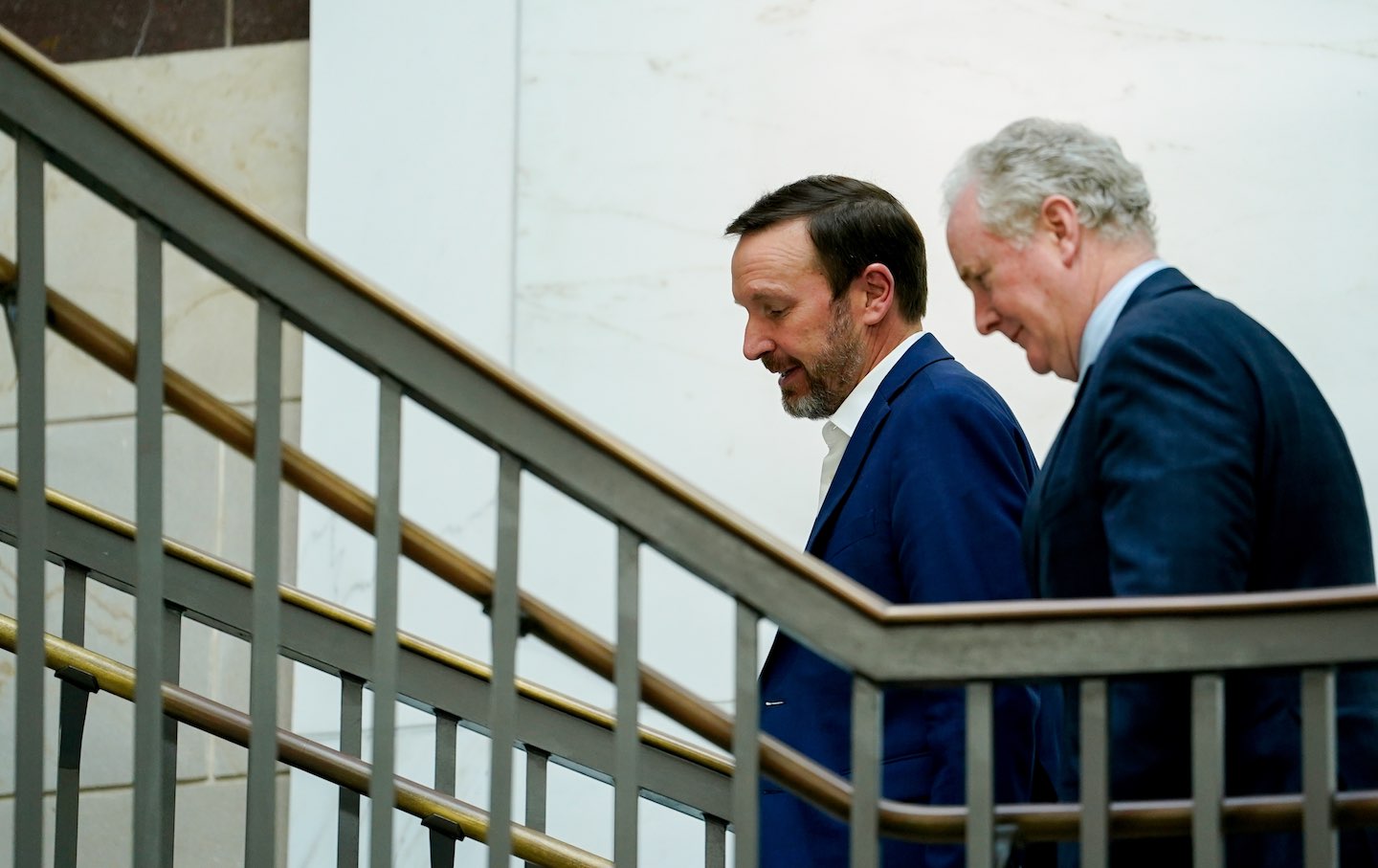
Democratic Senators Chris Murphy and Chris Van Hollen depart a briefing at the Capitol in Washington, DC, in June 2025.
(Kent Nishimura / Bloomberg)The Open Markets Institute, a DC clearinghouse of antitrust policy and legal strategy, didn’t lack for ambition in drawing up its convocation this year of political leaders, regulators, and writers attacking the powers of economic concentration. The gathering, hosted at an event space across from the grounds of the Capitol, was called “The Next American Revolution: Breaking Oligarchy and Making a New American Democracy.”
As Institute director Barry Lynn welcomed the crowd to a daylong series of panels on the challenges of antitrust enforcement and its place in our political discourse, it soon became clear that the call for revolution was another invocation of the country’s 250th anniversary; Lynn, like many of the later speakers at the event, reminded the crowd that anti-monopoly sentiment was front and center in the colonial rebellion against the British crown.
Still, events outside the room lent a fresh currency to the rhetoric. The night before, a slate of three democratic socialist candidates swept into victories over establishment-backed opponents in New York’s primary balloting, spurring pundit speculation over the rise of a “Democratic Tea Party.” And as the conference proceeded, President Donald Trump revoked his scheduled ceremony to sign Congress’s new housing affordability measure, which sought to rein in equity funds from acquiring rental investment properties and driving up the cost of shelter. The housing bill had been the last hope for incumbent Republican lawmakers to claim during the upcoming midterm cycle that they were trying to measurably improve living costs for an electorate battered by inflation. In a heated meeting with GOP senators, Trump insisted that he wouldn’t sign the measure until Congress also approved his pet bill to address the nonexistent scourge of election fraud, the SAVE act—an already doomed piece of legislation that signals to disenchanted voters that Republican leaders care more about blocking ballot access than unrigging a top-heavy political economy. Placed alongside Trump’s announcement that he “doesn’t really think about Americans’ financial situations” in his purblind negotiations over the Iran War, the housing bill debacle gives the lie to the creaky fable that the MAGA regime will restore economic sovereignty to forgotten American workers. Small wonder that Lynn wound up his introduction by declaring that “the American people are in a revolutionary mood.”
Many of the ensuing panels likewise kicked off with speculations over the results in New York, and their broader meaning for an electorate increasingly fed up with both the Trump oligarchy and procedurally minded Democratic rhetoric that overlooks the material conditions behind America’s sour political mood. Indeed, the challenges of aligning Democratic political strategy with the crusade against monopoly power in the economy are so pressing that the conference devoted two separate sessions to the question. And to a striking degree, the prominent Democrats speaking before the conference highlighted the same urgent need to reclaim the party’s identity as the party of disenfranchised working people. “It’s not enough simply to be opposing everything that Donald Trump does,” said Maryland Senator Chris Van Hollen, who along with his Connecticut colleague Chris Murphy, the conference’s keynote speaker, is now touted as a potential 2028 presidential candidate. New York’s results vindicated “the candidates who believe that we have to go beyond Trump and recognize that the status quo before Trump was already broken,” he continued. “We have much deeper issues to address, including the concentration of wealth, of economic power and political power.… We can’t just tinker around the edges. We need fundamental change.” Van Hollen went on to endorse Medicare for All, far-ranging campaign finance reform, an end to the filibuster, and an overhaul of the tax code to support struggling workers and fund the mitigation of climate change.
Murphy, for his part, presented a sober diagnosis of the country’s mounting anomie, drawn from his just-published book, Crisis of the Common Good, and highlighting the “inextricable link to the structure of our economy and the way people are feeling about the way they interact with the economy and our democratic crisis.” Both lawmakers seemed to be testing out stump pitches for the 2028 cycle, and it qualifies as undeniable progress for such disparate thematic appeals to be grounded firmly in the tenets of left economic populism.
Still, the sessions on Democratic strategy made it clear how far Democrats are from reconstituting the party as a persuasive and credible force for populist economic justice. Even as Kamala Harris inherited a strong antitrust record from the Biden White House, her 2024 campaign struggled, and ultimately failed, in its efforts to land a straightforward populist message. “In the 2024 cycle, we were screaming from the rooftops,” about the centrality of economic fairness in the campaign, recalled consultant Evan Roth Smith of Slingshot Strategies. “And Harris would react in context in an extraordinarily chickenshit way.” Smith went on to explain that such failures feed directly into the widespread public perception that Democratic candidates simply aren’t serious or trustworthy bearers of basic populist appeals. A recent set of large-format polls conducted by his firm employing “natural language, a low question count and open-ended questions” targeting up-for-grabs independent, swing, and disenchanted GOP voters, asked what kept them from voting for a Democrat. “The number-one word was ‘spineless,’” Smith said. “People were sounding the same all across the country.”
It’s less a problem of message-tweaking, he went on to explain, than of deep-seated ideology. “The Democratic Party made its peace with capital in like the last 20, 30 years. If you’re the center-left party, you’re supposed to be adverse, if not openly hostile, to capital.” For Democrats to gain real traction in this political climate, the prescription is simple, he said: “Just declare war on capital. That, I think, will return the confidence that we’ve seen erode in studies we’ve done of partisan Democrats—not just swing voters and independents.… And it doesn’t really matter if you win those fights. The fights have to be better chosen and louder; they have to break more norms and garner more attention.” A key proof of concept, he suggested, is the pending Michigan Senate primary, where Abdul El-Sayed is breaking away from a pack of establishment-anointed rivals with a simple Mamdani-style pitch for sweeping affordability reforms, Medicare for All chief among them.
Another Democratic disconnect was reflected on stage: For all the conference’s salutary focus on the need to recover the power of workers as the party’s organizing mission, the event’s roster didn’t include any representatives from labor unions. The closest anyone came was former union leader Dan Osborn, an independent Senate candidate in Nebraska, who explained how his experience in union organizing informed his political ambitions. Unions had played a key role in the New York primary results, and El-Sayed has benefited from getting the endorsement and grassroots support of the United Auto Workers. Yet most speakers evaluating the New York results stressed the (effective) organizing work of the Democratic Socialists and the outsize personal charisma in the campaign. Texas Representative Greg Casar, the head of the House Progressive Caucus, harked back to Franklin Roosevelt’s rousing 1936 nomination speech before the Democratic National Convention, with its forthright excoriations of “economic royalists” and FDR’s declaration that he “welcome[d] their hatred.” Yet that performance—and the broad New Deal coalition backing it up—was also a show of union power, in the wake of the landmark collective-bargaining provisions of the 1934 Wagner Act. In a day’s worth of bracing discussions of the democratic distortions wrought by a top-heavy political economy, it was striking that the chief messengers were elected officials, former federal regulators, academics, consultants, pollsters, policy wonks, and journalists. For the Next American Revolution to take root as something more than a conference name, it seems like a key starting point should be for workers to be calling more of the shots.
Become a Sustaining Donor This September
Between the reemergence of right-wing red-baiting and Donald Trump’s use of the chilling National Security Presidential Memorandum–7 to criminalize left political organizing, we’re seeing McCarthyism reborn before our eyes.
This assault on democracy cannot be ignored or wished away. Resisting it requires bravery in the face of threats and repression, a steadfast commitment to the truth, and the unwavering belief that we can—and will—overcome this darkness.
We must have an independent media that sets the record straight, unearths corruption and abuses of power, and advances a politics of justice and dignity for all if we’re to win this fight.
That’s why I’m writing to you today. This September, The Nation needs to add 100 monthly donors to sustain our progressive journalism. Your contribution makes the next investigative report, the next truth-speaking column, and the next pathbreaking essay all possible.
I hope you’ll support our work with a recurring donation today. If you donate $10 or more a month, we’ll send you a brand new “Hands Off the Free Press!” sticker to recognise your commitment to our cause. Please, donate today.
Onward,
Katrina vanden Heuvel
Editor and Publisher, The Nation