How to Win the New War for Black Voting Rights
It’s not enough to draw “neutral” districts. We need to overhaul the entire voting system.
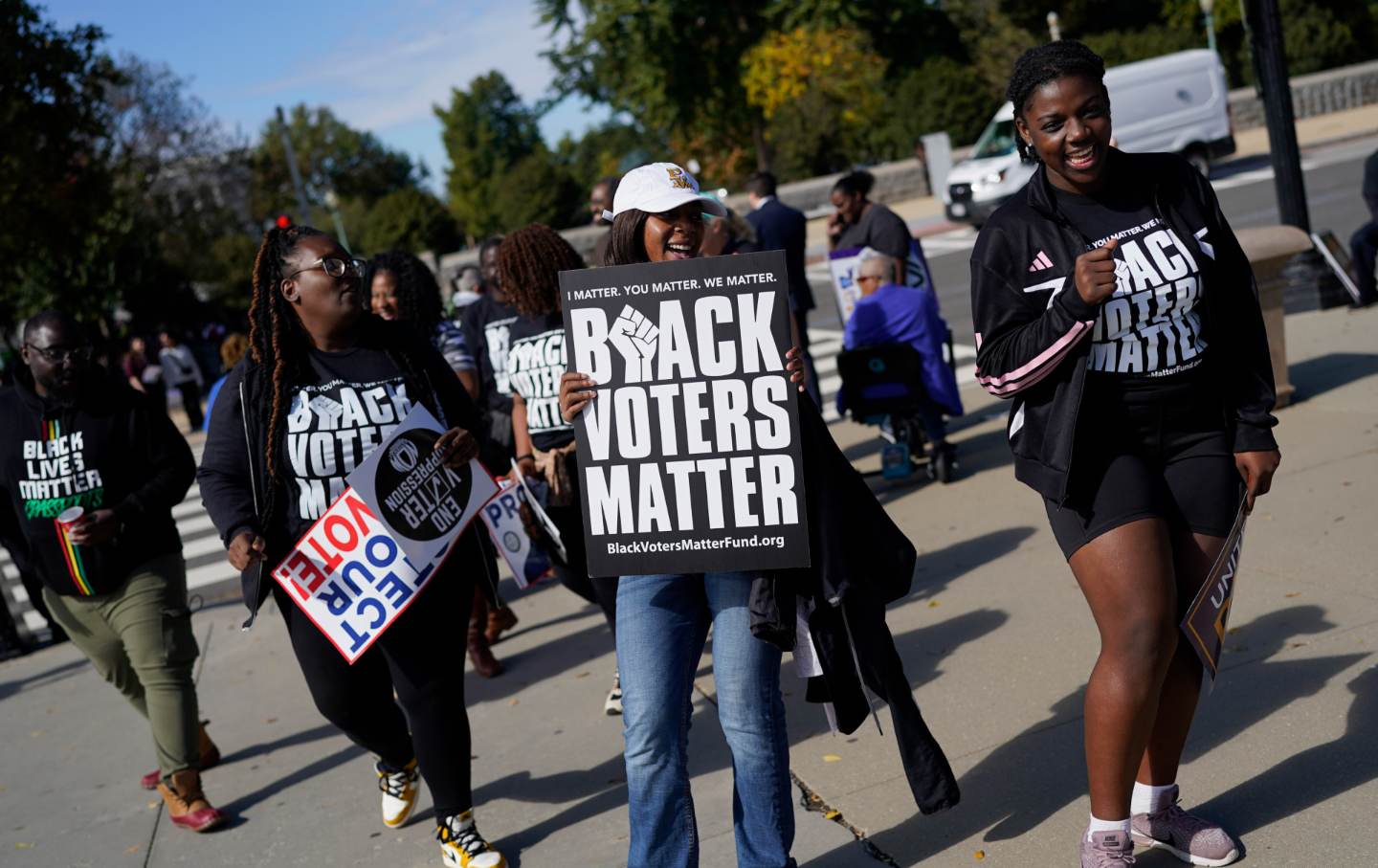
Activists gather in front of the Supreme Court of the United States during the re-argument of Louisiana v. Callais on October 15, 2025, in Washington, DC.
(Jemal Countess / Getty Images for Legal Defense Fund)In the aftermath of the Supreme Court’s Callais ruling decimating what was left of the Voting Rights Act—a decision likely to join Plessy v. Ferguson in the court’s Jim Crow Hall of Fame—people have suggested many paths forward, including strengthening the proposed John Lewis Voting Rights Advancement Act, pursuing state-level voting rights acts, and introducing proportional representation in our electoral system.
These strategies all have merit. But there are also wildly misguided tactics being proposed to deal with our new voting rights landscape. And perhaps none is as inadequate and outright dangerous as the recent suggestion by Nate Cohn and Eve Washington in The New York Times that pursuing so-called “neutral” maps could produce results for Black communities similar to VRA protections.
When Black Voters Matter, the organization I help lead, and Fair Fight released our study on the potential impact of the Callais ruling, we found that Republican‑controlled legislatures could redraw maps to eliminate 191 Democratic‑held state legislative seats and 19 US House seats, most of which are currently represented by Black lawmakers. We were called hyperbolic. But maps that erase Black districts passed in Tennessee, Alabama, and Louisiana, and attempts elsewhere demonstrate that our warning was an understatement.
Yet in their analysis Cohn and Washington argue that utilizing “a race-neutral, nonpartisan redistricting process”—as opposed to consciously working to draw Black-majority districts— could result in 23 congressional seats across eight Southern states for Democrats, compared to the 24 seats Democrats won in 2024. It’s an alluring proposition—but the analysis has several flaws, including inconsistent references to Black “opportunity districts” (e.g., districts with a majority of Black voters), voters of color, and Democratic voters at various points in the analysis. Those concepts are referenced almost interchangeably in the article; however, they are not at all equal, particularly in the South.
One needs only to look at the likely state maps to identify the glaringly unacceptable consequences. Using this framework, there would not be a single Black “opportunity district” anywhere in the state of Mississippi, a state in which the Black population is roughly 38 percent. In essence, this returns Mississippi to a Jim Crow–era level of representation, or lack thereof.
What, pray tell, is “neutral” about that?
Moreover, in the two states that have been the focus of recent Supreme Court cases, Alabama and Louisiana, so-called neutral maps would result in each state having only one Black opportunity district. While the Black population is roughly 27 percent in Alabama and 33 percent in Louisiana, Black voters would once again be limited to one in seven and one in six seats, respectively, versus two before Callais.
There is nothing neutral about normalizing and enshrining white power over Black bodies.
As a reminder, Jim Crow–era voting policies were also technically “race neutral.” On its face, the poll tax was “race neutral.” The grandfather clause was “race neutral.” The literacy test was “race neutral.” All were implemented in ways that were explicitly anti-Black. Today, data science risks serving the same purpose, but under the guise of race-neutral reform.
Nevertheless, there are some reforms that go much further than the simplistic neutral-map approach—that actually force us to reimagine how power is distributed.
As an undergraduate student, I watched as Bill Clinton’s nomination of trailblazing legal scholar Lani Guinier to a high-ranking position in the Department of Justice was abruptly rescinded. At the time, President Clinton, bowing to right-wing pressure, cited her “dangerous” ideas as the rationale.
If she’s dangerous, I thought to myself, I want to know what she’s talking about.
And what was this extreme, radical idea? Guinier supported proportional representation. The notion that a group or political party getting 30 percent of the vote should get 30 percent of the power, not 0 percent. As it happens, this idea is the most popular form of democracy in the world.
Instead of single-member, winner-takes-all districts, proportional representation creates multi-member districts where parties or groups win seats in proportion to their share of the vote. In proportional systems, manipulating district lines for partisan gain or to shun voters of color is often functionally impossible—because multi-winner districts are simply too difficult to gerrymander. Voters of color would gain representation in proportion to our numbers, regardless of where we live, effectively eliminating gerrymandering.
In part, that is what scares people about proportional representation, but there’s more. In addition to its potential to expand representation and power for marginalized groups, proportional representation is a direct threat to a broken two-party system and the zero-sum power structure that defines American politics.
Winner-take-all systems with single-member districts are what make gerrymandering possible in the first place, since you can draw a district so you have just enough voters for the slim majority you need to secure it. They create a high-stakes environment where a 51 percent victory is a total win and 49 percent is a total loss. This incites extremism, gridlock, and the demonization of the other side. It even further incentivizes the party in power—like the GOP currently—to suppress voters, since losing an election means being put out of power completely. This is how voters of color see district lines deliberately drawn around them.
Most of the world’s stable, high-functioning democracies use proportional systems and routinely outperform the United States on governance metrics. Beyond elections, proportional representation would help us create a healthier population and better living conditions. One study finds that countries with proportional systems outperformed winner-take-all democracies in population health, with up to 12 more years of life expectancy and 75 percent less infant mortality on average. Another finds considerably lower levels of income inequality in societies with proportional representation and higher government spending on social programs.
Popular
“swipe left below to view more authors”Swipe →In short, utilizing thoughtful proportional representation models to halt the march back to Jim Crow would result in a systemic transformation that would benefit all voters. Moreover, it could possibly increase the number of community members who shift from nonvoters to voters by producing a more direct connection between increased turnout and better policies. As history has consistently shown, when Black voting and civil rights are protected and access expanded, the entire country benefits.
None of this suggests that proportional representation alone is enough to fully protect Black voting rights. If we are not thoughtful about combining it with other tools, the results could be only a slight step above the neutral remedy proposed by Cohn and Washington. Nevertheless, it needs to be a serious part of the discussion.
Lani Guinier’s views on proportional representation were called “dangerous” because she challenged the structures of power, and she did so in a way that would particularly benefit Black voters—the canaries in the coal mine—as well as other marginalized groups. But history has a way of vindicating these transformative ideas, from abolition to women’s suffrage to marriage equality. But this vindication can only happen if we are willing to think more radically today.
Become a Sustaining Donor This September
Between the reemergence of right-wing red-baiting and Donald Trump’s use of the chilling National Security Presidential Memorandum–7 to criminalize left political organizing, we’re seeing McCarthyism reborn before our eyes.
This assault on democracy cannot be ignored or wished away. Resisting it requires bravery in the face of threats and repression, a steadfast commitment to the truth, and the unwavering belief that we can—and will—overcome this darkness.
We must have an independent media that sets the record straight, unearths corruption and abuses of power, and advances a politics of justice and dignity for all if we’re to win this fight.
That’s why I’m writing to you today. This September, The Nation needs to add 100 monthly donors to sustain our progressive journalism. Your contribution makes the next investigative report, the next truth-speaking column, and the next pathbreaking essay all possible.
I hope you’ll support our work with a recurring donation today. If you donate $10 or more a month, we’ll send you a brand new “Hands Off the Free Press!” sticker to recognise your commitment to our cause. Please, donate today.
Onward,
Katrina vanden Heuvel
Editor and Publisher, The Nation
More from The Nation

Even Republicans Are Figuring Out That Pete Hegseth Is a Disaster Even Republicans Are Figuring Out That Pete Hegseth Is a Disaster
Hegseth was always a horrible choice for defense secretary. At long last, some in the GOP are admitting it.

Clear Sign: Stop Gun Violence Clear Sign: Stop Gun Violence
Claiming over 130 American lives daily, a lethal epidemic is scarring our communities.

Mike Johnson Is the Most Dangerous House Speaker in American History Mike Johnson Is the Most Dangerous House Speaker in American History
His decision to shut the House down at a moment of crisis around AI is the act of a reckless charlatan.

The Ed Sheeran Controversy The Ed Sheeran Controversy
In a society that claims to promote free speech, what crosses the line from controversial to unacceptable? Who gets to define where the line begins and ends?
We Need to Protect College Sports From Ted Cruz We Need to Protect College Sports From Ted Cruz
In this week’s Elie v. U.S., our justice correspondent looks at the many ways Cruz’s bill threatens athletes’ labor rights. Plus: why our mail-in voting nightmare isn’t over.