Pedro Sánchez Isn’t Waiting for a Savior
At a recent summit, Spain’s prime minister gathered leftist leaders and warned of a new authoritarian world order.
After more than a decade of Trumpism, pathways to leftist victories can seem limited. Yes, the crushing defeat of Viktor Orbán in April’s Hungarian election showed that even entrenched authoritarians can be trounced when movements rise and opposition unifies. But Hungary’s new prime minister, Péter Magyar, is hardly a man of the left. So at a time when Donald Trump’s chaotic war with Iran threatens global economic stability and too many “leaders” offer inadequate responses, leftists find ourselves asking, “What’s next?” Well, Pedro Sánchez has just provided an answer.
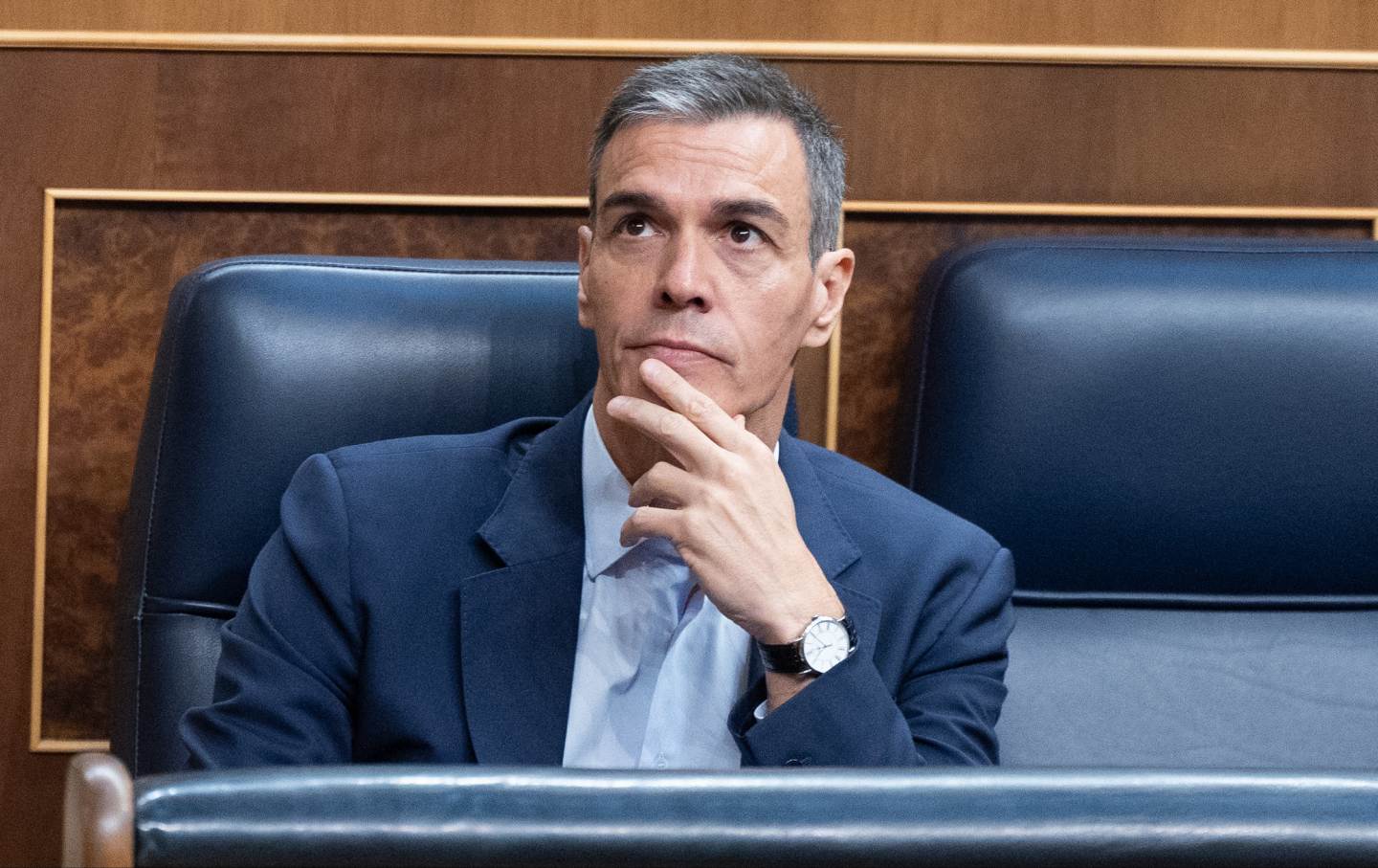
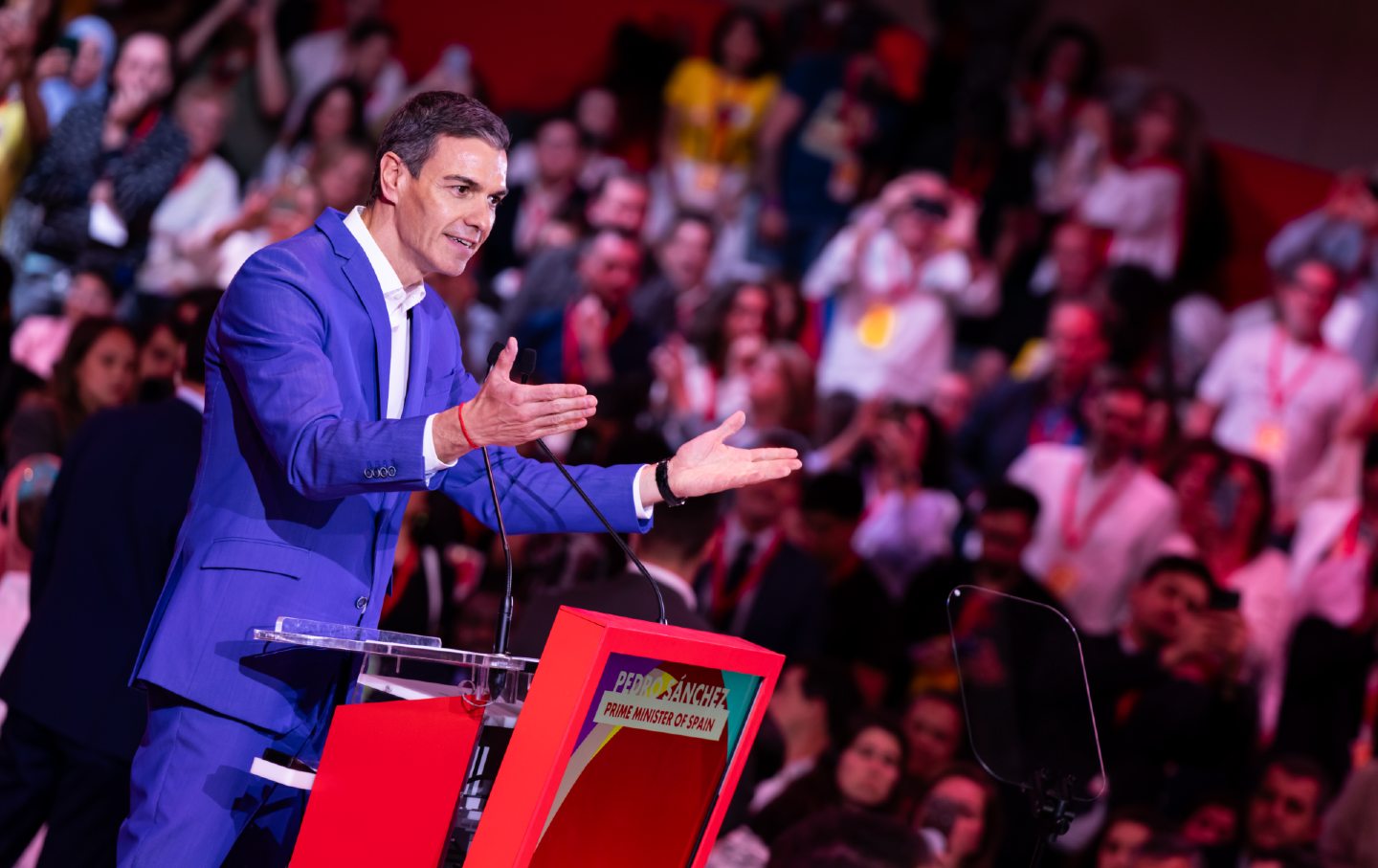
In mid-April, Spain’s prime minister offered a hopeful alternative vision to the world. Without pausing for direction from Berlin or Paris, he hosted the Global Progressive Mobilization Summit, where remnants of the European left convened with leaders from the Global South to advance a bold program: defeat fascism through economic populism, reject military intervention, and fight the rise of authoritarianism.
“A new world order is emerging. A world in which a zero-sum mentality prevails,” Sánchez declared in his blistering keynote address. “We must combat that vision, because it only brings conflict, inequality, and injustice.” Rejecting the growing anti-immigration sentiment, he continued, “Spain is the daughter of migration and will not be the mother of xenophobia. Don’t be fooled.”
Context matters. A little over a decade ago, the Southern European left erupted with promise as Greece’s Syriza party under Alexi Tsipras and Spain’s Podemos under Pablo Iglesias offered rebuttals to the austerity imposed by the International Monetary Fund and Germany. Then Brexit set off a wave across Europe, empowering right-wing movements with their anti-immigrant populism. Today, much of the once-hopeful European left is fragmented and grasping for wins.
Sánchez is the exception. He’s leveraged a complicated political math at home into global influence—at one point governing through a minority coalition comprising left populists and conservative Catalan nationalists. He has decried the genocide in Gaza, withheld arms from Israel, and warned of another Gaza in Lebanon if Benjamin Netanyahu isn’t held accountable for his war crimes. Spain even refused to air Eurovision as long as Israel competed.
In Barcelona, leftists from Chile to Slovenia wore red “Make Fascists Afraid Again” hats and chanted “Free Palestine” as leader after leader declared solidarity with Sánchez.
As a lonely leftist leader in Europe, Sánchez savvily invited Brazil’s Lula da Silva, Barbados’s Mia Mottley, and the former Palestinian prime minister Mohammad Shtayyeh to speak at the Barcelona summit, which was co-organized by the Socialist International. Mexico’s Claudia Sheinbaum and Colombia’s Gustavo Petro opted out but still appeared at side events, revealing the nuanced relationships that Mexico and Colombia have with their former colonizer.
Sheinbaum echoed Sánchez, saying, “Democracy means life is not for sale—nor is the freedom or dignity of peoples.”
Sánchez has positioned himself as a leader of the left who recognizes the need for strong alliances. In particular, the Spanish prime minister elevated the resilient 80-year-old Brazilian president, whom the crowd treated like John Lennon, chanting “Olé! Olé! Lula! Lula!” as he moved through the arena.
“The neoliberal project promised prosperity and delivered hunger, inequality, and insecurity.… Left-wing governments win elections with left-wing discourse and then practice austerity,” Lula proclaimed in his speech introducing Sánchez. “We have become the system. That is why it is no surprise that the other side now presents itself as anti-system.”
In a moment of compounding crises—wars, climate change, refugee migration, income inequality, and the obliteration of democratic institutions—Sánchez understands that we must use whatever power we have. As Paulina Lampsa, the executive vice president of the Socialist International, said, “The success of the Barcelona gathering showed just how deep the hunger runs for brave leaders with a coherent, values-based response to today’s overlapping crises.”
The US left has much work to do in building relationships with the broader global left.Only Minnesota Governor Tim Walz and Connecticut Senator Chris Murphy flew to Barcelona, while Vermont Senator Bernie Sanders and New York Mayor Zohran Mamdani joined by video. But perhaps the US absence gave Sánchez more authority to define a new left alternative—one not driven by Washington, London, or Berlin.
The answer to fascism has always been a populist, anti-colonial agenda, but it took Sánchez, a once-in-a-generation leader, to offer a counter-coalition for the left to unify behind. Sánchez’s opposition to the far right’s attempt to realign the world order at the expense of the poor and working people offers a lesson to the left: Study history, theory, and power—and don’t wait for anyone to save you.