
Taking Aim at Overpaid CEOs
Landmark San Francisco and Los Angeles ballot initiatives aim to hike taxes on corporations with huge gaps between CEO and worker pay.
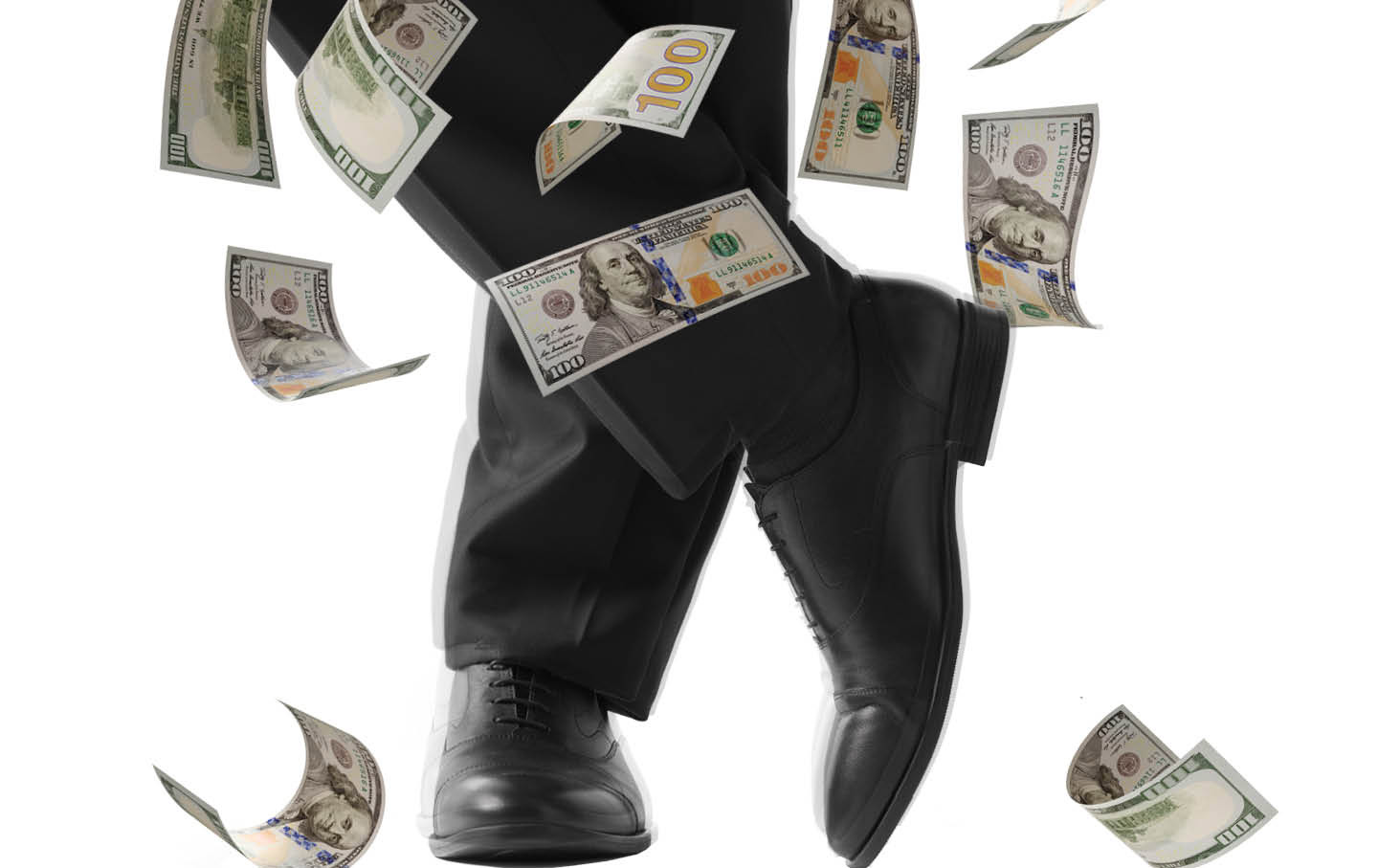
The espresso machine in Starbucks CEO Brian Niccol’s personal office in Newport Beach, California, retails for $14,000—almost as much as the $14,674 annual wage of the coffee giant’s median worker, a part-time barista.
In other words, nearly half of Starbucks’s 361,000 employees would have to spend every dime they make over an entire year to buy just one of these deluxe caffeine-delivery systems. In 2024, Niccol pocketed $95.8 million in compensation. With that windfall, he could have purchased 6,843 units of his favorite coffee maker—more than enough to luxuriously outfit every single elementary-school teachers’ lounge in the state of California.
So go the absurdities of our ever more unequal world.
Ordinary Americans across the political spectrum have been fuming about the obscene disparities in pay between corporate America’s CEOs and workers ever since those gaps began to soar in the Reagan years. But today, with budget cuts threatening the food and medical aid that so many working families depend on, the corrosive social cost of this exploding inequality has come into particularly sharp relief.
At many of our nation’s largest employers, median salaries have fallen below the $36,777 family-of-three income threshold for Medicaid benefits. Those employers, our research at the Institute for Policy Studies finds, are familiar names to most Americans: Starbucks, Home Depot, Autozone, Chipotle, Target, Walmart, and other corporate giants.
Pay practices at big businesses like these don’t just shaft workers. They allow corporations to shift their employees’ basic living costs onto taxpayers, which means we’re all subsidizing Brian Niccol’s ocean-view lattes—and the corporate jet he uses to commute to the company’s headquarters in Seattle.
All of us are also subsidizing the $47 billion that Lowe’s has spent on stock buybacks over the past six years, an outlay that artificially inflates its CEO’s stock-based pay. And don’t forget those three DoorDash cofounders: They’ve each become billionaires while their “Dashers”—the workers who deliver the food—earn an average of $12.23 an hour.
How can we crack down on all this executive excess? A greater union presence in the United States would certainly help: Countries with higher unionization rates tend to have narrower corporate pay gaps. But decades of fierce union-busting have reduced the share of union members among US private-sector workers to a mere 5.9 percent.
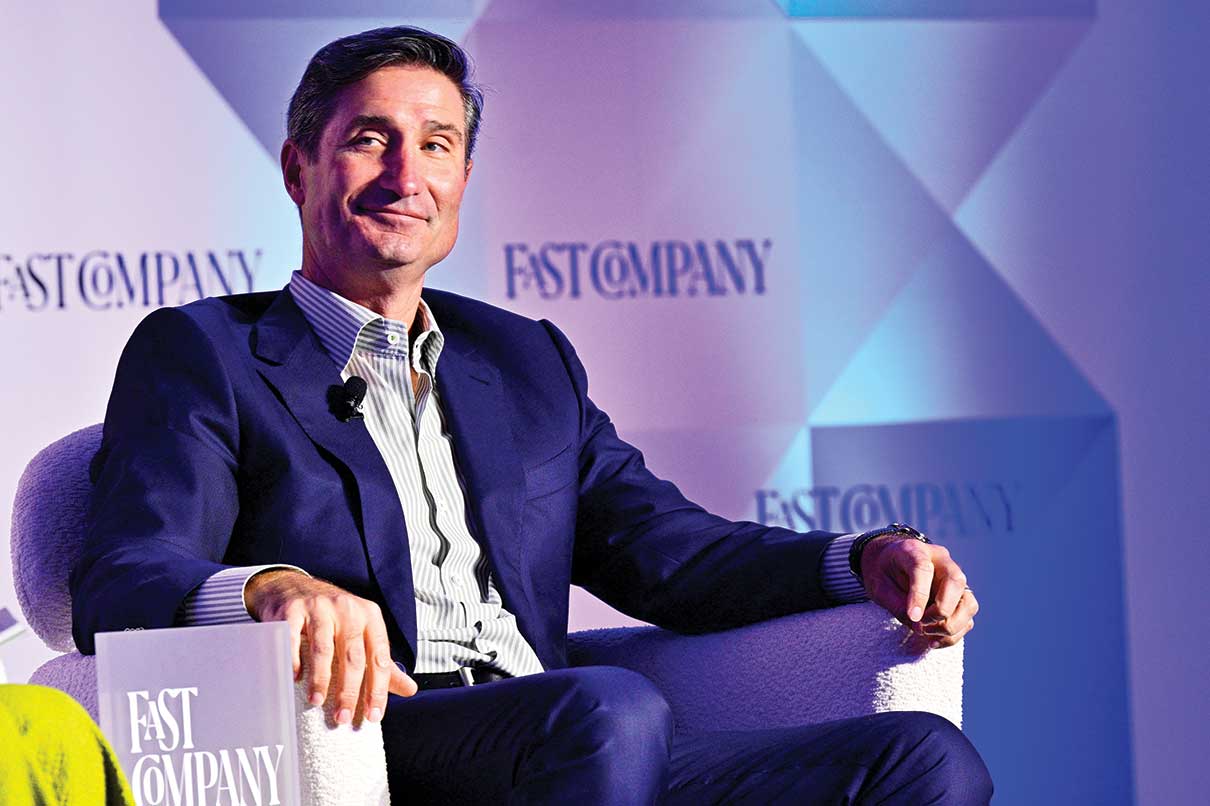
That reality has the US labor movement and its allies eyeing taxes as a tool for narrowing the pay divide—while at the same time raising much-needed revenue at every level of government. The basic idea: Companies with huge gaps between CEO and worker pay should pay more in taxes. And the wider their pay gap, the higher their tax bill should be.
Progressives in Congress have introduced legislation along these lines, such as, most notably, the Tax Excessive CEO Pay Act and the Curtailing Executive Overcompensation (or CEO) Act. A number of state legislatures, including in Michigan, have similar bills pending.
But the best opportunities for addressing this worker-pay injustice are opening up at the city level, with imaginative campaigns now underway in San Francisco and Los Angeles that are bringing the scandal of CEO pay straight to voters.
A decade ago, Portland, Oregon, became the first city to adopt a CEO-pay-related tax measure. Companies that operate there pay a higher local-profits tax if their CEO earns more than 100 times their workers’ median pay, whether they’re Walmart or Wells Fargo. This pioneering tax has generated an average of $5 million a year, and there’s talk of increasing the rates.
Voters in San Francisco followed suit in 2020 by overwhelmingly passing a ballot measure to adopt their own tax on companies with a CEO/worker pay gap of more than 100 to 1. This Overpaid CEO Tax is a surtax added to the existing levies on a company’s local “gross receipts,” or total sales. The tax generated higher-than-expected revenue in its first years before business interests succeeded in watering it down via a broad tax “reform” in 2024.
In 2026, with federal funding cuts projected to blow a $220 million hole in San Francisco’s budget, Stand Up for SF, a coalition of local advocacy groups and over a dozen unions, is aiming to substantially raise the rates that companies pay under the Overpaid CEO Tax. Signature-gathering is on track to qualify the proposal for the June 2 primary ballot. If approved, the strengthened Overpaid CEO Tax will likely generate at least $200 million in additional annual revenue.
But what if the measure is not approved? Brittany Hewett, a nurse at San Francisco General, fears for her patients. San Francisco General is a “safety net” hospital where well over half of the revenue comes from Medicaid, and the Trump administration’s cuts in federal funding appear likely to cause as many as 3.4 million Californians to lose their Medicaid insurance. If that revenue is not replaced by money generated by the Overpaid CEO Tax, the hospital will face even tighter budget constraints. “Even if they don’t cut nurses, what about the support staff? What about the people who clean hospital rooms?” asks Hewett, who is also a union steward with SEIU 1021. “The wait time to move out of the ER and into a room where my patients can get the specialized care they need can already be many hours, if not days. Especially for the elderly, longer waits mean longer recoveries.”
In LA, a campaign led by organized labor to put a similar Overpaid CEO Tax on the November ballot is also gaining momentum. “The federal government is doing everything in its power to enrich billionaires and corporations while squeezing working-class families for every dime,” says Víctor Sánchez, executive director of the Los Angeles Alliance for a New Economy. “If our national leaders won’t make these overpaid CEOs pay their fair share, then we will.”
As in San Francisco, the Los Angeles proposal would impose a surtax on the local gross-receipts tax, kicking in at a lower CEO-to-worker pay ratio of 50 to 1. The campaign’s researchers estimate that the Los Angeles Overpaid CEO Tax would generate more than $500 million in annual revenue, with the funds going to affordable housing, after-school programs, and expanded access to healthy food.
LA labor advocates are feeling confident about the initiative’s chances. They’re coming off of a May 2025 ballot victory for hotel and airport workers, whose minimum wage will rise to $30 an hour—the highest in the nation—by July 2028, in time for the start of the Los Angeles Olympic Games.
“In Los Angeles, we’ve shown again and again that when workers and community come together, we can win monumental victories—and the fight to pass the Overpaid CEO Tax will be no different,” Sánchez says.
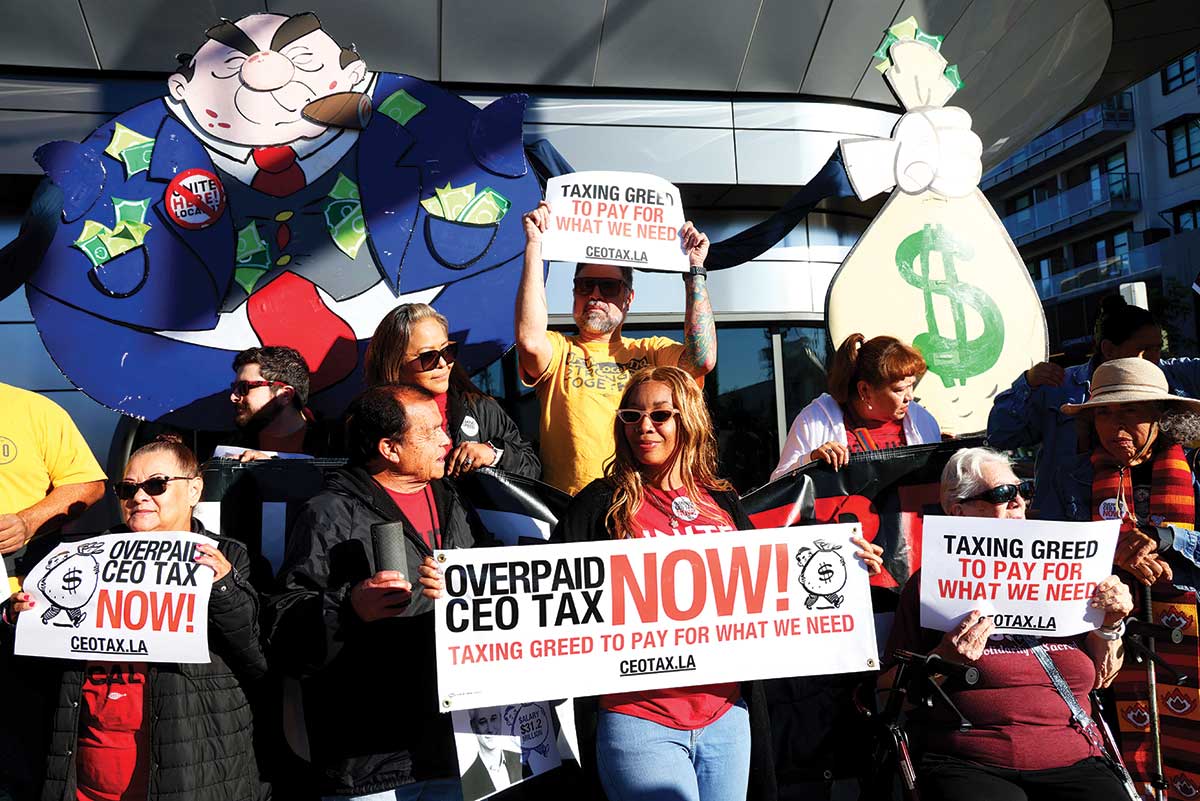
Overpaid CEOS, of course, are not taking this lying down. In both San Francisco and Los Angeles, they’ve deployed lobbyists to crush the labor-backed ballot campaigns. The San Francisco Chamber of Commerce, for its part, has amassed a $1 million war chest to push a “poison pill” ballot measure that would undercut the Overpaid CEO Tax under the guise of providing “small business tax relief.” Never mind that the tax already exempts businesses with $1 billion or less in US gross receipts or 1,000 or fewer US employees.
The Los Angeles Area Chamber of Commerce and other local corporate lobbying groups, meanwhile, are pushing a ballot measure that would repeal the city’s gross-receipts tax altogether, a nuclear option that would gouge an $800 million crater in LA’s budget.
Corporate-friendly forces are also charging that the proposed tax increases would foist crushing burdens on companies, leaving them no choice but to cut jobs for workers and raise prices for consumers. That’s a ludicrous argument. Companies would have a clear choice: either narrow their CEO/worker pay gaps to avoid the tax, or continue with their status quo and contribute more to the public services needed for a strong local economy.
Taxes on outrageous pay gaps are similar to tobacco taxes: They act as a curb on a harmful practice that has high social costs while also raising revenue for public services. Taxes related to CEO pay can even benefit corporations: The more that companies narrow their CEO/worker pay gaps, the more efficiently—and profitably—they can operate. Extensive research shows that extreme pay gaps lower employee morale and increase costly turnover rates.
In short, a tax on excessive CEO pay is a win-win-win for workers, corporate bottom lines, and the public at large. Yet corporations continue to threaten to pass the costs of such taxes on to consumers. Hewett, the San Francisco nurse, finds that “disgusting.”
“This city is already a very expensive place to live,” Hewett says. “If these corporations are not paying employees enough and are not paying their fair share of taxes, they’re just contributing to the problem.”
Lisandro Preza works at LAX as a cashier for Paradies Lagardère, a company that operates retail stores and restaurants at airports around the world. He works full-time and still feels just “one rent increase away” from losing his apartment.
“Between skyrocketing housing costs and paying for the medication that keeps me alive, there’s nothing left at the end of the month,” Preza says. “If an Overpaid CEO Tax means big corporations finally pay their fair share so workers like me can afford housing and healthcare, that’s not radical—that’s survival.”
More from The Nation
What Trump and Tucker Carlson Have in Common What Trump and Tucker Carlson Have in Common
Carlson has broken with Trump largely over the war in Iran. But on Ukraine and immigration, the two speak very much the same language.

The Jewish Case Against AI The Jewish Case Against AI
Haredi rabbis and the secular left agree: This technology is a threat to the entire social fabric.
The Fight for Educational Equality Is Also a Fight for a Just Supreme Court The Fight for Educational Equality Is Also a Fight for a Just Supreme Court
The court has severely weakened our ability to make an education system that fulfills the promise of Brown.

The Fall of “Scientific American” The Fall of “Scientific American”
When the beloved science publication got too political, its corporate owners stepped in. Now its future is uncertain.

The Bookstore Revolution in Taiwan’s Conservative Heartlands The Bookstore Revolution in Taiwan’s Conservative Heartlands
After Taiwan legalized same-sex marriage, gender-themed bookstores are working to build the social acceptance that the law alone couldn’t deliver.
Jalen Hurts Deserved Better. We All Do. Jalen Hurts Deserved Better. We All Do.
In a country that treats workers as expendable parts, Hurts’s playing through a blood clot is just the highest-profile example of the price workers pay in an oligarchy.

