
To Build Bridges, We Must Block the Bombs
Brad Lander in The Nation: “When I am elected to Congress, I will support the Block the Bombs Act to protect more Palestinians from being killed by Israel.”
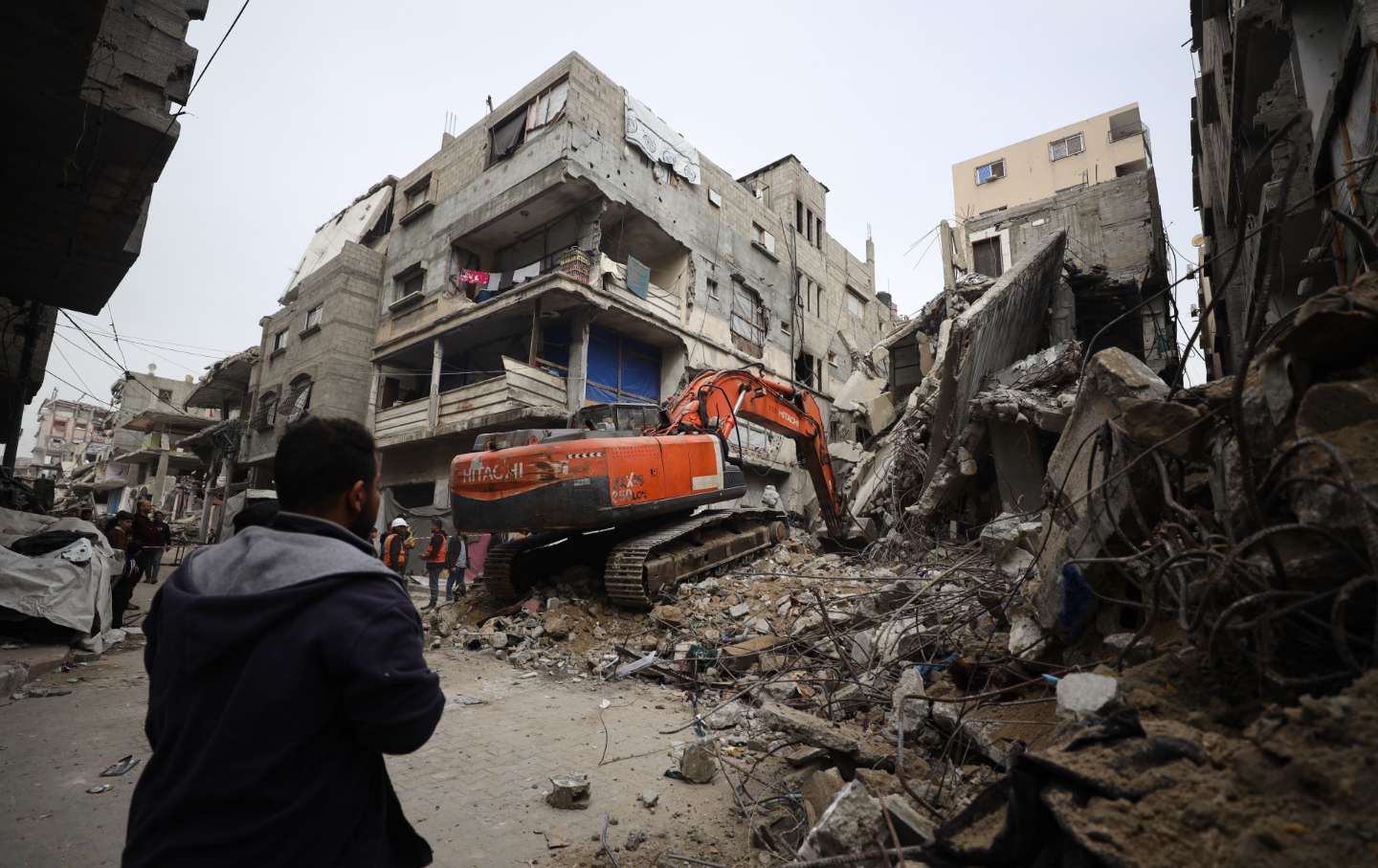
Civil defense teams carry out operations to recover the bodies of five members of the Abu Nida family who were trapped under the rubble of a building destroyed in Israeli attacks on the Sheikh Radwan neighborhood in the Gaza Strip on February 9, 2026.
(Khames Alrefi / Anadolu via Getty Images)Last week, The Nation took the unusual step of turning its entire home page over to coverage of the ongoing calamity in Gaza. While the world’s attention has turned away, Israel’s bombs are still falling, paid for by US taxpayers. Hunger persists, as aid only trickles in.
Last month, Israel recovered the remains of Ran Gvili, the final hostage held by Hamas in Gaza, a step I welcomed with an aching heart, providing at long last some small measure of closure to the grieving families of October 7. But the remains of thousands of Palestinians still lie in the smoldering wreckage of Gaza, while their grieving families face winter in makeshift tents. Where is any measure of closure, or safety, or even just a roof, for them?
Over the past two years, I have struggled to mourn both Israelis and Palestinians killed since October 7—to recognize their equal humanity, but also the very unequal magnitude and duration of the devastation. In that effort, I have frequently joined weekly vigils in Union Square with Israelis for Peace, demanding an end to the war in Gaza and the return of every hostage. We’ve heard from both Palestinians and Israelis whose lives have been ripped apart. People like Maoz Inon, whose parents were murdered by Hamas on October 7, and Aziz Abu Sarah, whose brother was killed by settlers in the West Bank. “Our futures are intertwined”—we chant—“Israel and Palestine.”
Our futures are intertwined here in the US as well—where Congress continues to be complicit in Israel’s destruction of Gaza, providing unconditional support for Netanyahu’s unchecked aggression. American working families struggle to understand why their tax dollars are paying for the 2,000-pound bombs that have leveled the hospitals and schools of Gaza, when there isn’t sufficient funding for affordable healthcare, better schools, or affordable housing here at home.
That is why, as a candidate for New York’s 10th Congressional District, I am announcing my support for HR 3565, the Block the Bombs Act, sponsored by Representative Delia Ramirez. This bill bans the Defense Department from selling Netanyahu’s government the catastrophic weaponry it has used to commit a genocide in Gaza (and yes, after spending a lot of time with the words of Raphael Lemkin, the Polish Jew and Holocaust survivor who developed the term, I am quite sure he would consider it one).
When I am elected to Congress, I will join 60 of my colleagues in cosponsoring this bill and fighting for its passage. The Block the Bombs Act will protect more Palestinians from being killed. I believe it will push Israel to live up to the Jewish and democratic values that I long for it to uphold. It’s a critical step to begin to rebuild the conditions needed for genuine peace and stability in the region.
It is also necessary for beginning to restore any modicum of credibility in US foreign policy. As Mark Carney forthrightly declared at Davos, Trump’s narcissistic takeover of Venezuela and threats to Greenland have caused a “rupture” to the putatively liberal global order.
But Trump’s actions sit atop a longer-term hypocrisy in American foreign policy—that we act in multilateral coalitions and abide by the rules-based, international order… except when we don’t. The two most salient recent examples of our doing as we please: the Iraq War, and unconditional support for Israel’s destruction of Gaza.
If we aim to rebuild a US foreign policy that is grounded in human rights, that respects sovereignty, that builds multilateral coalitions to end forever wars, one important place to start is by ending US complicity in the genocide in Gaza.
I believe that the values I hold as a proud Jewish New Yorker—most notably that every human being is created b’tzelem Elohim, in God’s image—give me a particular obligation in this moment to speak up louder for the lives of Palestinians. As I confessed last Yom Kippur, and, as I felt reading The Nation coverage last week, I have not always done so to the level those Jewish values require.
We can take inspiration in this agonizing work from the remarkable example of Maoz Inon and Aziz Abu Sarah. Despite heartbreaking losses, or maybe because of them, they have dedicated their lives to building peace together across borders and backgrounds in Israel and Palestine. From their grief, instead of despair or rage, they have formed a partnership, grounded in the recognition of intertwined fates.
Their compelling sense of equal humanity does not prevent them from recognizing the utterly unequal scale of suffering, or the political structures that perpetuate it. Their courageous example reminds us that, while we are too often torn apart by religious or national identity, the real dividing line is between peacemakers and those who perpetuate war. Between those who call for more violence and those brave enough to reject it.
So far, the United States has been on the wrong side of that dividing line. We must work to change that. To build a just and safe future for Israelis and Palestinians, and to move toward a US foreign policy that aligns with our principles and our interests, it’s time to block the bombs.
More from The Nation
Donald Trump Is Bad at Politics Donald Trump Is Bad at Politics
The president’s flailing midterms campaign underscores a truth we should be acknowledging more often: He kind of sucks at this.
Obama Delivers a Scorching Rebuke to Trump—and Centrist Dems Obama Delivers a Scorching Rebuke to Trump—and Centrist Dems
Unlike other establishment figures, the former president isn’t scared to associate with the party’s left flank.
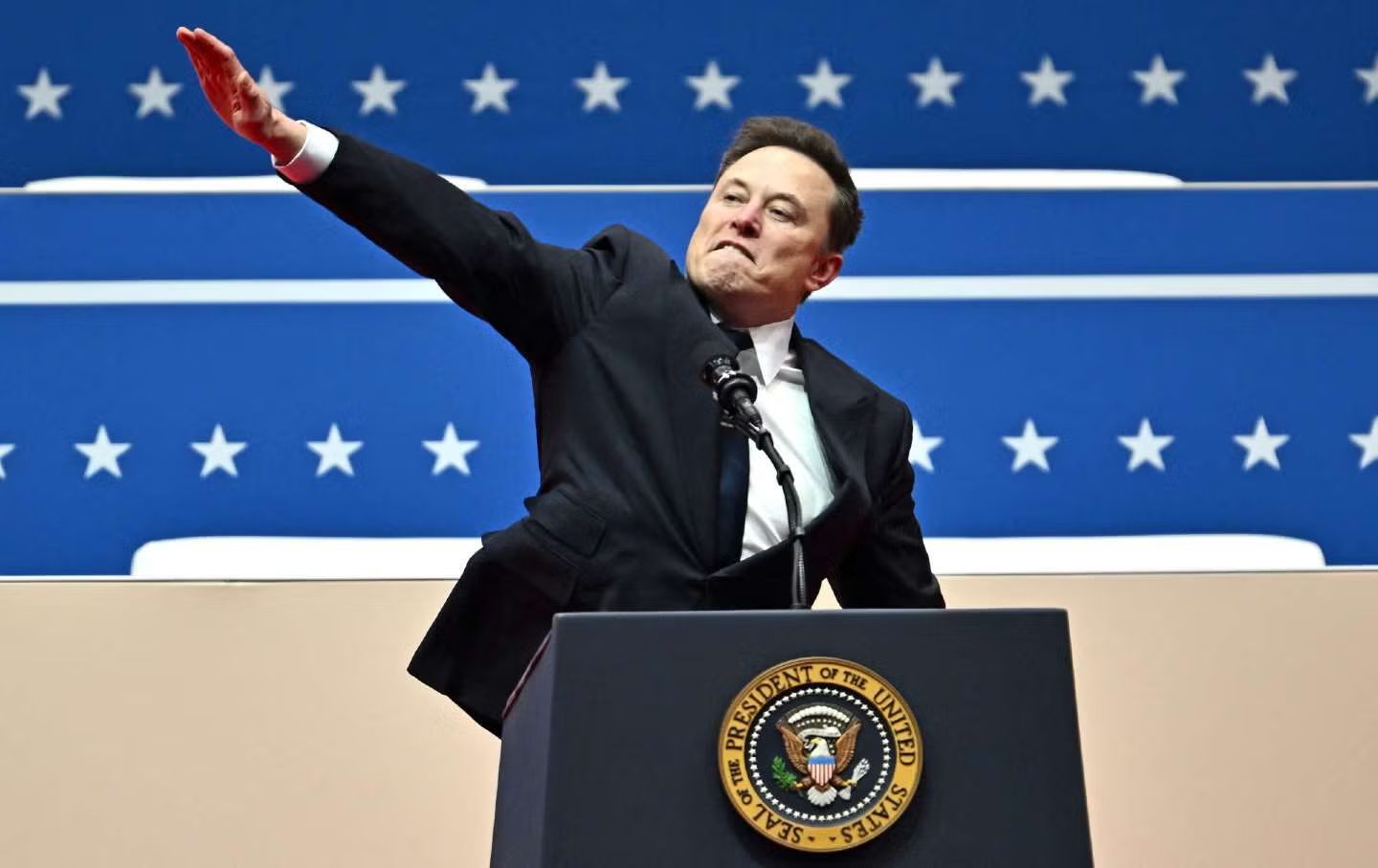
Elon Musk’s Mortal Threat to Democracy Elon Musk’s Mortal Threat to Democracy
The world’s richest man—saying he’s “wised up” to the fiction of self-government—is leveraging his wealth to sway elections, threaten Congress, and alter the global balance of pow...
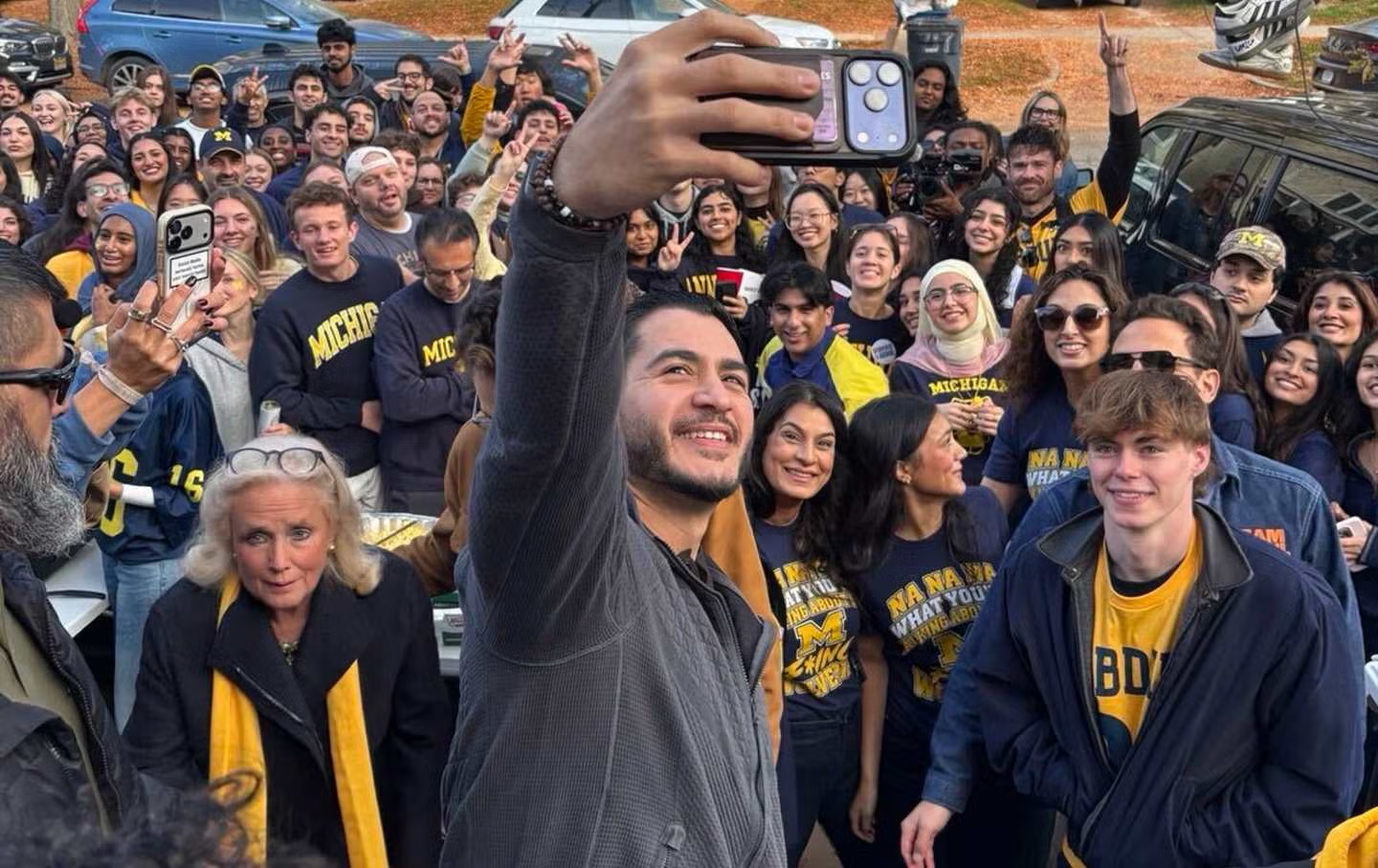
Michigan Students Are All In for Abdul El-Sayed Michigan Students Are All In for Abdul El-Sayed
The progressive Senate candidate has won over students with his politics—and, in at least one case, his protein intake.
What Are Democrats Prepared to Do if Trump Rigs the Election? What Are Democrats Prepared to Do if Trump Rigs the Election?
In this week’s Elie v. U.S, our justice correspondent challenges Democrats' lack of a plan if Trump steals the midterms. Plus: the most racist, and honest, AI add ever.

