
The People Are Winning the Battle Against ICE
The brave protesters in Minneapolis are doing everything that Democrats and even the law have failed to do.
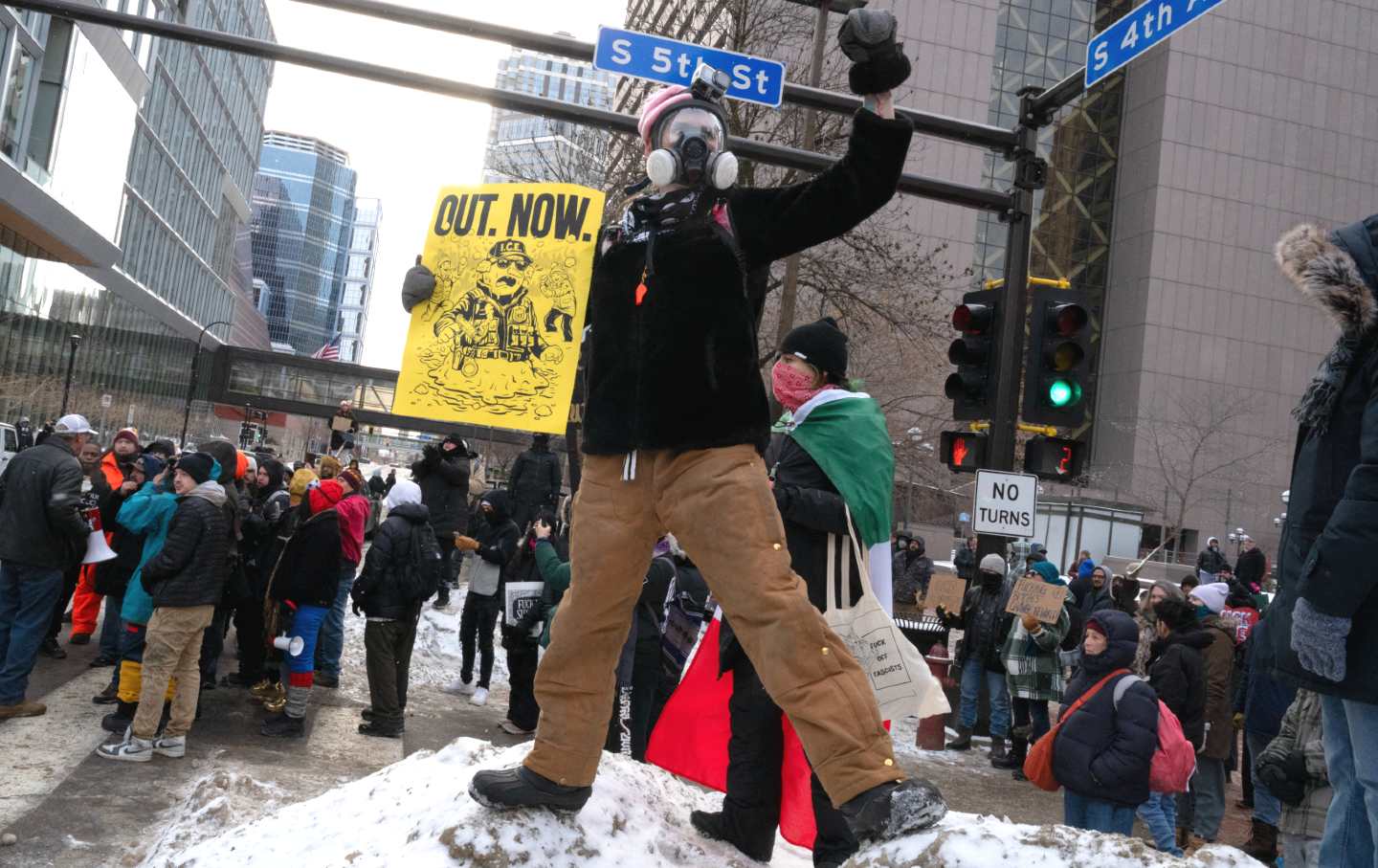
An anti-ICE protester raises a fist in downtown Minneapolis.
(Roberto Schmidt / AFP via Getty Images)Most people where I come from know the opening narration to the television show Law and Order by heart: “In the criminal justice system, the people are represented by two separate yet equally important groups: the police who investigate crime and the district attorneys who prosecute the offenders. These are their stories. [Ding-ding].” But what happens when federal terrorists masquerading as law enforcement are the ones committing the crimes, and the district attorneys and judges are ignored by the federal government?
In Minneapolis–St. Paul, we are getting our answer: The people are taking matters into their own hands and representing themselves. “People v. ICE” would be the heading on a criminal charge brought against the American storm troopers. The People versus ICE is what we’re seeing in the streets.
For the record, there have been actual lawsuits—lots of them—in response to the ICE operation known as “Operation Metro Surge.” State Attorney General Keith Ellison filed one to halt ICE’s occupation of the Twin Cities, and it received a hearing earlier this week. In a separate lawsuit, Chief District Court Judge Patrick J. Schiltz ordered the acting ICE director, Todd Lyons, to appear in his courtroom and answer for the unlawful arrests and detentions carried out by ICE, in violation of the right to due process. The ACLU and the International Refugee Assistance Program have filed class actions against ICE over its illegal deportations and kidnappings. And numerous individual Minnesotans have filed lawsuits over the illegal harassment and brutality they’ve faced at the hands of ICE.
These lawsuits are all worthy and necessary—if nothing else, they remind us of what our rights should be. But none of them have stopped or even restrained ICE. None of them have scared the Trump administration into putting down their copies of Mein Kampf long enough to read the Constitution. And none of them have turned public sentiment against ICE or motivated the Democrats to take hard stances against Trump’s unlawful occupation of Minneapolis.
What has mattered is the people. The people are leading—as we see when they show up to protest peacefully in freezing temperatures against the ongoing occupation of their state. The people are helping—as we see when they walk neighbors’ children to school so their parents don’t have to risk abduction at the hands of ICE. The people are dying—as we see when they try to offer support and comfort to their fellow protesters who have been brutalized by ICE. The people are doing what the law cannot: defending their rights and the rights of others. And, unlike the lawyers and judges and politicians, the people are willing to risk their lives doing it.
That has made all the difference. Trump is now backtracking (and backing up the bus over Homeland Security cosplayer Kristi Noem) in a way we’ve never seen before. Democrats, belatedly, are starting to get a clue, not because they’ve finally realized they’re on the correct moral and legal side of the issue, but because the people will accept nothing less. Trump is starting to look for a way out of Minnesota, not because of the strength of the opposition party or the numerous legal challenges to his government, but because the people have made it impossible to ignore their cause.
What’s happening in Minnesota is not some kind of weird inversion of the normal order of things. It’s not strange that the people are ahead of the law. This is usually how change happens: The law is a lagging indicator of social justice. The law is not now nor ever has been a leader in reversing fascism, authoritarianism, or atrocity. Movements start in the streets and later, often years later, the law tries to catch up and codify what movements have already made a reality. We celebrate legal and legislative victories—like Brown v. Board of Education or the Civil Rights Act—as bloodless acts of social change, but we forget that these victories are not possible without the toil and blood of people who take to the streets, willing to risk it all for progress and justice.
Should Trump lose any of the myriad lawsuits he faces in Minnesota—and should he actually follow court orders against him—it will be, at least in part, because of the people. Yes, the cases are strong. But we like to act like judges are immune from public pressure (the theory behind lifetime appointments is to inculcate judges from that pressure). They are not. Judges can see and respond to the way the wind is blowing, just like everybody else. When ordering acting director Lyons to appear in his courtroom, Judge Schultz acknowledged that his request was “extraordinary,” but also said that “the extent of ICE’s violation of court orders is likewise extraordinary”—adding, “The court’s patience is at an end.”
Would Judge Schultz have reached this unprecedented point without the desperate resistance of the people of Minneapolis? I doubt it. And while it is easy for me to predict that Trump will not make Lyons go to Minnesota and answer for ICE’s action, there’s more of a chance of that happening now than there would have been if all we had were a court order and another strongly worded letter from Democrats.
Don’t get me wrong: The cost to the people is high. People are dead. Children have been kidnapped. Lives and livelihoods have been destroyed. Victory has not been achieved. Yes, Trump is moving Greg Bovino out, but he’s moving Tom Homan in. (I saw a person on social media say replacing Bovino with Homan “is like shitting your pants and changing your shirt.”) Trump flinched in Minnesota, but when Stephen Miller wakes up tonight and crawls out of his casket, he will surely advise Trump to “double down” on evil. The Battle of Minneapolis is far from over.
But, if I may quote the otherwise forgettable Iron Man 2: “If you could make God bleed, the people would cease to believe in Him.” Minneapolis made ICE bleed—not physically, of course: ICE does all the violence at protests—but politically. Other cities have resisted ICE, but Minneapolis is showing that resistance can produce change. Its people are showing that Trump and ICE are not inevitable. They’re showing that peaceful yet sustained and uncompromising resistance to the Trump administration can force the Trump administration back on its heel. They’re showing that we don’t have to wait for a court order, a midterm election, or a blocked artery to change the calculations of the fascists in power. We can, right now, start to take the power back from these people, and nobody needs to get permission from John Roberts or Chuck Schumer.
It’s an illustration that, I think, people cannot unsee. ICE’s tactics are always the same: terrorize, abduct, murder. Resistance tactics are constantly evolving. People saw what methods of resistance worked in previous ICE attacks in Los Angeles and Portland, and have applied what they learned in Minneapolis. Next, people will use Minneapolis as a blueprint for how to do things wherever ICE strikes next. The George Floyd protests also started in Minnesota. Do you remember what happened when those protests hit Philadelphia? Let me tell you, ICE does not want any part of Philly. They’ve got a long winter and no Super Bowl to celebrate.
I haven’t yet mentioned that many of the people on the front lines of the Minnesota resistance are white, and I should (because I certainly would if white people were nowhere to be found). Regular readers might assume that I have a long rant about this country’s racial politics and how it reacts to the murder of innocent whites entirely differently than it reacts to the destruction of similarly situated innocent Black people… and I do, but I’m compartmentalizing that issue in my own head for the moment. That’s because I know that when white people in this country stop waiting for the law to come to save them, and instead take to the streets, it’s an accelerant for social change.
During the height of the George Floyd protests, I (correctly) predicted that white folks would soon lose interest and frustrate any chance for lasting change, despite the outcry from Black and brown folks for police reform. The fact that white folks are out front in Minnesota, as opposed to offering the tepid “allyship” that typically doesn’t last through tax season, makes these protests different. White folks generally feel entitled to tell everybody else how long they have to endure oppression, and their answer is usually “longer,” but when white people are the ones being oppressed, they have the power to demand immediate redress.
That is what we’re seeing now. Anti-ICE protests have wrapped in white folks who “don’t like to talk about politics” and have the wealth and privilege to ignore the suffering of others if they choose to. Support for ICE has collapsed among white folks, including whites without a college education. White folks no longer have the political power to make something happen all by themselves (a point that sticks in the craw of Trump and MAGA), but when a majority of whites get to where Black people always are, this country can change rapidly. ICE could survive murdering brown people. It can’t survive murdering white people. That’s a sad commentary on America, but it’s also reality.
Popular
“swipe left below to view more authors”Swipe →I’ve said repeatedly that the law cannot save us from Trump and his MAGA goons. Even in Minnesota, that is still the case. The law has failed to stop the kidnappings and murders. But we can save us. We can make them stop.
ICE can defeat feckless Democrats. It can defeat the Constitution. But it cannot defeat the people. The People versus ICE is the one battle ICE cannot win, and even Trump is starting to figure that out.
More from The Nation

The Accidental Activists of Data Center Alley The Accidental Activists of Data Center Alley
These would-be rebels in Northern Virginia joined the fight against data centers mostly to stop the encroachment on their homes and exclusive private communities.
An Effective Movement for Palestine Needs Allies Like Zohran Mamdani An Effective Movement for Palestine Needs Allies Like Zohran Mamdani
In order to build a broad-based coalition, we need to work together—not practice purity politics.
The First Amendment Applies to Concert Stages Too The First Amendment Applies to Concert Stages Too
Protests like that of Macklemore on Palestine should never be silenced by billionaire owners.
France’s Students Won’t Back Down France’s Students Won’t Back Down
Without full-time teachers, temperature-regulated classrooms, or school nurses, French students are turning their grievances into a national movement.
Inside Cornell’s Week of Protest Inside Cornell’s Week of Protest
“We won’t be silenced anymore. Our university needs to start protecting us, like they should’ve with Jane Doe and all other survivors on campus.”
Netanyahu Came to New York. New Yorkers Were Ready for Him. Netanyahu Came to New York. New Yorkers Were Ready for Him.
Scenes from the defiant protest against the genocidal leader’s UN speech.

