
Trump’s Naked Imperialism
The return of US gunboat and dollar diplomacy threatens the future of Latin America and beyond.
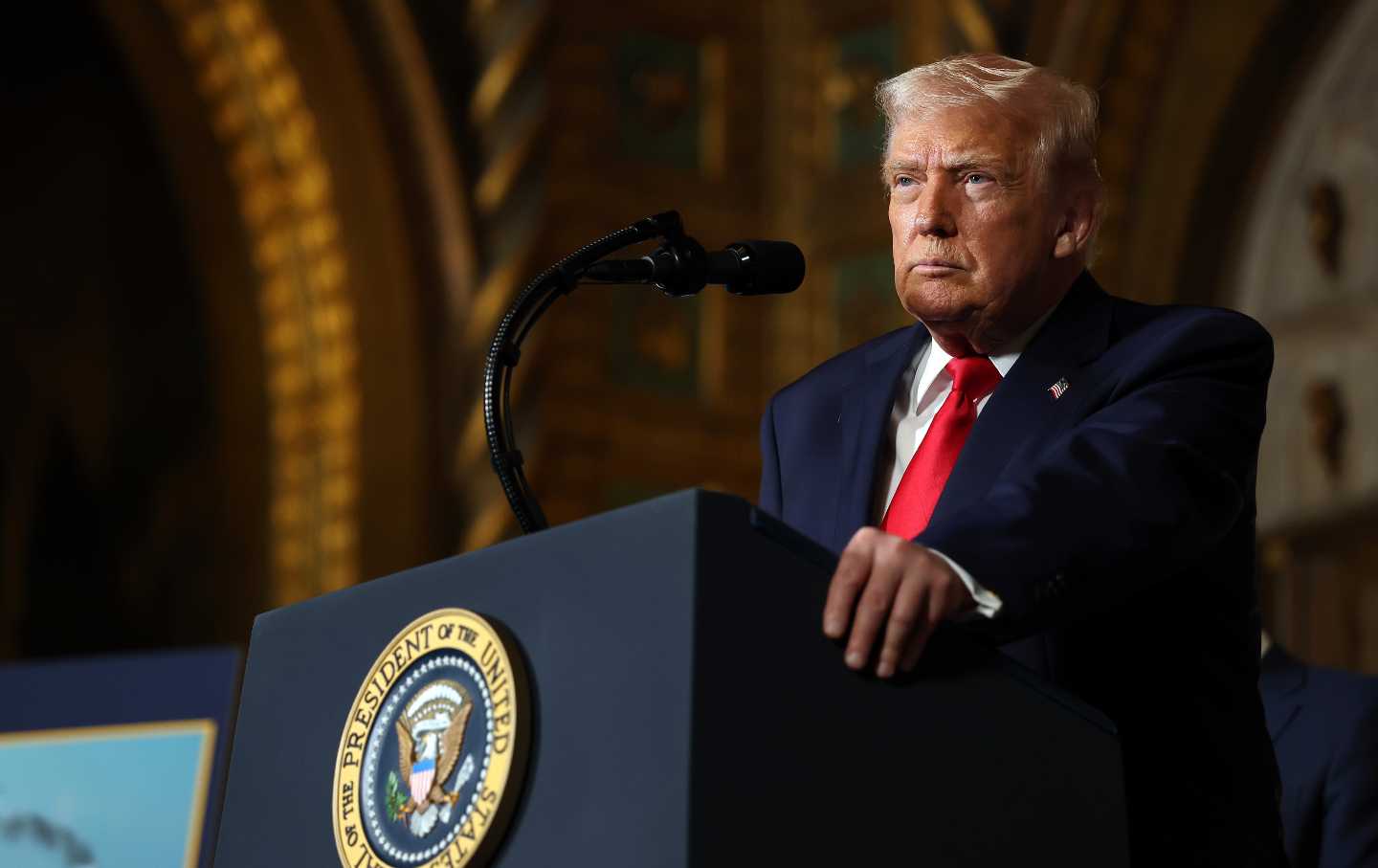
An unabashed imperalist.
(Tasos Katopodis / Getty)As 2026 gets underway, President Trump has already fulfilled one of his leading New Year’s resolutions: overthrowing the Venezuelan regime of Nicolás Maduro by force. In the early hours of January 3, the US military launched a coordinated bombardment of key targets in Caracas, while a special Delta Force team—no doubt acting on CIA-gathered intelligence—located and seized Maduro and his wife, Cilia Flores, who were holed up in a fortified compound. They were helicoptered to the USS Iwo Jima battleship deployed in the Caribbean and then flown to New York, where Maduro and his wife face a brand-new indictment for engaging in a “narco-terrorism conspiracy,” conveniently issued January 3, 2026.
That charge, as The New York Times has pointed out, “is particularly ludicrous.” Venezuela does not produce cocaine and is not a major hub for drugs bound for the United States. The “Cartel de los Soles,” of which Maduro is the alleged kingpin, is not an actual organization, but rather a moniker invented by Venezuelan journalists to refer to the diffuse networks of smugglers and their enablers moving drugs through Venezuela on their way to Europe.
Moreover, Trump cares not a whit about bringing drug traffickers to justice. Just a month ago, he pardoned the former president of Honduras who had been convicted of smuggling more than 400 tons of cocaine to the United States over two decades.
Trump’s true goals, now openly announced, are to seize Venezuela’s vast oil reserves—he falsely claims they were “stolen” from the United States—and to advance the so-called “Trump Corollary” to the Monroe Doctrine whereby the United States asserts its predominance over the subordinate nations of Latin America. “They now call it ‘the Donroe Doctrine,’” Trump noted at an extraordinary press conference from Mar-a-Lago, as he described how the United States will now exercise authority over Venezuela’s future and run its oil industry. “American dominance in the Western Hemisphere,” he proudly stated, “will never be questioned again, never again.”
The Mar-a-Lago press conference was almost as shocking as “Operation Absolute Resolve”—the codename for the US military effort to seize Maduro and depose his government. Trump and his national security team—Secretary of War Pete Hegseth, Secretary of State Marco Rubio, and Joint Chiefs of Staff Chair Gen. Dan Caine—provided the most unabashed glorification of the bald exercise of US power in recent history. “Welcome to 2026,” Hegseth crowed. “Under President Trump, America is back,” he declared, hailing “the sheer guts and grit, gallantry and glory of the American warrior.” Hegseth seemed to revel in the bloodshed; the Caracas death count has gone largely unreported. The seizure of Maduro, he asserted, showed that “America can project our will anywhere, anytime.” Trump was no less enthusiastic. “It was dark. It was deadly,” he said, describing “one of the most stunning, effective and powerful displays of American military might and competence in American history.”
Trump proclaimed not only US imperial powers but also his imperialist aims. “We’re going to be running it,” Trump declared. “It’s largely going to be—for a period of time—the people who are standing right behind me,” meaning his own national security team. “We’re going to be running it.” And if Venezuelans did not cooperate, it would be “really bad for them,” he promised, adding, “We’re not afraid of boots on the ground”—apparently a threat of full-scale occupation.
Venezuelan oil was top of mind for Trump. “We’re going to have our very large United States oil companies, the biggest anywhere in the world, go in, spend billions of dollars, fix the badly broken infrastructure and start making money for the country,” Trump promised. The US built the oil industry in Venezuela, Trump claimed; its nationalization was “theft of our property,” he asserted, as if Venezuela’s natural resources belonged to the United States all along. Washington’s imperialist land grab in Latin America could hardly be more explicit.
Trump also made it clear that the “Donroe Doctrine” extends beyond Venezuela to other nations in the region. He falsely claimed that Colombian President Gustavo Petro was “making cocaine” and sending it to the United States “so he does have to watch his ass.” Cuba, Trump and Rubio both suggested, was also threatened. “Cuba is something we will end up talking about,” Trump noted, before turning over the microphone to Rubio. “If I lived in Havana and I was in the government,” the secretary of state opined, “I’d be concerned at least a little bit.”
Given the capricious nature of Trump’s unprovoked military attack and attempt to take over Venezuela, leading Latin American nations are now extremely concerned. President Petro has already denounced Washington’s regime-change operations as an “assault on the sovereignty of the region.” He ordered Colombian troops deployed to the border with Venezuela and requested that the United Nations urgently convene to address the crisis. Chilean President Gabriel Boric has already issued not one but two denunciations “energetically condemning the actions of the United States.” “Today it is Venezuela, tomorrow it could be some other country,” Boric noted. “The threat of external, unilateral control over [Venezuela’s] natural resources,” he added, “constitutes a grave violation of the principle of territorial integrity, and puts at risk the security, sovereignty and the stability of the countries in the region.”
Mexican President Claudia Sheinbaum also condemned Washington’s actions, citing article II of the UN Charter prohibiting such violations of sovereignty. Mexico, which has also been threatened by Trump, opposes foreign interference and supports only peaceful solutions, she stated, and security cooperation with Washington would remain one of “collaboration and coordination, but not subordination.”
Brazilian President Luiz Lula da Silva denounced US intervention as “crossing an unacceptable line.” The attack on Venezuela has created “an extremely dangerous precedent for the entire international community,” Lula submitted. “To attack countries in flagrant violation of international law is the first step toward a world of violence, chaos and instability, where the law of the strongest prevails over multilateralism.”
Indeed, Trump’s empire-building posture of might-makes-right is a direct assault on the entire world order of international law and respect for the sovereign rights of all states. Beyond violating the War Powers Act at home, the attack on Venezuela has undermined numerous international accords abroad, among them the OAS and UN Charters. Trump’s unilateral exercise of power against a small regional nation legitimizes the expansionist ambitions of other major powers who claim their own spheres of influence and control—Russia in the former Soviet states and its “near abroad,” and China in Taiwan and the South China Sea.
Popular
“swipe left below to view more authors”Swipe →In the era of imperialism in the 19th and early 20th centuries, the great powers divided the globe into spheres of influence. Their experiment with balance-of-power politics failed. Great-power rivalries and resistance from the colonized destabilized the system, producing two world wars that killed more than 80 million people. Resurrecting that failed system, as Trump seems intent on doing, starting in the Americas, is folly. “I know not with what weapons World War III will be fought,” commented Albert Einstein on the urgency of not repeating the mistakes of the past, “but World War IV will be fought with sticks and stones.”
More from The Nation
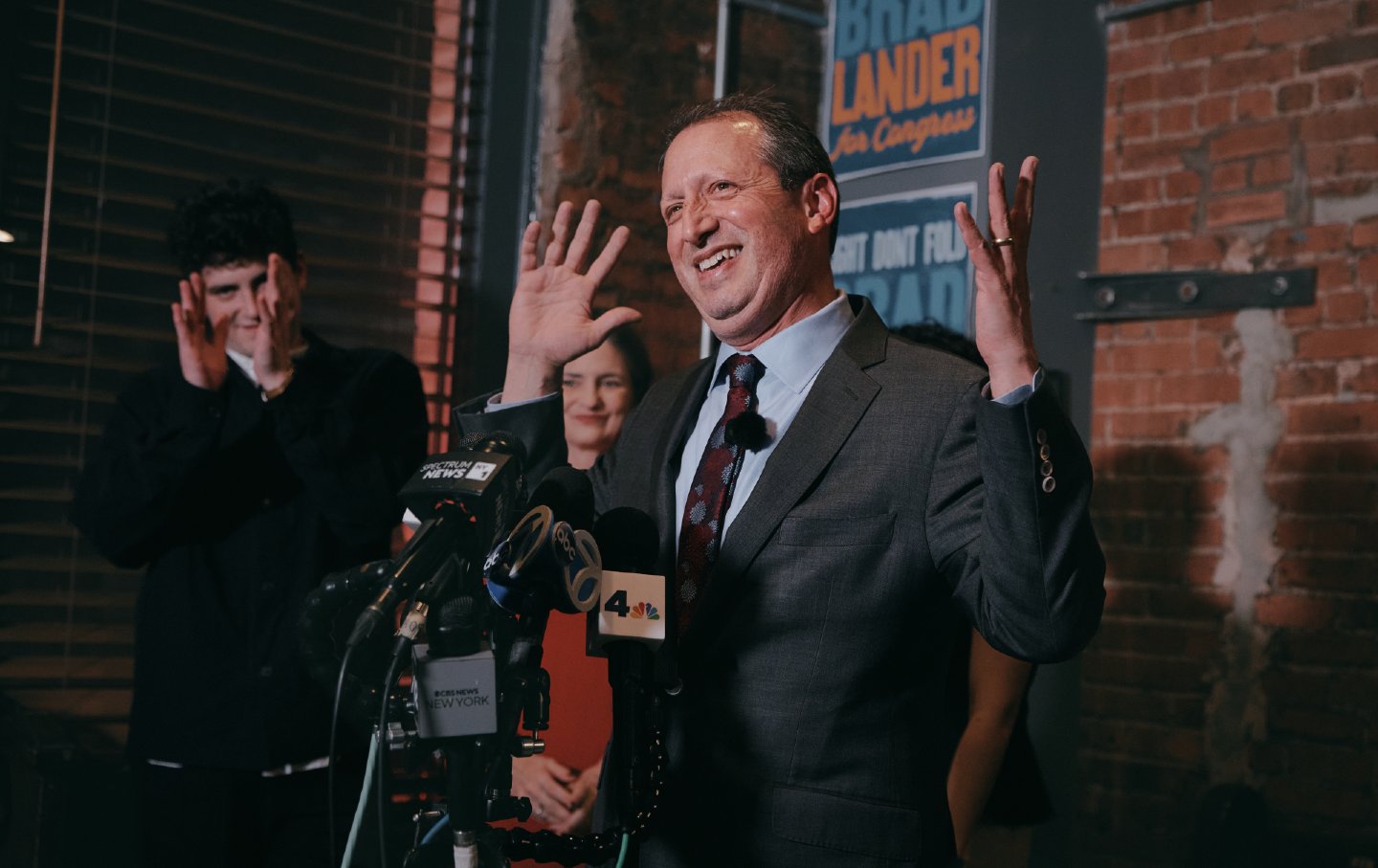
Dan Goldman Voted With Labor. The UAW Is Still Choosing Brad Lander. Dan Goldman Voted With Labor. The UAW Is Still Choosing Brad Lander.
UAW Region 9A’s endorsement of Lander over one of the wealthiest members of Congress signals that pro-labor voting records alone no longer guarantee labor’s backing.
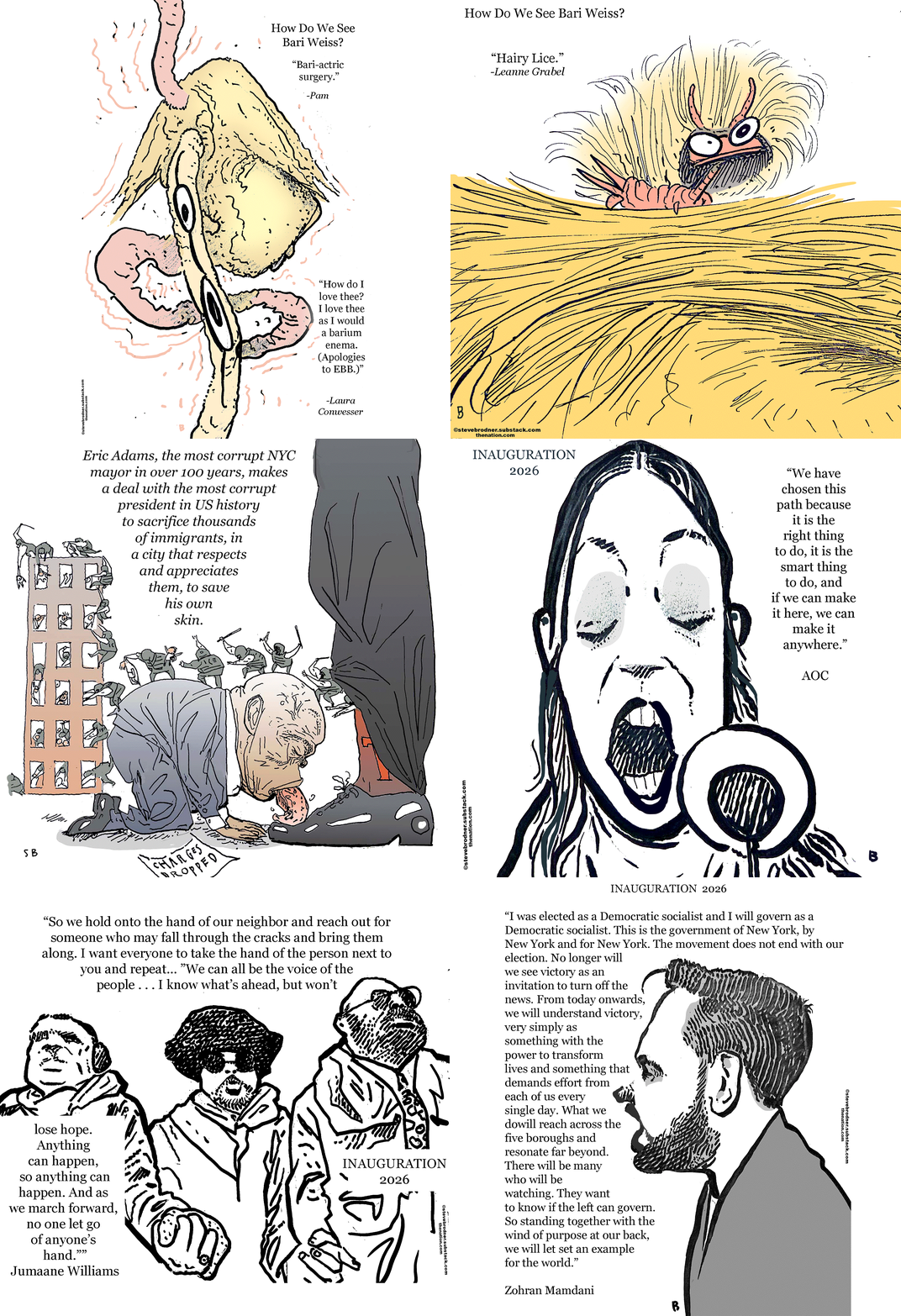
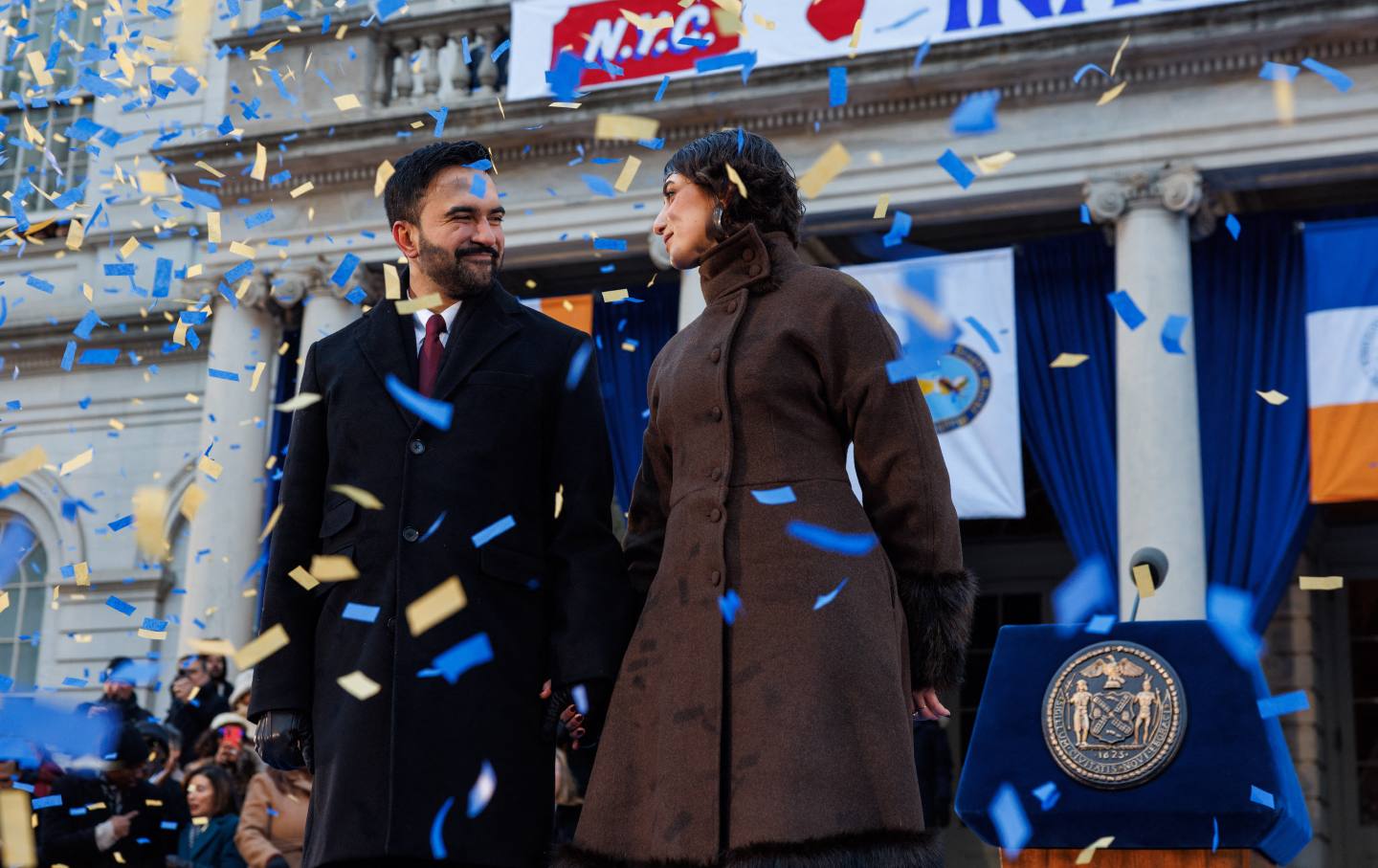
“I Will Govern as a Democratic Socialist” “I Will Govern as a Democratic Socialist”
Mayor Zohran Mamdani defies the cold and the calls to move to the center with the promise of a New York that belongs to the people who live in it.
How to Save a Democracy How to Save a Democracy
Looking at how the Trump administration fits into a pattern of authoritarian governance can empower people to think about how to best resist the country’s slide to autocracy.
Mar-a-Lago Was Key to Jeffrey Epstein’s Criminal Enterprise Mar-a-Lago Was Key to Jeffrey Epstein’s Criminal Enterprise
New reporting shows that Trump’s split with his pedophile friend was opportunistic.

Winter In Gaza Winter In Gaza
Children are suffering as aid is blocked by Israel.

